


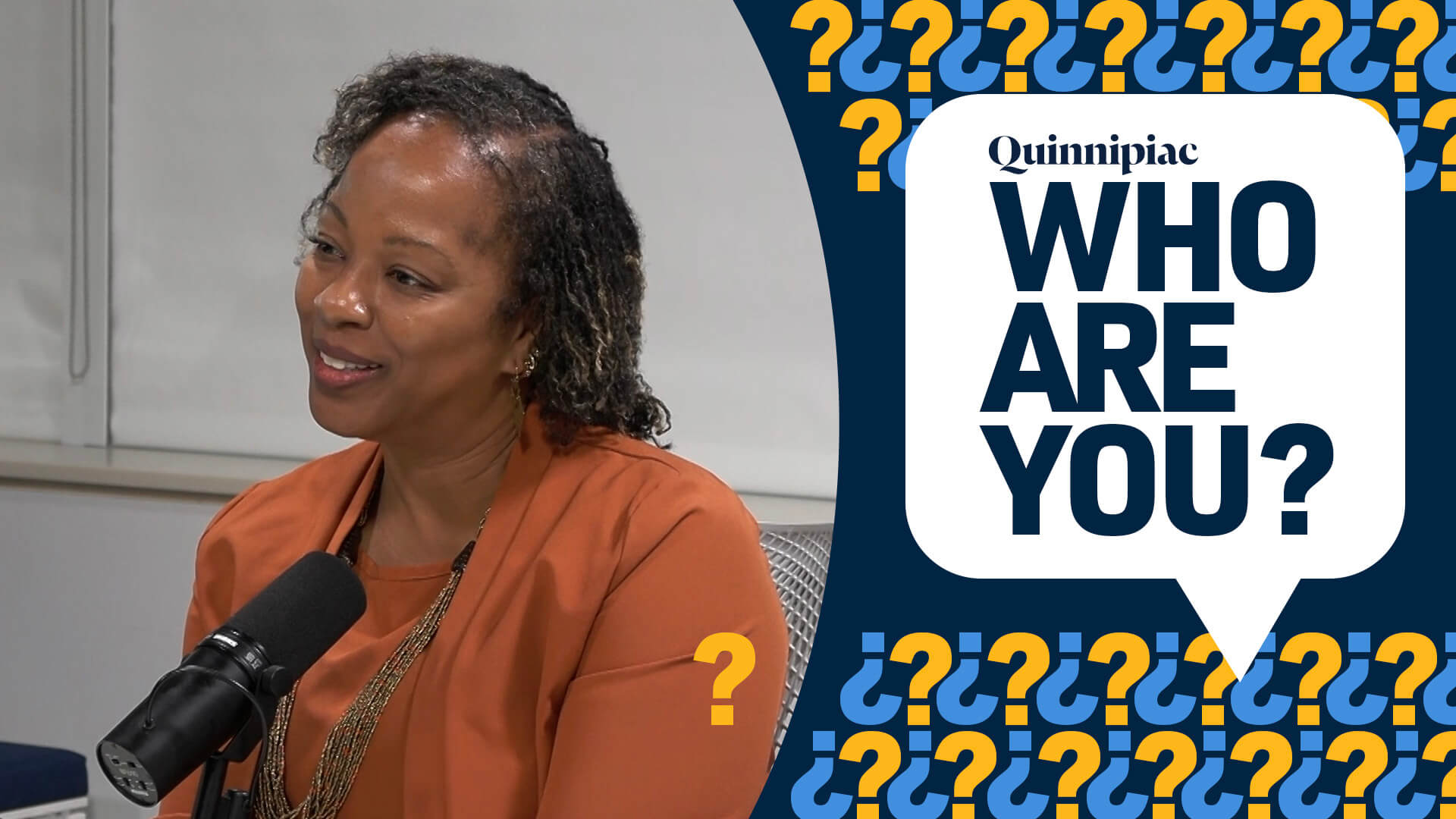
‘Who Are You?’ podcast with guest Ganine Marottolo ’24, MSW ’25
Finding her place at Quinnipiac and discovering a passion for social work

Finding her place at Quinnipiac and discovering a passion for social work
Joel Vanner: Welcome to ”Who Are You?,” the Bobcats you know, the stories you don't. I'm your host, Joel Vanner, inside the Podcast studio at Quinnipiac University School of Communications. I'm joined for today's episode by Ganine Marottolo. Ganine, welcome to the show.
Ganine Marottolo: Thank you. I'm happy to be here.
Joel Vanner: So, Ganine, I'm sure you could tell by the name of the program. Well, my first question to you is going to be: We know your name, but who are you?
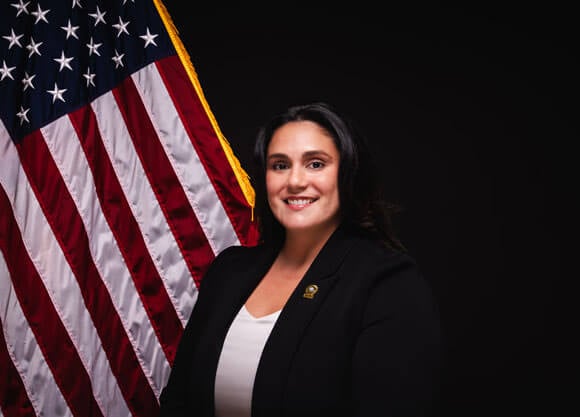
Ganine Marottolo: My name is Ganine Marottolo, and I am an undergrad psychology major and a master of social work student.
Joel Vanner: So that's like a three-plus-two program. What- how do those studies connect?
Ganine Marottolo: So, I graduated from Quinnipiac last May with my undergrad in psychology in three years. And in the last year of your three-year program, you start taking graduate classes. So I slowly started taking my social work classes, and now I will graduate from Quinnipiac again in May of 2026 with my master's of social work degree.
Joel Vanner: Oh, awesome. So tell me a little bit about how you learned that these fields were maybe something that you would want to study.
Ganine Marottolo: So I originally had the idea that I wanted to go into PT or OT at Quinnipiac. I had met with some of the staff here at Quinnipiac. And I was really on that course, and then I was sitting with my best friend, Sarah, and she started to move her kneecap one day, and I thought it was disgusting. I was like, Oh, and she was like, Ganine, if you want to go into PT, like, this is what you're going to be looking at. And I was like, thank God you showed me that because I cannot be dealing with that for the rest of my life. But I knew that, like, helping people was something that I really loved. So I just kind of needed to find the new direction of helping people that wasn't watching their body parts move in weird ways.
Joel Vanner: So that landed you into psychology?
Ganine Marottolo: Yes.
Joel Vanner: Tell me a little bit about your experience in psychology and getting all that knowledge.
Ganine Marottolo: So, I took a couple AP classes in high school, and one of them being AP psych, and I found it really interesting, and I kind of liked being able to see kind of how the mind worked in some ways. But I also love to yap, but I love to listen as well. So, like-
Joel Vanner: Self-proclaimed yapper.
Ganine Marottolo: Yes.
Joel Vanner: Tagline.
Ganine Marottolo: Yes. And my friends always came to me when they needed advice on things, and I knew that that was a part, or I could make that a part of psychology. So then when I had to pick a major for Quinnipiac, I was like, that seems to be the course I wanted to take. I wasn't sure where I wanted to narrow it down to yet at that point, but I knew that was kind of like the full picture idea.
Joel Vanner: So psychology in three years and you started your social work courses in your last year, how has that connected to your social work courses?
Ganine Marottolo: So, I took a couple, I guess, courses that dealt with more of children and, like, younger generations. I took child psychopathology and then children in adolescence development, and I loved learning about how your environment can impact you, like your parents and your family members and what you surround yourself with can impact you, as well as your genetics and biological features. So then when I started taking my social work courses and we started I took behavior- my behavior course, but with individuals. And I learned more about children. I really learned that in social work, I think I love working with a younger generation and really seeing, like in the prime years of development, like how I could be of benefit to that population.
Joel Vanner: In your social work courses, are you in the standardized patient area on our North Haven campus?
Ganine Marottolo: Yeah. All of my courses are on North Haven, and we do get to work with the standardized patients. I worked with them.
Joel Vanner: They're like paid actor right to simulate a real world experience in that way.
Ganine Marottolo: Yeah. So we go down. There's like these pretend doctors' offices, and then they have paid actors who come in and pretend to be a patient. They've gotten a storyline, and they follow it, and they can take it in. They're either told you need to say this, and if a student says this, you say this or they're told, Here's your baseline; do as you please with it. So I had my first standardized patient in the fall of this the 2024, 2025 school year.
Joel Vanner: And was that your first social work class that you took?
Ganine Marottolo: That was my first social work class I was taking as a full-time grad student.
Joel Vanner: Okay.
Ganine Marottolo: So we were like, now, full in the swing of things, and I was scared out of my mind because I was like, There's video camera, so you get recorded so that you and your professor can watch it back.
Joel Vanner: This calls being recorded vibes.
Ganine Marottolo: Yeah, yeah. Yeah, exactly. So I was like, but I also knew if I messed up in any way, I wasn't causing any harm to anyone. It was an actor. It was a learning experience, which I think is awesome because when we are in our field placements, you're working with actual human beings, and, like, you have a supervisor, so nothing can go terribly wrong, but, like, it was nice knowing I had a cushion. So working with the standardized patient, it was good. Like, I had the person afterwards. It was a 30-minute session, so I yapped for 30 minutes, which was nice. I listened for 30 minutes. And then at the end, she was like, How do you think you did? I'm like, I don't know. I think I did good. Like, I was nervous. She's like, Well, you didn't seem nervous. But you asked this question, and I would have told you this information if you had then asked this question following, and I was like, Oh, I never thought of that. So, like, my standardized patient gave me great feedback. And then they take it to a different level. Now I'm in a clinical diagnosis class learning how to diagnose patients with the DSM. And we have standardized patients come into our classroom, and we do it as a class, and they're given a diagnosis that they have to portray, and those have been a little more intense, I feel like.
Joel Vanner: What is DSM?
Ganine Marottolo: So that's the diagnostic statistical manual of mental disorder. So it's just a book full of all mental diagnosis that a clinical therapist or a clinical worker can diagnose a patient with.
Joel Vanner: And your experience in the standardized patient area that was under the mentorship of a faculty member?
Ganine Marottolo: Yeah, so my fall semester was with doctor Emily McCave. She was the professor there, and she made it the most she was very comforting 'cause she knew we were all freaking out. And she at least was like, It's gonna be okay. Just get through it, and then we'll talk about it after. So she was a great person to do it with.
Joel Vanner: So, in addition to doctor McCave, you've had other mentors during your time here at Quinnipiac. Tell me a little bit about who else has been involved in your journey.
Ganine Marottolo: Yes. So actually, when I applied to Quinnipiac, I had applied to be in the honors program here at Quinnipiac. And the one really nice thing or not the one, but one of the really nice things about the honors program is that they give you a mentor. So you find out who they are over the summer; they reach out to you through email, you start following them on Instagram. And when I got to school, they are moving you into your dorm room. They are the move-in crew. Yes. So I knew that my mentor's name was RJ Schroeder. I had, and I knew-
Joel Vanner: Is RJ a student or a staff?
Ganine Marottolo: Yes. So he's a student. He's a three-plus-three law student. So he graduated his undergrad with psychology, which is why we were placed together because we had the same major. Right. And now he is in his second year of law school at Quinnipiac. So, funny enough, we will actually graduate together next year. Obviously, with his law degree, my MSW, my master's social work degree. But it's a nice, very full circle moment.
Joel Vanner: Right.
Ganine Marottolo: But so I knew what this kid looked like from his Instagram, and next thing you know, these kids swarm my car. My parents and I are like, What's going on? Our car was cleared out in like 5 minutes, which was amazing.
Joel Vanner: They do everything but crowd surf you and-
Ganine Marottolo: Yes, literally. And I just have this kid come up to me and he's like, Hi, I'm RJ. I'm your Honors mentor. I'm going to take you out to dinner tonight. We'll go to the cafe. I'll meet you right outside your building. And, yeah. And next thing you know, he disappeared. He went back to doing his job. And I was like, Okay. And it was funny because the rest of- I lived with eight girls in Mountain View, my freshman year. And the rest of them all had girl women mentors. So they were like, Oh, my God, do you have a guy? This is so cool. I'm like, Okay, yeah. Like, I get this, like, great. But he picked me up for dinner that night. We went to the cafe. Um, and he's probably one of the best experiences I could have had at Quinnipiac. We still talk to this day, and he's the reason I made friends. And even when I was having hard, like, some hard times freshman year, he was constantly there for me. He actually then introduced me to my best friend, Brian Wanamaker. So who I am still in contact with today, we have a group chat of the three of us. And he's just been such an influential part not only to my education here at Quinnipiac but to my social life and my friends I'll be graduating and taking my grad pictures with in the future.
Joel Vanner: It's got to be hard, right. At that point in your life, it's your first day off to college. You're moving in, moving away from home, maybe for the first time. It's like a whole lot of emotions and a whole lot of things going on, so it's great you had a RJ there to mentor you through.
Ganine Marottolo: Yeah, 100%. And he was a part of a fraternity on campus, Beta Theta Phi. And he was nice enough to introduce me to those guys. And within the first week of school, like, if he was sitting with them in the cafeteria, he was like, Come sit with us. And I was like, Are you sure? And all of the guys were great, and they were all like, Yes, come sit, and I became best friends with them. I ended up joining a sorority, not my freshman year, but my sophomore year.
Joel Vanner: Which Sorority?
Ganine Marottolo: I was- I still am in Gamma Phi Beta.
Joel Vanner: Okay.
Ganine Marottolo: But they also the fraternities all have what's called a sweetheart, so they can nominate a member of a sorority to just basically be a brother for a year, almost. So because I was in G Phi and because RJ and Brian had introduced me to so many people, I got to be their sweetheart, and that was an amazing opportunity, as well. So he was just they all had been.
Joel Vanner: So, Greek Life gave you another community, expanded your community. And then you also had a leadership position in your sorority, as well. Tell me a little bit about what that role was.
Ganine Marottolo: Yeah. So, I served on our executive board as the membership vice president for one year. That basically was I was in charge of all things recruitment. So when girls arrive to campus, they are- they can go to meet the Greeks, which is an event on the quad, and you meet all of the you can meet all the sororities and fraternities on campus. So I was in charge of that event, and then I was also in charge of the three days of recruitment. So leading up to the three days of primary recruitment, my sorority, or all the sororities, have workshops. So we had a week worth of workshops. The workshops could go from 1 hour to 5 hours, and they are long, hard days, but I had an amazing group of women with me, and even on the days that I came in and I was like, guys, I got no sleep last night. I'm exhausted. Like, let's just power through it. They all stood behind me. I was lucky enough because my big Ella Isleb was the president of our sorority at the same time that I was on E-board. So I had her support, and then my little Cam Tour was, um my assistant membership vice president. So it was nice to kind of have my entire family or, like, my sorority family surrounding me, and I felt very supported, which was really nice.
Joel Vanner: Right. You were being mentored up and then mentoring.
Ganine Marottolo: Exactly, yeah.
Joel Vanner: Right. And so you were giving back two years sorority once you joined in those different roles which is a common theme. Your work in the College of Arts and Sciences, Advising Common psychology is a part of the College of Arts and Sciences. What role did you have in the Advising Commons, connecting with students?
Ganine Marottolo: So, yeah, I worked in the Advising Commons my sophomore year at Quinnipiac for the spring semester. And it ended up being very beneficial, I felt like, because I think the College of Arts and Sciences is a huge school. So it can be hard. I was very close with my professors and my fellow, like, psychology major students, and I had a minor in sociology, so I had met those students. But I didn't really know a lot of other people, especially, like, the faculty that worked more on the career and, like, um like class assignment side. So when I got the job in the Advising Commons, I got to meet all those people. And they are wonderful people. I love them all. I got to work on helping if students came in and needed help with course registration or fixing up their resume or just kind of understanding what their course requirements were for their major, especially freshmen; I got to work with them. So I got to meet a lot more CAS students than I had ever known in a lot of different majors. There's actually a student who came in to CAS that I remember helping, who's now in my social work program, who sits on the other side of the classroom from me in my clinical diagnosis class that I never would have met before. And funny enough, Alyssa Rubel, I believe, is her last name, who works in the Advising Commons. She had emailed me a little bit ago, Hey, we're having our last admitted Students Day. Could you come to our table for a little bit? And I got to do that, and it reminded me that even though I'm not in CAS anymore, I'm a CAS alum, and I can still be giving back to that community even after having graduated, which was really nice.
Joel Vanner: How has being connected to these various communities that you've been a part of? How have the things you've learned in the Social Work program informed your involvement in those communities? How are they connecting for you?
Ganine Marottolo: I think it's really just shown me that with social work, you're meeting people at such a vulnerable time in their lives most of the time, and you really don't know what's going on in someone's life or what's behind the cover. Like, we all have heard the phrase, Don't judge a book by its cover, and I think that's so true. And I also have then tied that into my sorority. You know, during recruitment workshops, I always said, girls who are coming in on the first day of recruitment have been to, at that point, maybe five other sororities. They've been- they're in heels, they're in a dress, their feet hurt, they're tired. They just want to call their mom. Don't judge a book by its cover. Give them time to open up to you. And even if it's been a little rough, give them a second chance. You know, they might come back on day two and be like, a whole new person because they got the first day under their belt. And same thing with the when I'm working in when I worked in the Advising Commons, um, when I met a student, and they were maybe they weren't in the best mood, they were frustrated about their class. They were stressed. And as a fellow student, I understand that when course registration comes, and you're waking up at 6:50, and your hand is hovering over the registration button.
Joel Vanner: It can be a tough, It can be a tough day, and sometimes somebody just needs someone to be there.
Ganine Marottolo: Exactly.
Joel Vanner: You had an interesting internship, and internships and fieldwork are part of the MS Master of Social Arts program. Tell me about your internship that you had and what you did.
Ganine Marottolo: So this past year, I was at Ross Woodward Magnet School in New Haven, and it was an amazing experience. My supervisor, Carrie Martin, is an amazing human being. Originally, I was supposed to be placed at a different placement, and that placement ended up falling through. And I was really nervous because I was like, It's the day before our social work orientation, and I don't have a placement. Everyone else, or most of the other people, do, and I don't. And Miss Martin was the one administering the placements for the New Haven public school system, and she had not given herself an intern yet. So she had told me later, she was like, Yeah, I was waiting for the right intern. And then I met you, and I'm like, I think this could be a good fit. And it really was her staff like, not only her but the staff members at her school were amazing. They let me sit and have lunch with them every day. We chatted. You know, I was even able to ask her personal advice when it came to especially, things relating back to social work, and working with the students in that school were amazing. I got to do two sixth-grade girls groups to help them work on their self-confidence, and that was a really rewarding experience. And then I got to do some one-on-ones with students.
Joel Vanner: What did you take away from that experience?
Ganine Marottolo: I think I took away that I can do this. I- going into Quinnipiac, I had an, um, I was accepted into that social work program, but I never I didn't necessarily apply for it. I was just accepted into it, which-
Joel Vanner: It was new at the time, right?
Ganine Marottolo: Yeah, it was a couple years old, so it was brand new, and I had really never heard of social work before. I had heard a therapist, and that was kind of about it. And thank God for Quinnipiac. They had known previously, but they just must have known because they helped me get on the right path. And after that first thing of fieldwork, I was like, I can do this. I can work with students. I can help them, cause, at the end, the students are like, you're leaving? You're not going to be here next week? And I'm like, No, like, I have to go back to school. Just like you're in school. I got to go back to school. And it was nice for them to feel that they were gonna miss me, and I was gonna miss them. They had taught me more than I mean, it's been a long time since I was a sixth grade girl. And they had taught me a lot, which was really nice.
Joel Vanner: So, how have all of these experiences- your on-campus involvements, your fieldwork, your internships helped you grow? And how are you looking to transition all those experiences to life after Quinnipiac?
Ganine Marottolo: I've learned now that I love working with kids. I love working with their families. I got to my sorority participates in Q-thon on Quinnipiac's campus, which is working with Connecticut Children's Hospital, and each- you have the opportunity to get a miracle child. So we've gotten a Miracle child. For the past three years, I've been a part of it.
Joel Vanner: It's like an eight-hour day. Yeah, an eight-hour dance marathon.
Ganine Marottolo: So even talking with the families that day and hearing their stories on how the social workers have impacted their lives was amazing, and it further it further nailed down that that is what I want to be doing.
Joel Vanner: And this is like an unplanned journey, right from the start too.
Ganine Marottolo: Exactly. So I truthfully don't know where in the social work department life will take me. Next year, my fieldwork, crossing our fingers, will be in a hospital system, which is very different than anything I've ever done. I've done summer camps. I've worked in a school system, but I've never done a more clinical or traditional clinical setting. But I just know that helping people and being a support system and a shoulder to lean on is what I will be doing for the rest of my life.
Joel Vanner: You could give a piece of advice to a student who maybe has an opportunity like you did to pursue social work, but just isn't quite sure if it's the step for them. How did you approach that situation and start working in it?
Ganine Marottolo: I would say, ask questions, even if you're not a yapper like me, like, ask the questions, and the experiences that are provided for you, take them and run with them. I used RJ a lot as my mentor to ask him a lot of questions. He had already taken his psych courses, and he had kind of told me what he did like, what wasn't for him. And I was able to learn through that. And also, the faculty here know so much. They have so many experiences that they're not gonna talk about in their course because it might not be relevant to that specific course. But once you catch their ear, like, they're more than willing to talk to you, and asking them questions has been so amazing for my academic and, you know, future personal goals.
Joel Vanner: Well, Ganine, thank you so much for sharing your Quinnipiac journey and your story with us today. It was awesome to hear all the things you've been able to do during your time here at Quinnipiac.
Ganine Marottolo: Thank you for having me. I had a great time.
Joel Vanner: If you like today's episode of Who Are You, be sure to like and subscribe and find other episodes of ”Who Are You?,” on Apple, Spotify, YouTube, or wherever else you get your favorite podcast. Until next time, when I ask my next guest, who are you? I'm Joel Vanner. Bye for now.













Quinnipiac Today is your source for what's happening throughout #BobcatNation. Sign up for our weekly email newsletter to be among the first to know about news, events and members of our Bobcat family who are making a positive difference in our world.
Sign Up Now