



‘Who Are You?’ podcast with guest Quinto Melnick ’26, JD ’29
The transition from the military to business and law

The transition from the military to business and law
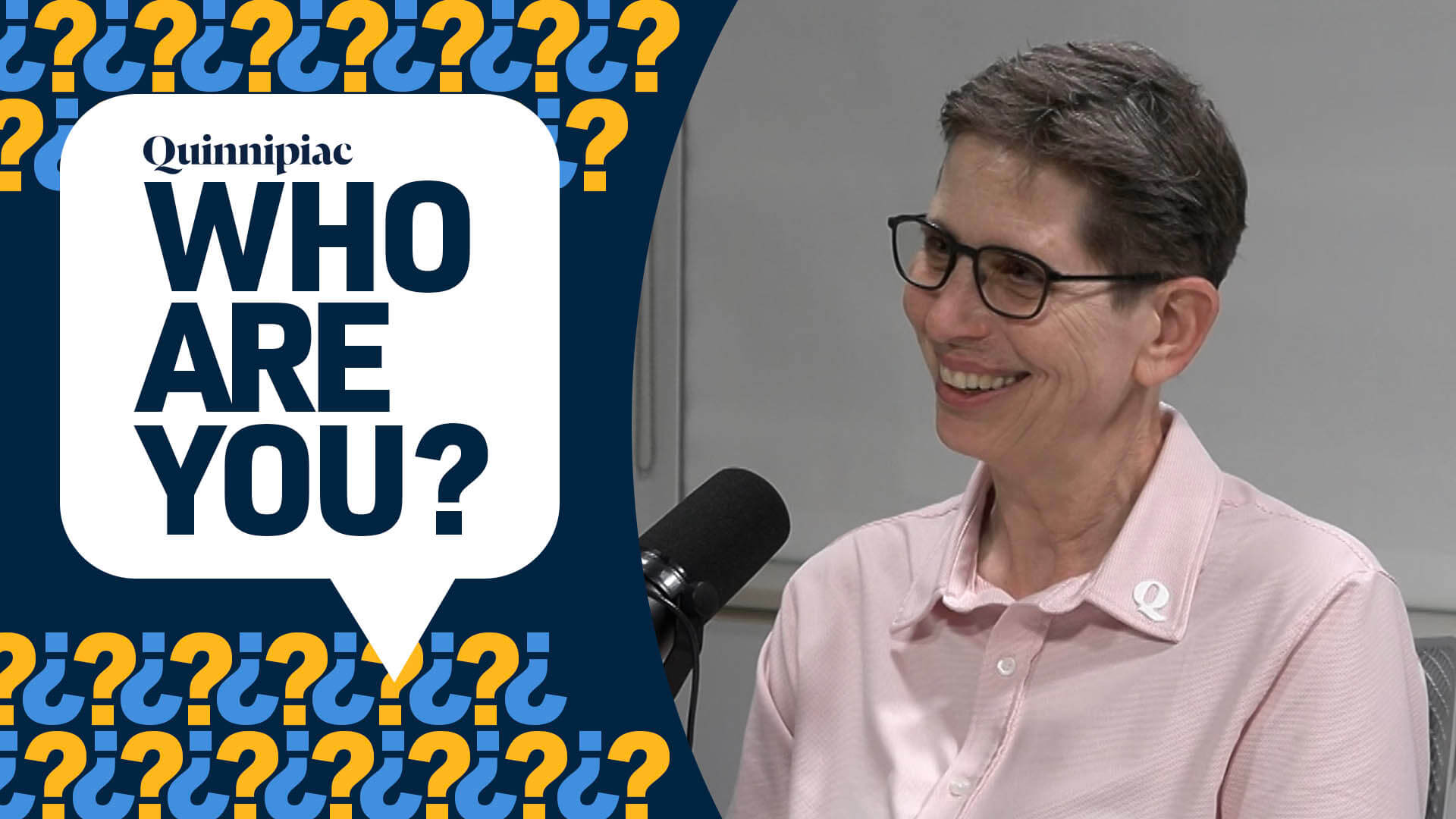
Joel Vanner: Hello, and welcome to ”Who Are You?,” the Bobcats you know the stories you don't. I'm your host Joel Vanner inside the podcast studio at Quinnipiac University's School of Communications. And I'm joined today by my guest, Quinto Melnick. Quinto, welcome to the show.
Quinto Melnick: Thanks for having me.
Joel Vanner: You have a very interesting story,so I'm glad you're here, which we'll unpack throughout this episode. But first, I ask my guest the same first question every time, and that is, tell me, Who are you?
Quinto Melnick: So I'm Quinto Melnick. I'm in the 3+1 with a finance undergrad, and then I'm going to be shifting to Quinnipiac Law.
Joel Vanner: Congratulations.
Quinto Melnick: Thank you.
Joel Vanner: Quinnipiac everything. Even got the Quinnipiac button. I got to get one of those after the show. So, Quinto, tell me growing up, you're from Delaware, right?
Quinto Melnick: Yes.
Joel Vanner: Tell me, growing up in Delaware, what was younger Quinto like? What were you interested in? Where were your passions? Passions and my interests.
Quinto Melnick: Growing up, I was definitely very passionate about learning how a little bit of everything worked. For a long time, I thought that meant I needed to be an engineer. But then I started to realize that it wasn't just about how things work, but why they're allowed to work, which eventually led me to that more of the law path of things.
Joel Vanner: And your journey into Quinnipiac is not a I don't want to say typical journey, but it is one with many stops along the way. You come to us from six years in the Navy. Tell us a little bit about your journey into the Navy and kind of where your perspective was there.
Quinto Melnick: Yeah, so before I decided to actually go in the Navy, I had quite a bit of a unique childhood. My parents went through some trouble during the 2008 financial crisis where my dad actually lost the company he was working for. And then during some time of trying to recoup some losses, he actually got hurt at home while trying to do some jobs for people. And that led to him being on bed rest for a few years, which is very unfortunate. I had to really grow up quick to learn how to take care of my dad.
Joel Vanner: That's a lot of responsibility to take on.
Quinto Melnick: Yeah. And to make things a little worse, my mom made some not so good financial decisions and ended up getting in trouble and got sent to federal prison. And they left me and my little brother. I had three older brothers who were all moved out at that time. Two of them were actually due to drug addiction and left home on their own. The last and my oldest brother, He finished college basically before any of this happened and was kind of on his own, but not necessarily in a place to support anybody's, you know, fresh graduate, trying to get his own feet under him, getting his first apartment and things. So it was really just me and my little brother taking care of my dad for a few years. And I think I came to, like, a realization that I wasn't necessarily ready for the conventional college route and that I needed something that would help me not just get my feet under me, but develop my experience so that way, when I was done, I'd be ready for anything, and the military was that choice for me.
Joel Vanner: While you were in the military, you had these and I want you to tell us about these experiences you had that kind of showed you where you would end up going while you are here at Quinnipiac in finance and also going on to Quinnipiac Law School. What were those experiences that kind of showed you what path you may want to take your life after leaving the military?
Quinto Melnick: Yea so I had a ton of experiences while in the military that led me one way or the other, kind of ping ponging around. During my time in the military, I was able to qualify as what's called the Command financial specialist. I from there was helping sailors budget and learn how to navigate financial responsibility. And that led me to wanting to do the financial route of schooling and my undergrad, but also my day job, what I did most of the time was in navigation. And for that, I had to learn the cool regs, nautical laws of the road, which led me a little more into the legal study side of things. And then I think I've kind of collided the two now to be like, This is where I want to go going forward of both my financial side and my legal mind and hopefully taking that further in my career.
Joel Vanner: So after high school in the Navy for six years, you left in 2023, on submarines, tightspaces, all that stuff.
Quinto Melnick: Yeah, I was on submarines my entire time. I was a quartermaster of the watch. So my job was I was in charge of this large electronic map that I got to help plot what we're doing, where we're going, when we have to be places, help enforce what we're supposed to be doing correctly, safely, ensuring safety was number one priority. And then getting to do that really bred more responsibility into me in terms of not just taking care of the few people at home but taking care of hundreds of people on my ship and knowing what it meant to wake up early, be prepared for what's next and be prepared for my job didn't mean just waking up and starting to do my job because at that level, that's not what you can do. You wake up early, you understand what's happening, and that definitely bred me into a place where I was ready to launch myself into a career, even post Quinnipiac.
Joel Vanner: And bringing that experience and that responsibility for others, what was it like having that experience in the Navy from, you know, growing up in your experiences that you had at home? How did that kind of transform you?
Quinto Melnick: While in the Navy, I think a big part of the way that my life and my experiences of everything that happened prior to that really gave me a sense of wanting to continue to help others, especially, no matter their situation. So becoming a command financial specialist meant more than just helping somebody who needed to budget on their own. It meant also counseling people who were not taking care of their finances correctly. But for me, that didn't mean just writing them on a piece of paper and saying they're in trouble. I meant sitting them down and talking them through their situation because everybody's a person. So everybody needed their situation to be handled uniquely differently, but with passion and care and a little bit of time. And that really is what my childhood helped me bring into my career.
Joel Vanner: And that was something that usually only those above rank would be able to participate in, but it was something that you were able to participate in while you were in the Navy, right?
Quinto Melnick: Yeah, absolutely. So I was able to qualify this. I was one rank under what is typically required, but I was able to write a letter to my ship's captain and explain why I felt like I was able to fulfill this role for our ship. And then for a large period of time, for over a year, I was the only command financial specialist on the ship, so I had to help run the entire program. Really designed the program. The first ship I was on was the USS Oregon. I'm a plank owner. I would help build it at General Dynamics, and then being part of that, being part of the crew and building up some systems, building up the financial responsibility of our sailors really went a long way with me.
Joel Vanner: So you're preparing to leave the military. You're in nearby Groton, Connecticut, my hometown, the submarine capital of the world. And you're thinking about education next. What are you doing at this point to kind of find out where you may want to go after the military?
Quinto Melnick: Yeah, it's an excellent question. So I spent some time researching what I wanted to do, and I knew that I wanted to be in a position where I could positively affect people in any type of way that I felt I was confident in doing, and part of that was in the financial realm. So I knew that I needed some education in order to get into a position where I could be in a role that affected most amount of people at once. I had some friends getting out of the military at the time. One of my best friends named Austin, who is a health science major here at Quinnipiac introduced me to the school and the connection, Jason Burke.
Joel Vanner: Jason is our executive director of veteran and military affairs. Your experience with Jason goes just beyond that initial campus visitor introduction, right? Jason is a veteran and is here to support our veteran students here at Quinnipiac. What is having that support meant to you, and how has that helped you adjust and be successful as a student here at Quinnipiac?
Quinto Melnick: Yeah, so Jason is also a Navy veteran, which is the best branch, but it was important to me because it gave me a place and a person to talk to when I was unfamiliar with how to reach out to specific people, unfamiliar with what is the right way to do things, a little cautious, anxiety driven, and he created that framework, that grounding of being the one I could reach out to first, and he would help me with the next steps. He helps every veteran here at the school with the next steps as needed. He introduced me to the veteran lounge, the student Veteran organization, the Student Government Association, Student Philanthropy Council, which were all organizations that I really wanted to be a part of to help continue my journey, but also to help those who are on journeys after me, before me, anyone around me and be a part of these groups or being a part of their own groups that I could then help.
Joel Vanner: And those are some of over 150 plus student run clubs and organizations here at Quinnipiac. You mentioned finance is where you landed while you're here at Quinnipiac. And you're in our accelerated dual degree program, 3+1 student. What drew you to Finance at Quinnipiac and then also the three plus one program here?
Quinto Melnick: So, finance at Quinnipiac what drew me to that specific degree actually had to deal with their Bloomberg terminals and their access to alumni and the education post schooling that I would have access to the 3+1 program, I thought was great to be accelerated. But what was nice about being able to be a part of a program at Quinnipiac was not being capped on my classes. So I'm actually going to be finishing my undergrad in only two years versus three.
Joel Vanner: Wow you were accelerated accelerated.
Quinto Melnick: Absolutely, which was great. And it led me into a position where I felt I was empowered to take my education into my own hands.
Joel Vanner: What examples do you have from some of the classes you've been from your professors that have allowed you to accelerate the accelerated program and adjust to even first just being a college student studying finance.
Quinto Melnick: Yeah, so I like to look at most of my classes as they all have a reason that they blend together and they made my studying a lot easier, rather than thinking about how one class is completely different than the other, because the material is different. To me, it's where is the middle ground? And then going, Okay, like, this is why it's important to know both and then being able to study one at a time. Using that for all my classes going forward because I know how it compounds and scaffolds.
Joel Vanner: So, you mentioned that the classes are connected that you found while you were studying made studying a little bit easier. Are there any faculty that have supported you along the way in your studies in finance so far?
Quinto Melnick: Yeah, absolutely. So even extended beyond just the finance portion of it, one of my professors, Doctor Paros, has been instrumental in helping me understand the way of thinking, the way of framing my mindset, and understanding internal and external biases, which has been great. The class style I've really enjoyed. It's set up and structured in a way that really elevates your ability to present yourself, which has been nice. It's helping me break out of my shell of not wanting to participate or not wanting to stand up and answer a question first, because I've always been the student who will sit at the front, but I'm not always the student who wants to raise my hand to answer a question and ask the deal a little bit with some of that internal bias of maybe I don't feel like I'm smart enough to answer that question. Another professor who's been helpful in that process has also been Professor Awudu, he's been great in terms of letting me know that the things I'm answering are correct and going beyond just giving me feedback in the class but talking to me outside of class about it. The same goes with Professor Genevieve, who has done some nice things in terms of helping me with my law school application and writing me a letter of rec. But before that, she was my professor for one of my classes that helped me choose that law school was the right path for me. And the way her class was structured was centered around specific type of information and the way that she provided her test, I could tell that she was definitely a caring professor and why that's one that stuck out to me.
Joel Vanner: Sounds like professors giving you the confidence to believe in yourself and know what you know and be able to share that with your classmates in your class.
Quinto Melnick: Absolutely. That's a huge part of it.
Joel Vanner: And your plus one year is a Masters of Business Administration, MBA?
Quinto Melnick: Yes.
Joel Vanner: What is that transition like between undergraduate studies, your MBA program, and then also you're off to law school here at Quinnipiac as well. How are you processing all of that together?
Quinto Melnick: Yeah so for me, the transition during the plus one has been a little unique as well in terms of being non conventional already. But Quinnipiac offers the plus one where during your undergrad, you can take three MBA core courses, and they have accepted me to take one extra MBA course during my undergrad, which I'm taking now in project management offered by Professor Paros.
Joel Vanner: Who was also on an episode of the podcast. Did you give that one a listen?
Quinto Melnick: It was a good episode. And what's nice about that is because of being able to take the education into my own hands, traditionally, it's not something offered, but I was able to voice my reasoning to the dean and get permission from the professor to take this course ahead of time, which really set me up to go into law school because in law school, I'm looking at doing the JD MBA joint program. And what that allows me to do is take my full law school as required. But for the MBA portion, it cuts down on credit requirements, and then I'm only required to take one non law elective, which I will now have fulfilled, and I'll have four classes done before I even roll back into the joint JD MBA program.
Joel Vanner: I don't think we touched on this earlier, but your interest in law school, which is something that Professor Genevieve Quinn helped you understand, kind of formulate during your time here at Quinnipiac comes from your experience in the Navy, right?
Quinto Melnick: Yeah, absolutely. So during my time in the Navy, not only did I have to study nautical law for the navigation rules of the road, but during my transition out, I was placed as a command investigator at the sub school, which is the submarine capital of the world. And during that time, I worked for the navy jag who processed nonjudicial punishment. So I was in charge of, like, the processing and paperwork and investigation of these cases, which definitely continued to lead my interest into law.
Joel Vanner: So all of your academic experiences, finance, MBA onto Quinnipiac Law School, all of that and everything else you've experienced here at Quinnipiac, what have you learned so far and learned about yourself looking back on the journey that you've had?
Quinto Melnick: I think one of the big takeaways I have from looking back is understanding that life is not a path, but rather a field. There is something on the other end of the field, and I got to walk down my field to get there. But I say it's not a path because if I divert, I'm not off the path. I'm still in the field. So I know where I want to go, but the way I'm getting there may be unique, and it probably is unique compared to anybody else and everybody else's story is also unique. And that's why I appreciate getting to support everybody in their unique journeys too.
Joel Vanner: Everybody's field is different, and people like Jason Burke here at Quinnipiac are here to help you navigate that field and go at your own pace and figure out what works for you and your interests. What advice would you give to a veteran who's looking to go back to school, isn't quite sure if they want to take that step. How would you guide them to take that step?
Quinto Melnick: One of the pieces of advice that I give, even some of the people I know that are still in trying to decide if they want to stay in, if they want to get out and go right into working, if they want to go to school is, where do you want to end up? Is the next step a positive step forward in the direction where you want to end? It doesn't have to be a straightforward shot. You don't have to go into the exact degree you want. There's plenty of veterans I know that are in undecided majors, but it's getting them there, and that, to me, is, like, the important step of moving forward.
Joel Vanner: Taking a step.
Quinto Melnick: Yes.
Joel Vanner: Whatever that is to whatever's next.
Quinto Melnick: Absolutely.
Joel Vanner: Quinto, it's great to have you on the show.
Quinto Melnick: Thank you for having me
Joel Vanner: Thank you so much for joining me.
Quinto Melnick: Thank you.
Joel Vanner: If you enjoy today's episode, be sure to subscribe, share and find other episodes on Apple, Spotify and YouTube. Until next time, when I ask my next guest, who are you? I'm Joel Vanner. Bye for now.























Quinnipiac Today is your source for what's happening throughout #BobcatNation. Sign up for our weekly email newsletter to be among the first to know about news, events and members of our Bobcat family who are making a positive difference in our world.
Sign Up Now