



Visionary leaders set tone for Quinnipiac’s next generation of founders during ‘Trailblazers’ distinguished speaker series
October 14, 2026
October 14, 2026
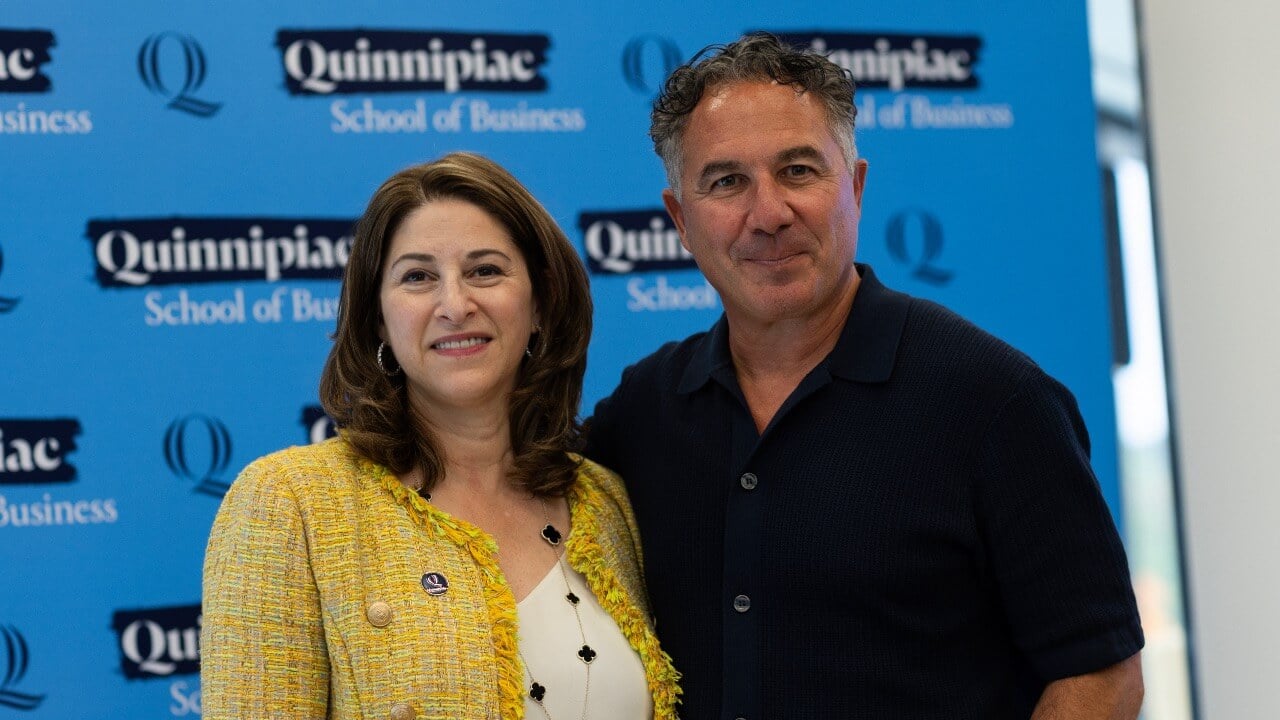
Haz launched Seaav as a Quinnipiac student, building a sustainable activewear and lifestyle brand centered on movement, community, and ocean conservation. Today, NCV serves as a lead investor in the company, which Haz still majority-owns. Saia chairs Seaav’s advisory board and is also Chair of the Advisory Board for York IE, an NCV Strategic Partner.
Haz joined Raider and Saia at the School of Business via video conferencing from Seaav’s headquarters in Boston, Massachusetts.
“This is such a unique opportunity to hear from both of them and the relationship of founder and mentor,” said Raider, who welcomed Quinnipiac community members including President Marie Hardin, students, faculty and staff on October 13.
During his 30-year career at Deloitte, Saia served as CEO of Deloitte Risk & Financial Advisory, with prior roles including Chief Risk and Regulatory Officer. A dedicated philanthropist and educator, he serves on the boards of Quinnipiac University and the Rheumatology Research Foundation.
Inspired by his You Got This, Kid! (YGTK) 2021-2023 book series, Saia founded the nonprofit YGTK Leadership Foundation to develop young leaders through hands-on training. He’s presented programs to Fortune 50 companies and universities nationwide. At Quinnipiac, Saia’s YGTK philanthropy stretches across graduate leadership symposiums, student internships, MBA projects, medical research grants, environmental programs, and a six-week summer immersive program at the Frank H. Netter MD School of Medicine.
Saia co-founded NCV in 2021. The firm invests in early-stage founders while providing strategic guidance to help companies grow and scale. Since its inception with just three members, NCV has expanded to 50 highly seasoned executives and investments close to $20 million.
Raider asked Saia where NCV finds its investment sweet spot within the broad venture landscape.
“We’re primarily early-stage investors, but we’ll be opportunistic,” Saia explained, emphasizing the firm prioritizes the founder, first. “We assess if they are coachable, among other factors. Are they going to work with us? Take our advice and our business sense as they drive their strategy?”
When asked what specific traits NCV looks for in an entrepreneur, Saia pointed to three core pillars: coachability, vulnerability, and resiliency.
“Mckenna is the A-plus star in our portfolio around resiliency,” Saia added.
Highlighting Saia’s person-first philosophy, Raider asked how he views the role of a mentor in guiding early-stage founders.
“Most important is availability and being available to your mentees,” Saia said. “There has to be chemistry between you and the person you’re mentoring. It doesn’t always work, and that’s okay. The other piece is that my network is yours. You don’t want just one mentor. I don’t want Mckenna solely dependent on me. My network is here to get her positioned with as many people as I know who can help her.”
Saia also shared it also requires a combination of pushing through hard conversations and giving mentees space to navigate challenges independently.
“I don’t want it to look like we haven’t had hard moments,” Saia said. “It’s about the founder, but it’s also about letting Mckenna breathe. Even though I’ve ‘been there, done that,’ if I see her walking into a wall, I have to be really careful about when I step in front of it; because she brings a fresh mindset that I’m learning from, too. Knowing when to step in becomes an interesting balance. She’s the CEO, so she needs to make the decisions. There are moments when we spar, and I think that’s healthy.”
Haz said she has confidence in her vision for Seaav and while they may spar, Saia’s advisement has been invaluable.
“Chuck listens to me and will hear me out, and I’m also humble enough to understand, once we talk it out, that okay, maybe you are right,” Haz said.
During her Quinnipiac journey, Haz was an NCAA Division I rugby athlete. She majored in advertising and integrated communications with a minor in entrepreneurship and small business management.
“While competing as an athlete and while being an extraordinary student, she also started an amazing company,” said Raider.
Haz launched Seaav from her Quinnipiac dorm room. In 2020, she was named Connecticut’s Student Entrepreneur of the Year, followed by winning a WBENC Collegiate Accelerator Grant in 2021. Just five years later, Seaav has evolved into a nationwide, purpose-driven brand.
“It’s crazy to think that this idea started from a dorm room with very little understanding of what Seaav would become today,” Haz said. “Thinking far ahead into the future and having mentors like Chuck have helped me really think bigger about what the five-year and ten-year goal is.”
Reflecting on her time at Quinnipiac, Haz said choosing to minor in entrepreneurship and small business management was directly responsible for her decision to found Seaave, sparked by Professor Whitney “Trip” Sanders’ introductory course.
“Trip Sanders really stemmed the idea and helped me figure out how I could combine what I was most passionate about -- athletics, the oceans and fashion -- and wanting to build something that I owned, but also something that was bigger than myself,” Haz said.
The idea of turning single-use plastic waste into athletic wear came to her while visiting her hometown beach on Vancouver Island in British Columbia, Canada. At Quinnipiac, Haz said she focused on having a clear vision, strong ambition, and a willingness to learn from people who knew more than she did.
Today, that vision has scaled Seaav into a national activewear brand with high-profile partnerships including Disney and Universal Studios, burgeoning online sales, and inventory in over 100 boutique yoga and Pilates studios. To date, Seaav’s partnership with social enterprise Plastic Bank that has diverted more than 1 million plastic bottles from ocean shorelines.
Driven by her mission to inspire people to move, connect, and “make waves, not waste,” Haz founded Seaav’s Make Waves Wellness Club over three years ago. The club has grown from an initial gathering of 50 attendees to monthly wellness and shopping events drawing 400 to 500 people in Boston, as well as adding club events in nine additional cities in the past year, building a dedicated community of thousands. Looking ahead, Haz aims to have 40 community leads running Make Waves Wellness Club events in 40 cities by the end of 2027.
“My biggest goal is for Seaav to be the ocean impact brand within the athletic wear space, and not only the activewear space, but the wellness space as a whole,” Haz said. “It’s one of the biggest reasons why I started Make Waves Wellness Club – to combine movement, connection and shopping in real life.”
With artificial intelligence (AI) inserting itself into daily life, Haz strongly believes people are looking for ways to connect in community.
“I feel like the more that AI is taking over, the more in-person community and connection individuals are craving,” Haz said.
Raider invited Haz and Saia to share strategies for remaining agile amidst industry disruptions such as AI and economic volatility.
“I feel like there’s always disrupters. If anything, I’ve learned to become comfortable with being uncomfortable,” Haz said.
She cited AI as a powerful tool for scaling efficiency, noting it helps Seaav compete on the same playing field as bigger corporations in areas from market research to creating presentation decks. On the financial front, Haz highlighted tariffs as a primary supply chain disrupter impacting strategic product planning.
“It forces us to think critically about our margins and inventory schedules,” she said.
Amidst the noise of disruption, Saia said that strategic clarity, staying on purpose and maintaining sufficient capital is paramount to driving sustainable business.
“The only thing I would point to is stay on strategy. It’s the Wellness Club, it’s bringing the community together, it’s the DTC [direct to consumer] business,” Saia said.
Saia also praised Haz’s exceptional branding, which is allowing her to pursue more boutique revenue, develop wholesale relationships, and generate event sponsorship revenue.
Highlighting Haz’s execution in expanding Seaav, Saia emphasized that her company’s growth trajectory relies far more on Haz’s strategic brilliance and the team she’s gathered rather than leaning on NCV’s network of experts.
“Yes, we leverage our network, but this is one of the greatest strategic minds I’ve ever worked with,” Saia shared. “She just highlighted to you the importance of people connecting and coming together; and when she told me last year at this time she was going to be in nine cities next year, I was skeptical. But she did it.”
Additionally, Haz bootstrapped her way into 70 boutique studios within her first two years, a feat which big companies desire and cannot easily replicate, Saia said.
Addressing business majors in the room, Saia said Haz is creating two very important moats.
“One moat is a purpose-driven community that competitors will have a difficult time breaking through; and wholesale boutique deals,” Saia said. “And then, she dropped in AI. Mckenna’s already thinking about how to bring AI into her community impact.”
During audience Q&A, Professor Mostafa Analoui, Carlton Highsmith Endowed Chair of Innovation and Entrepreneurship and Director of the M&T Bank Center for Innovation and Entrepreneurship, asked Haz to share her rationale for pursuing a high-risk startup as a college graduate, over entering a traditional career with a predictable income.
“Not a lot of rationale -- a lot of naivety,” Haz shared, laughing. “I dove in the deep end because I was very passionate about building Seaav. If I knew what it would actually take to get the company where it is now, and even looking forward to what’s still ahead of me, I probably wouldn’t have taken the risk. I’ve been lucky enough to be gritty enough to keep opening doors, pushing through and building connections.”
Saia added that when a business is purpose-driven, such as Haz’s refusal to accept plastic waste on local beaches, it becomes easier to embrace that early naivety. But he also stressed there are real trade-offs involved in rejecting corporate stability.
“If you’re going to go build a startup, you have to acknowledge you may have to live in mom and dad’s basement, or an aunt and uncle’s basement,” Saia said. “You can definitely make more money in your 20’s not doing a startup. You have to be willing to give up an easy path and a salary. And that’s what Mckenna has done.”
Underscoring Haz’s relentless persistence, Saia recalled turning her concept down multiple times before extending the offer of an assessment review by the NCV board.
“I said no three or four times, and she kept showing up,” Saia shared with a smile. “Finally, I said, ‘I’ll bring you to the group.’ We’ve been working together for four years now.”
Mckenna advised student entrepreneurs to be vigilant and to start building their network now, with outreach as simple as asking to meet over coffee.
“I think that reaching out to people that you admire, and just showing up in this room, connecting with somebody like Chuck today, you’re already a step ahead of all the other student population,” Haz said. “What I’ve found is that successful people want to help somebody that’s genuinely extremely ambitious and willing to put in the work.”
Beyond taking that initial networking leap, Haz advised students to anchor their ventures in authentic passion. Lastly, she urged aspiring founders never to let self-doubt or inexperience hold them back.
“You belong there just as much as anybody else, especially if you have a willingness to be coachable and to learn,” said Haz.


















Quinnipiac Today is your source for what's happening throughout #BobcatNation. Sign up for our weekly email newsletter to be among the first to know about news, events and members of our Bobcat family who are making a positive difference in our world.
Sign Up Now