


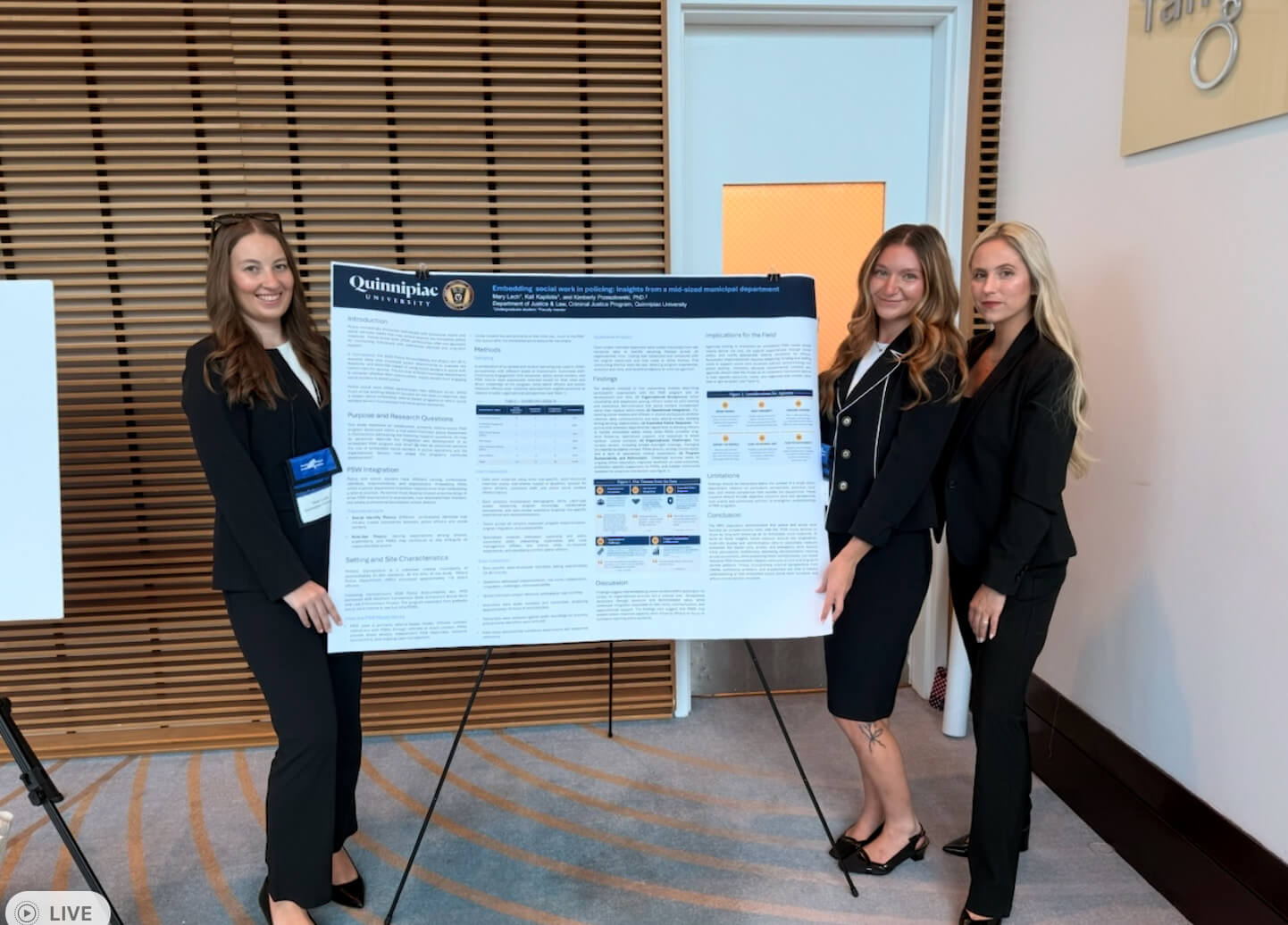
‘Who Are You?’ podcast with guest Elizabeth Pratt ’22, MSW ’27
Choosing Quinnipiac before choosing a major

Choosing Quinnipiac before choosing a major
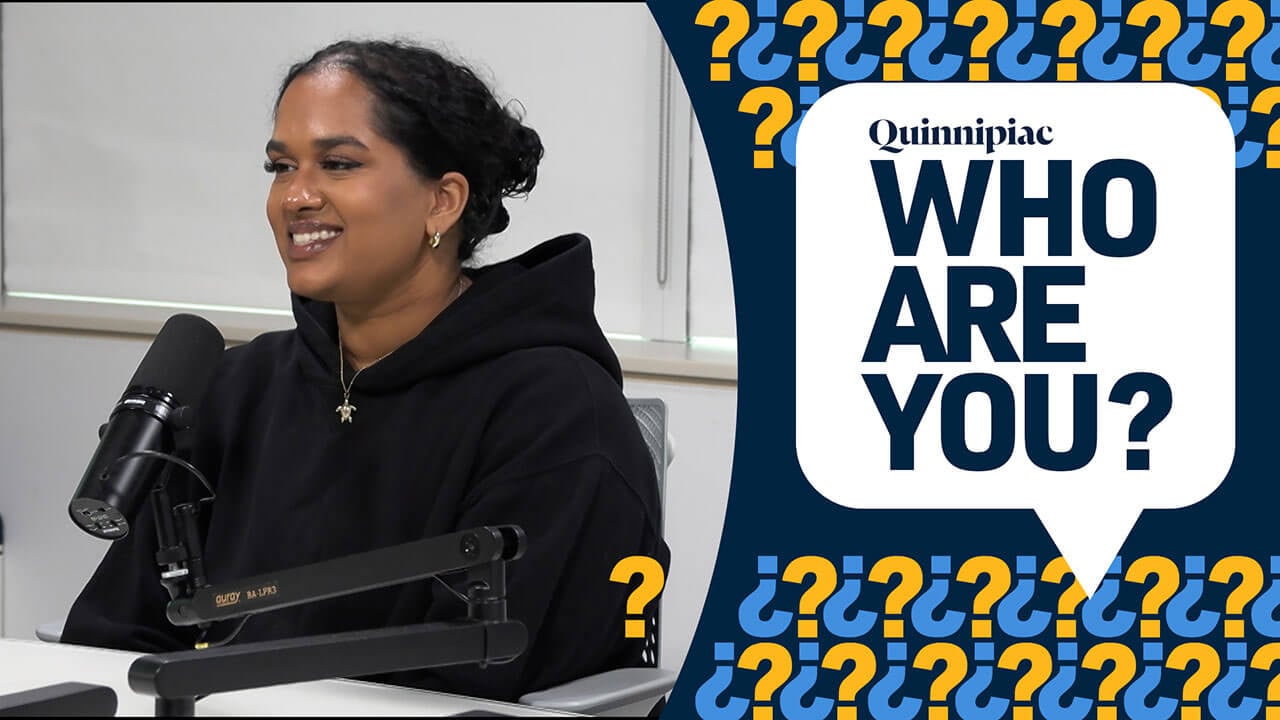
Joel Vanner: Hello, and welcome to ”Who Are You?,” the Bobcats you know, the stories you don't. I'm your host, Joel Vanner, in the podcast studio at Quinnipiac University's School of Communications, and I'm here today with my guest, Elizabeth Pratt. Elizabeth, welcome to the show.
Elizabeth Pratt: Thank you so much for having me. I'm happy to be here.
Joel Vanner: I'm happy you're here. I'm not sure if you've seen an episode of our program before, but I asked my guest the same first question, and that is we know your name, but tell me who are you?
Elizabeth Pratt: Yeah. So my name is Elizabeth. I am currently in my first year master's program at the North Haven campus, getting my master's in social work. I graduated from Quinnipiac back in 2022, and then decided ultimately to come back all these years later for another degree. I graduated with a double major in criminal justice and psychology. Went and lived in the real world, quote unquote for two years, and then decided to come back.
Joel Vanner: Come back for your master's in social work, which we'll unpack all of that later. But, Elizabeth, let's go back in time, way back past your undergraduate experience, and tell me what were you passionate and interested about? Who is Elizabeth back then?
Elizabeth Pratt: So I think back in high school, I remember being surrounded by everyone who was like, I want to be a nurse. I want to be a teacher, I want to go be an accountant. And I remember thinking, I have absolutely no idea what I want to do, but I knew that I liked connecting with people and I liked being able to listen to other people's stories and not only provide any assistance that I could, but also to try to find commonalities between myself and others or between people that I knew who didn't know each other.
Joel Vanner: So you must have been the friend group, like confidant in that aspect, right?
Elizabeth Pratt: I guess, to some extent, but I do think that when I was going into applying for colleges, I didn't apply for anything in particular, Quinnipiac. I remember doing the tour. I really liked campus, and I really felt like the size of the school was a good fit for me, but I did come in undeclared, which I think I remember my parents were like, What are you doing? Like, you don't know you don't know? And I was like, I have literally no idea what I want to do and what I want to committ to.
Joel Vanner: It's a big time in life, right? The age you are to determine what you want to study for the next four years, although it can change. You came in undeclared. Tell me about that experience. So you picked Quinnipiac. You were looking at colleges, not for the programs, but just for the fit environmentally, and you came in undeclared. What was that experience like?
Elizabeth Pratt: I remember getting, you know, in every class, what's your name, what's your major? And I remember people being kind of like, Oh, you're undeclared. Like, what does that mean? You don't have a major? I said, No, I don't. I took classes that I was interested in that aligned with my interests so sociology, criminal justice, and then I took, obviously, the core curriculum that we have to take care for undergraduate, but I really remember enjoying my sociology class, Sociology 101. I also really enjoyed criminal justice 101, Intro to Criminal Justice. I was very hesitant to commit even then after the first semester because what if you change your mind? What if you decide that you don't want to do this What if you want to add something? I had prior to going into undergrad, I had completed a summer program at a small Liberal Arts College in New York, gotten my Psych 101 credit there, and it was transferable to any university, I think, in New England as long as the standards were the same. So I ultimately decided on criminal justice as my first major. And then after some consideration, I said, you know, I just I'll add on psychology. They kind of go hand in hand. I figured that it would open more doors for me when I graduated for job opportunities. So yeah.
Joel Vanner: So going through that transition, taking those 101 level courses, kind of finding out what you're interested in, what kind of support did you have here at Quinnipiac to guide you in that way of declaring those two areas as your majors?
Elizabeth Pratt: I think that what was really nice, in my opinion, was the size of the classes. I know for intro classes, they're typically larger than your more concentrated electives as you go through the program. But I felt like the faculty at Quinnipiac really offered a lot of opportunities for students to get to know their professors, but also utilize the resources that the professors have here and getting connected with other professors and other faculty and community opportunities for people. Everyone knows somebody. Sure. I felt like they really, you know, encouraged guest speakers to come in for us to utilize guest speakers, learning commons, any kind of TAs that were available. So I felt it was a very supportive experience.
Joel Vanner: So when you finally decided on criminal justice and psychology, what were some of the support systems that you used in your studies, internships, etc, to help guide you through that transition?
Elizabeth Pratt: I really connected with my youth crime professor, doctor Alan Bruce. He's one of the criminal justice professors here in the undergrad program.
Joel Vanner: Who's also been on the Podcast?
Elizabeth Pratt: Yes, he has. Yes, he referred me. He sent me your guys information. But in my second year, he had guest speakers come in from the Juvenile Review Board who were looking for some volunteers for panelists. And so I didn't see anyone else take the paper, and I said, I'm interested in seeing what this is about. And I needed a reference for it. I remember going to his office hours and, I kind of was asking him more questions about, do you know, you know, exactly what the schedule would be or what they do or have you had students in the past do this volunteer opportunity? It wasn't an internship, it was volunteer opportunity on Saturday mornings, and he said, No, you'd be the first. I'm pretty sure. And so I said, can I use you as a reference. And he's like, Of course, you can use me as a reference. And that ended up being my first, I guess, boots on the ground experience as a volunteer. It was very low stakes, but I did really enjoy meeting with those individuals, those individuals and families in New Haven. And I was able to bring that experience back into the classroom for youth crime, and that ultimately did spark my interest in working with children and families.
Joel Vanner: What were some of the next steps in those programs for internships? What was your experience like now having committed and moving forward with those? What changed for you?
Elizabeth Pratt: I think well, when I was in undergrad, my sophomore year was when the pandemic hit. So internships.
Joel Vanner: So everything changed.
Elizabeth Pratt: Everything paused. Like, we went home for spring break and then we literally never came back, and that was a really crazy time because no one knew what was going to happen. Professors didn't know what they were going to do for classes, if we were no one knew what Zoom was yet or Microsoft Teams, really. But, they had paused the internship application process because I think in sophomore year or senior second year, you take your class where you are learning how to apply for an internship and how to make a resume and write a cover letter, and they said pause because we don't know who's even taking interns, who's not taking interns.
Joel Vanner: And that's stressful because it's a required part of your program, right, to have an internship.
Elizabeth Pratt: Yes. So I think everyone was in full panic mode at that point. But we may do, and some people had virtual internships. I did not have a virtual internship. I waited until my final year in undergraduate to complete my internship.
Joel Vanner: Where was your internship?
Elizabeth Pratt: It was at a female transitional home in New Haven, so it was really great experience. I think it was our first year partnering with that agency at the time. So there were definitely some growing pains, but I think that it really did give me a chance to apply everything that I had been learning in the classroom, both in person and online to that setting.
Joel Vanner: So then after graduating, you said you experienced life and did life. Tell me about the life that you had after graduation for a bit.
Elizabeth Pratt: After graduation, I had started working full time, my first job post grad. It was at a nonprofit in Waterbury, Connecticut. I was an employment specialist for individuals who have disabilities, helping them find employment and then helping them maintain their employment, whether it was full time or part time. And I lived at home. I think that there's a little bit of stigma around living at home postgrad, but, I mean, you save money.
Joel Vanner: Absolutely.
Elizabeth Pratt: I think there's no shame in it. I think that no one really also addresses an undergrad, how much impostor syndrome you have leaving leaving campus and leaving, you know, school life behind.
Joel Vanner: And it's you and 1 million other students applying for jobs at the same time, having the same timeline in that way. It's definitely very stressful.
Elizabeth Pratt: Very stressful. And you kind of get out there and you're like, am I qualified for this? Am I in the right for this?
Joel Vanner: Am I in the right place. Right.
Elizabeth Pratt: Yeah, am I doing what I, you know, am I going to be the person that, you know, professors hoped I would be that my peers thought I would be, and then after that, I kind of was very resentful of Connecticut. I think it was mostly just because I've lived in Connecticut my entire life. I grew up here, went to college here, wouldn't trade it for the world, but I was in the mindset of, I kind of want to go and do something for myself while I'm young and, you know, I can. And if I don't like it, I can always, you know, switch it up and come back. So I did move out to the Seattle area.
Joel Vanner: You picked the other coast. You said let me go as far as I can without leaving the country.
Elizabeth Pratt: Yeah, exactly. Pretty far away. And it was a great experience. I just think that it gave me such a new outlook on where I came from and, you know, all my experiences here. And yeah, it was a transformative experience, but I did ultimately decide to come back.
Joel Vanner: And we were talking before the show, you went to a couple of Seattle Kraken games. So you kind of learn the Pacific Northwest culture. Maybe you even went to the First Starbucks or to the Pike Place Market, which are all the touristy things. You probably got it done in the first week you were there. But let's shift to you came back to Connecticut, and now you're in the Masters of Social Work Program. What encouraged you to go back to school? And then what encouraged you to come back here to Quinnipiac in the Social Work program?
Elizabeth Pratt: Yeah I think that I had a bit of a bumpy path, I want to say, leaving the Seattle area. I really tried to give it my all and seeing if it would be somewhere that I would settle down long term, but I just couldn't picture it. And so I remember I called my parents and I said, I want to come home. I just want to come home. That was really hard to being away from family. So I figured it out. I ended up leaving my job there. I was working in Juvenile Probation Court over there, which again, was a really great opportunity to apply everything that I had learned at Quinnipiac to the real world in a different area too, with a very different group of people in the Pacific Northwest. But I wanted to come back to Connecticut because it was familiar and I felt like for those couple of years that I was there, everything was so new and it was always a process to re learn how to learn the environment or learn the people.
Joel Vanner: A bit overwhelming while you're trying to start your career, too.
Elizabeth Pratt: Yes.
Joel Vanner: In in that sense.
Elizabeth Pratt: Yeah. But I did ultimately decide to come back to Quinnipiac because it was I had such a great experience in undergrad, and I took a look at the social work curriculum, decided that I did want to get my MSW so that I could get my LMSW and then my LCSW later on.
Joel Vanner: So our Masters of Social Work Program, abbreviated MSW. Tell us about the program, what the structure is like, and then what you're doing now in your first year in the program.
Elizabeth Pratt: So the structure is I'm an on ground student. We do have an online program, as well.
Joel Vanner: Which is relatively new the online offering of MSW.
Elizabeth Pratt: I do know that they're hiring more faculty for the online program because the program itself, the whole social work program is growing very rapidly.
Joel Vanner: The faculty is amazing.
Elizabeth Pratt: I cannot say enough good things about the faculty in the social work program over at North Haven. So the classroom size, I would say is pretty small. I think we have, I guess I'm still in the larger courses because they're not necessarily elected yet. We're still on a core curriculum. I want to say about 20 to 25 students per class. Then we also have some 3+2 kids, 3+2 students or 4+1 students as well. They're in their undergraduate, but they are taking graduate level classes at the same time as their undergrad.
Joel Vanner: So it's a good mix there.
Elizabeth Pratt: Yeah, it's a really good mix. But what's unique about, I think, the faculty is that a lot of them are part time faculty or they're full time faculty, but they're part time social workers in the community. So they are able to bring stories or able to bring their own experiences and perspectives into the classroom. So when we're learning about certain modalities of interventions or therapies or we're talking about different lenses to look at a client interaction through. They're able to bring their own unique experiences, but also give us feedback on, you know, if we say an answer, maybe critiquing in a constructive manner, you know, the language that we use and how we go about just looking at the situation from that person environment perspective, which is what they really emphasize throughout the entire program is looking at each situation as person and environment.
Joel Vanner: I like that you said that the faculty are experienced in their fields, too, outside of the classroom or in addition to their work in the classroom, because that's something that you would find in many different departments and programs here at Quinnipiac that you have those faculty that are out practicing what they're coming back and teaching.
Elizabeth Pratt: Exactly. And I think that they bring such great stories, too. So if we're learning about something in particular, certain, you know, setting that you can be a social worker in or certain modalities that are popular in a certain setting of social work, they're able to bring some kind of story in of their personal experience. And that to us is what sticks with us when we're because it's a real world application of what we're learning about. And so I think that those experiences and being able to share. And then also, we are all in our first year internships. You have to do your generalist year internship and then your specialized year internship. So we do have our dedicated internship class where we meet and everyone kind of shares what's going on in their internship. But we also talk about all of our internships in each class as well. So we can all bring in different stories or ask questions about how to use or utilize certain modalities, interventions or ask for feedback from both peers and faculty about a way to look at a situation or to handle a situation.
Joel Vanner: What's been your experience, like in the program so far?
Elizabeth Pratt: So it is a clinical focused program. So each, you have your intro classes, your intro graduate level classes, and then I'm in my second semester of my first year now. They refer to it as your generalist year. Next year is your specialized year. You take policy course. You take practice groups or practice courses, and you learn about different modalities of interventions and therapies. It's a lot of reading. There is a research component as well in the curriculum, and we do have every semester, every semester, we have live actors come in. They're called standardized patients, and it is part of your grade. You are graded on I think it starts off as a participation grade, but as it goes on, it's on your ability while you're in that area. They have live actors come in to therapy rooms because we are in the School of Health Sciences, so we do have access to those resources, and they come in and they'll present an issue or they need to be connected to a resource, and your job is to, I think you have 10 to 20 minutes to connect them and kind of implement everything that you've been learning in the classroom into a live session.
Joel Vanner: It's a very real world simulated experience with the standardized patients. They really stick to their script and profile that they're given and it's great that you have that experience before you go out into the real world outside of Quinnipiac and have other clinical experiences, too.
Elizabeth Pratt: Yeah, for sure. I think that I know I've worked with clients before, but for people who are either coming right from undergrad into a graduate program or who are new to social work, it's a really great experience because, you know, you can read about it and you can do cases all you want, but being able to sit in front of a person and read body language and understand dialect is really important.
Joel Vanner: And then debrief with your faculty afterwards and learn all you need to. So two questions for advice from you. First question is, what advice would you give others who maybe are looking to come into college undeclared, and maybe their families are having the same confusion question, and they're just not quite sure if they're ready to decide on what they want to study. What advice would you give them looking back on how you found your areas here at Quinnipiac?
Elizabeth Pratt: I think that when you're 18-years-old, when you're applying for undergrad, I think that it is a very it's a very difficult time because you're trying to, you know, you're trying on all these different hats, but you're also seeing other people commit to something, and I know the pressure that you can feel from that. And I think that I would say to someone who is unsure of it's going to be okay. You're going to figure it out. You're allowed to try and it's not the right fit. You can pull a 180. I would know. And you don't have to commit to something. And I think that also utilize your resources on campus, utilize those professors, your peers, the community resources to help you find your path because you don't need to do it alone.
Joel Vanner: Sure, Everyone here is just so accessible, too, from your faculty up to the Dean's office, too, in many schools, you can schedule a meeting with the Dean just to talk about your career interests, and they can, like you said earlier, connect you in different ways that maybe not in that room there. My second question for advice from you is, what would you say to those who maybe are looking to go back to school for a master's of social work or other master's program after having some life experience? How would you suggest they handle that transition and kind of think through that process?
Elizabeth Pratt: Going back to the imposter syndrome aspect that you feel when you graduate and go into the working world into your first full time job, but then also addressing the same I had the same exact feelings when I went back into school. I was like, Am I too old to be here? Like, you know, is this the right path for me? As you know, education is, you know, you pay for it. So, is this the right move financially for me, as well. But I do think that it's one of those things where it is okay to start over. And, you don't have to if you try it out and it's not for you it's going to work itself out. I think that trusting yourself and your ability to figure it out is really important. And also, to, again, lean on your resources, not just at the school, but your personal resources, your friends, your family.
Joel Vanner: Your community here at Quinnipiac, too.
Elizabeth Pratt: Yeah.
Joel Vanner: Well, Elizabeth, thank you so much for joining me on the show and sharing your insights. It was great to meet you today.
Elizabeth Pratt: Thank you, you as well.
Joel Vanner: If you enjoy today's episode, be sure to subscribe and share and find other episodes on Apple, Spotify, and YouTube podcasts. Until next time when I ask my next guest, who are you? I'm Joel Vanner. Bye for now.
















Quinnipiac Today is your source for what's happening throughout #BobcatNation. Sign up for our weekly email newsletter to be among the first to know about news, events and members of our Bobcat family who are making a positive difference in our world.
Sign Up Now