



‘Who Are You?’ podcast with guest Professor Gabe Acevedo
From rockstar to sociology professor
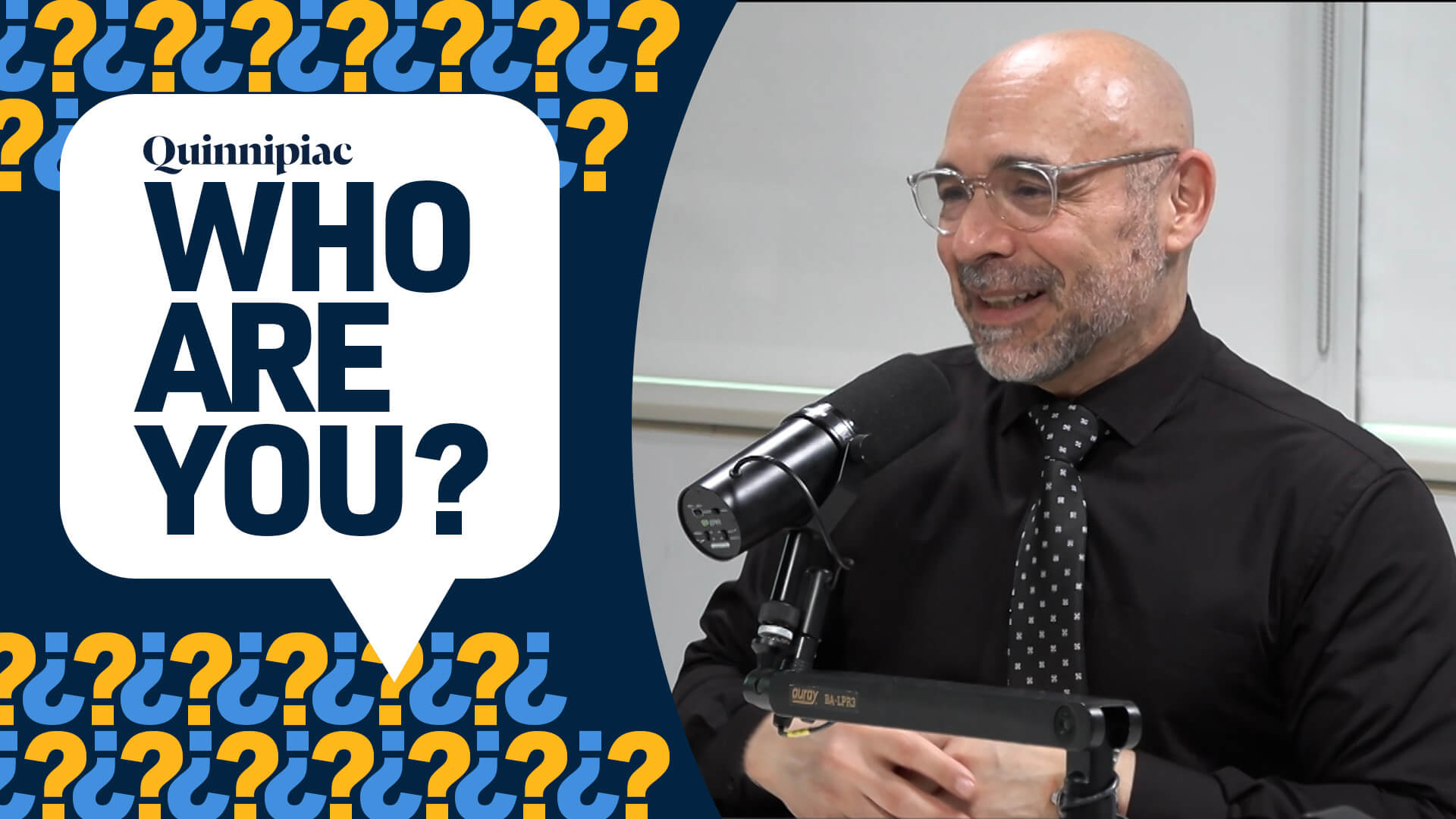
From rockstar to sociology professor
Joel Vanner: Hello, and welcome to ”Who Are You?,” the Bobcats, you know, the stories you don't. I'm your host Joel Vanner inside the Podcast Studio at Quinnipiac University's School of Communications, and I'm joined today by my guest, Gabe Acevedo. Gabe, welcome to the show.
Gabe Acevedo: Great to be here. Thank you for having me. It's awesome.
Joel Vanner: Gabe, I ask my guest the same first question every time, and that is tell me. Who are you?
Gabe Acevedo: So, I am a member of the teaching faculty here in the sociology department. I've been here about three years. I mean, you know, I've been around the block once or twice. So I've taught in multiple institutions. I got my PhD late in life, so I'm not a traditional student. My parents are immigrants from Colombia, from Catalina from South America. And I grew up most of my young life in Miami, Florida. And then as you'll see, when we go through this, music as a young person, music took me on a pretty wild journey that took me living many parts of the United States. So I don't even know where home is.So.
Joel Vanner: I forgot my map with the pins and the string to kind of give our listeners and viewers a visual here, but let's actually get into that. Music is something that kind of took you on a journey early in life. But when we say music, let's talk about instruments.
Gabe Acevedo: Yeah.
Joel Vanner: How did you get your first instrument? What's the story behind that?
Gabe Acevedo: Well, that's an interesting story. So, as I said, so my family is migrated from Columbia to the United States, and I was very little. I was like, in first grade. I think it was my first grade in the United States, and we lived in South Miami and bordering a town called Homestead, Florida, down there. And my dad, who was a mechanic and just did kind of different things, would go around often times and collect trash, the big trash, you know, the big trash that we leave on, you know, I live in Cheshire now, right? And people leave out the big trash.
Joel Vanner: Bulk waste.
Gabe Acevedo: The bulk stuff, the bulk stuff. And, you know, and there was a little I'll never forget. It was, I'm oh, my gosh, I'm almost 60 now. And so I must have been six or seven or something like that. And there was a little I still remember little tin green paper kind of drum set that was there, and I was like, Oh, I really wanted it. But we didn't have room, you know, in the thing that he was driving. He was, I'm not taking drums. I can't sell that. Can't sell that. I, you know, I need dressers and TV stands. So anyway, one of the few times I saw my mother ever yell at my dad. Well, not one of the few, but she said, No, you're you're going to take him back, and you're gonna get that damn drum set.
Joel Vanner: Did you go back and.
Gabe Acevedo: So we went back the next day. He was nice enough to get it. And then I tore through that little toy drum set very quickly.
Joel Vanner: The price was good, huh?
Gabe Acevedo: Yeah, the price was good, and I just destroyed it in about a month. I loved it. And then from there, you know, we had some friends that had a son in the music thing, and we ended up with, like, a real drum set. So I was really little. So I was little when I just developed a love for this crazy this crazy, challenging instrument. And so, you know, from that time, I played much it was later, you know, I was very difficult financial for my parents to, like, give me lessons and stuff like that. So I just kind of learned by, you know, some church stuff. I would see church drummers playing. My mom was very religious. And so we would go to some sort of Southern Baptist kind of churches. And I always listen to the drummer. And then I listen to I had a lot of I was the last of six kids. I was the youngest of six.
Joel Vanner: Wow.
Gabe Acevedo: And so my older siblings were into some very cool music at the time. And so I listened to a lot of those records. And so that kind of stirred the passion for music, and it just stayed with me, you know. You know, we'll get into it, I suppose, but I put the drums away for decades when I sort of, you know, straightened out my life a little bit.
Joel Vanner: And they're back out now in some of the volunteering work you do, which we'll get into later. The encouragement from your parents to continue playing the drums as you were going through school, how did those two things kind of come together, graduating high school, interest in drums, career in music. Where did you go after having that interest in passion?
Gabe Acevedo: Yeah, great question because a lot of that is really it all intersects, you know? So I teach in my classes, I often when I teach theory, I often teach this stuff called rational choice theory about human behavior being based on a series of rational decisions we make about rewards and costs. So what really happened to me at a very young age, I didn't really care much for school, but my parents at some point, and they said, Well, you can do this drum thing, but you have to keep your grades up. The only way.
Joel Vanner: It's very motivating.
Gabe Acevedo: Yeah, so, neither of my parents had my father had a GD and my mother really didn't have much education. And so they were very interested in us doing that. And so they said, you can play the drum thing, and as long as you keep your grades up, and so I did. So that just kind of forced me to be good in school. I was, again, very young when I actually started to play in bands with older people. So by the time I was like, you know, 12 you know, 12, 13, I was playing with, like, grown men and stuff.
Joel Vanner: And you were self taught, too.
Gabe Acevedo: Well, I guess at this point, by ten ish, maybe by ten, my parents realized that, you know, that I liked it. My brothers and sisters sort of convinced them to, like, get me lessons.
Joel Vanner: Sure.
Gabe Acevedo: And so I do at that point, I started to take more, like, real lessons from real, like, more advanced drummers and that helped immensely. That was huge. And then, you know, the teens I was playing with really, like, in bars, and I'll never forget, like bar owners would freak out, like, Oh, my God, who's this this kid. You know, you got, like, a kid playing drums. And they would often make me sit in the back. I could never be in the bar area in these little towns like Homestead, Florida, these little tiny bars, you know. And yeah, so that's so I think just like them forcing me to them forcing me to be good in school so I could be out all night playing music. And then at some point, you know, it's interesting because I did sort of start to develop, you know, sort of a real love of books and reading certain things. And, you know, I started to, like, dissect song lyrics a lot, and I would connect song lyrics to things I was doing, like in middle school, and teachers seemed to really, like, like that.
Joel Vanner: So understand the meaning, form that connection.
Gabe Acevedo: Yeah, yeah.
Joel Vanner: With the things you're interested in, to make things more relatable to you and personalize.
Gabe Acevedo: Yeah, yeah.
Joel Vanner: Your music career took off for a bit, right? You were signed to a label, joined a group, toured around a little bit. Walk us through what that experience is like and what you took away from that and how it kind of informed the next step in life.
Gabe Acevedo: Yeah, also, great question. So so by the time I got to high school, I was dead set on being a drummer, you know? And but it was still by this point, I've left home. I left my parents' home in Miami, and I went to live with my sister, my oldest sister in St. Louis. So high school for me was all in St. Louis.
Joel Vanner: Blue's music. Popular?
Gabe Acevedo: It was very popular. The Hill, you know, the famous Chuck Berry spot, you know. But I was playing more rock. You know, I was still playing, like, a lot of rock and roll stuff when I moved to St. Louis, playing, like in rock bands and things. 70s, a lot of 70s rock. But I made these friends, you know, these friends of mine who went to a sort of a competitor high school. There was a big jazz high school. My high school was a big marching, so I was in the marching band. It was more like a drum corp, really. And so I, you know, met these guys that were in a very good R&B band. They were all African American guys from St. Louis. And I really had never played R&B, but they knew that I was very serious. And so one day, they were a very well known local band, and they walked up and said, you know, we're having problems with our drummer. And I was like, I've never played R&B. And they said, Yeah, but we just want to know, are you going to college? Are you going in the Army? Because that's what we all did. We were all pretty low income kids. So everybody, if you were lucky enough to get a scholarship in sports or music, you'd go to college or you'd go to the Army or something. And I said, No, I'm not doing either. I want to do music. And so that's how I got in their band. So I got in this band.
Joel Vanner: They took a chance on you.
Gabe Acevedo: They took a big chance, and they beat me up. Metaphorically and literally to get better as an R&B drummer. So I listen to a lot of R&B music and really just dug into different styles of music. And then things got again you know, and so things moved on, and they would make a short story long. There came another point where we decided, you know, to start writing music and to leave, start doing less covers and, like, pack up and try to go to Minneapolis where it was Prince was doing his thing, and there were a lot of R&B bands so concentrated in Minneapolis all trying to make it because it was sort of like I tell people I tell my students, you know, it's sort of like the Motown thing that happened in Detroit. It sort of happened in a small way around Prince in Minneapolis. There was a lot of great bands at that time, both R&B, punk bands, you know, sort of what we now call alternative. So it was a really vibant. So you know what I mean? It was a good word. It's a very cool scene at the time, you know, right? So this is the late 80s. So there's a lot of good music happening. And yes, and so, sure enough, you know, kind of a record producer guy saw us playing at a club and liked our band and liked our music. And so he took us to Capitol Records and to A&M Records. And this new label that was out there called Interscope that I think was owned by A&M. It doesn't matter. But anyway, the band ended up signing with Capitol Records, and we did an album. The band was called Cool School, of course. Cool School, you know, yeah, and so we put out that record, did an MTV video that's, you know, now my students.
Joel Vanner: All the usual, all the usual stuff that students, they dig up. Is this the same guy right here?
Gabe Acevedo: They're like, This is our professor with, like, a phone the size of a You know, like the size of a big baseball bat. But yeah, so I did that, you know, and we toured. Interestingly, our record sold really well in Japan.
Joel Vanner: Okay.
Gabe Acevedo: I mean, well, yeah, relatively speaking, it did well in Japan. So we found good audiences there, and we would go to Japan, you know, usually twice a year, and we would make some decent money and play shows there. And it was just really interesting because, like, these young Japanese kids were, like, they didn't speak a lot of English, oftentimes, but they knew all the lyrics to, like, our hit the bigger hit songs.
Joel Vanner: They were vibing with it.
Gabe Acevedo: They were vibing.
Joel Vanner: They felt it. It spoke to them.
Gabe Acevedo: So those are really great. Those you know, we're all a bunch of, like, pretty much, middle class, lower middle class. And, you know, a couple of us came from you know, pretty low income backgrounds or whatever. And here we are in Japan.
Joel Vanner: Making it.
Gabe Acevedo: Like here we are in the middle of Japan, like in big cities and playing these clubs. So yeah, it was quite a ride. It was quite a ride. It was fun. But it's hard to make it in that business, right? Like, 99% of the people that get that far, you know, you don't get much farther, right? Because it's really hard to make it in that business. It's sort of like AAA ball, you know, right? Even playing AAA ball is really hard, but to get into the Major League, AAA for the baseball stuff, sorry, the baseball analogy, but to make it into to make it into the show, you know, and, like, make a living, it's not easy, so.
Joel Vanner: It's hard, and taking that experience, all that experience over the period of time, what brought you back? You mentioned you're a non traditional student. What brought you back into the classroom? Where are we now? Back from Japan. What's next for us?
Gabe Acevedo: Yeah, you know, so the band did that for several years. We toured the South a lot. Back then, they, you know, sort of called it the Bible Belt, where there were large, you know, large African American markets for R&B music. And so, you know, so our record would would sell good in, like, a city like Memphis, you know, the record labels noticed, Hey, you've got pretty good record sales in Memphis, Go play in Memphis. We opened up for some pretty big acts, and so we're going to the south a lot. But anyway, we got quote on quote dropped from the label. So we lost our record deal. And so we were all, you know, young guys in our 20s, trying to figure out, you know, Hey, should we stay together? And we did, and we thought we would stay together and try something else and get another record deal. But, you know, I mean, not not to get this to be like a gender gendered thing or stereotypes of any type, but any kind. I met someone. I met met a person. I met a woman. And so, you know, when we decided you know, to, like, get serious and all that, you know, how do we how do we make this, you know, docile for the audiences? A baby was coming.
Joel Vanner: Sure.
Gabe Acevedo: A baby was on the way. We lived together. We had a great thing going, and a baby was coming. And so that's when I decided to leave the music. You know, I was it. I was going to just get married and try to be a father. And that's when I pretty much let it go, went to work. You know, I went to get a job. I was doing jobs at, you know, factories or washing dishes. I washed dishes at an airline. But then at some point, I decided, you know, yeah, if I want to kind of improve myself, I should do this thing that people call college.
Joel Vanner: Right.
Gabe Acevedo: And so I found even back then. So this is by this point, we're talking 92, you know, long time ago. There was a university in the Midwest. It was a private Catholic university that already back then was really kind of gearing up for adult students. And so they had sort of evening classes, and at a time when that really wasn't hot stuff and weekend classes. And so through that, I worked and got my undergraduate degree.
Joel Vanner: Did you think at that time sociology was what you wanted to study? Did you know that from the outset? I'm sure it's a lot becoming a new parent, going back to school a little bit later at this institution that's a bit ahead of the time for adult learners and classes in that way. That's a lot to manage. Did you know off the bat that sociology was what you wanted to study?
Gabe Acevedo: Absolutely not. I think, like, a lot of people in my position and maybe students now, you know, I went to school to major in business because I just thought that's what you did. You know, you major in business and you get a job. And I took an accounting class and realized business wasn't for me. But at the same time, I was taking a requirement in intro to sociology that was being taught by an adjunct, and I regret that I don't remember her name. I was one of the even then, I was one of the older students in the class. And this adjunct said, Hey, you know, you're pretty good at this stuff. I like your comments. And she loaned me a book called the Elementary Forms of Religious Life by Emil Durkheim, one of the sort of founders of of at least in the Western tradition, one of the founders of sociology. And I read the elementary forms, and it just, like, really changed my thought process. And I thought, I don't know what this Durkheim, you know, and this is 1800, right? I'm like, I don't know what this guy is or was but whatever it is, that's what I want to do.
Joel Vanner: I want more of that.
Gabe Acevedo: Yeah, I want more of that.
Joel Vanner: And so centered on sociology.
Gabe Acevedo: Yeah.
Joel Vanner: And continued to graduate school?
Gabe Acevedo: Kind of.
Joel Vanner: Where did you find your love for teaching?
Gabe Acevedo: Yeah, so I think that, you know, I think that I did that. And actually, since it was a Catholic institution, I double majored in sociology and theology. They made me take so many theology courses. I thought might as well just double major.
Joel Vanner: While you're there.
Gabe Acevedo: While I'm here, you know, I liked it. I enjoyed, you know, philosophy and theology and reading a lot of that material. And so so professors, you know, really, it was the mentorship of professors that said, you know, Hey, you know, you're pretty good at this stuff and you're a decent writer, and you've got some interesting ideas. You're older. You've traveled a lot. So did you ever think about graduate school? And when, you know, when they started saying things like that, I was like, what is that? What is it? You know, what is that? And I remember saying, you know, I don't think I can afford. And that's when I started learning about fellowships and that oftentimes in graduate programs, you can be fully funded. But, you know, the trick, I tell my students all the time. You know, it's life it is what it is, you know, sometimes it's a smooth ride. Sometimes you have challenges. Everybody's a little different. So I found a challenge of that. But at this point, I have three kids. So now, my ex wife oh, poor woman, poor woman, she put up with me for so long. But at this point, we have three kids. You have three kids. So now I'm considering going to graduate school in my early 30s with a family and moving, you know, moving far away to do this PhD thing. And my ex was extremely she's still a great friend and a wonderful person. She was very supportive. My kids were tiny, and we decided to to give it a go, you know.
Joel Vanner: It's on your side?
Gabe Acevedo: Yeah, yeah, my faculty mentors at that at my undergraduate institution helped me, you know, they told me how you apply and what an SAT is. I didn't know any of that stuff. No one in my family had a college degree, so I wasn't socialized in a lot of that. So I owe so much those faculty that sort of told me how to prepare for an SAT and what it meant and then to apply, you know. And then the next rub was, like, you know, healthcare and how do you get all that stuff. So I learned that only certain institutions provided health care for graduate students. So my ex wife said, Well, that's where you're applying, you know, because wherever we end up, we have to have family health care. So I was fortunate, you know, to get, you know, to get a decent offer, full funding and everything at pretty well known New England institution. I'll leave it at that. And so we moved, you know, and we moved. At this point, we left Minnesota. And then I started this wild journey as a graduate student in, you know, my 30s with a family.
Joel Vanner: Couple stops along the way, including one here at Quinnipiac for a period of time. And you're back here. You mentioned at the beginning. You've been at Quinnipiac for three years now. let's stay with Quinnipiac specifically. How do you take all of that lived experience you have,knowledge of sociology and experience teaching but also your love of music and experience there and your upbringing and infuse that in the classroom for your students. What are some examples? What are your favorite examples of doing that for your students?
Gabe Acevedo: Yeah, that's a great question. I know I mean, I'd say, you know, ask my students and they'll probably tell all kinds of horror stories. But, yeah, I love music. It's it's a great passion. So a lot of times, there's two ways I think. A lot of times I use music as a metaphor or as inspiration, maybe. I know students often get down on themselves. It's a tough time of year. A lot of them are here away from home for the first time. It can be stressful. And so, the other day, I remember telling them, Hey, listen to everybody, for your assignment, you're going to listen to Alanis Morssette One hand in my pocket. You know, I want everybody just go listen to that, I think that'll make you feel better, cause I can tell you know, I can tell we're getting on edge and rightfully so, it's a tense time for a lot of these kids. I mean, I shouldn't call them kids, but for a lot of my students. So, I like to do that, sometimes to give them a little inspiration from old music. And a lot of times they come and say, Wow, what a great song. I appreciate it.
Joel Vanner: They probably all take something different away from it, too to their.
Gabe Acevedo: Absolutely Yeah, and that's such a great song about, you know, nobody's got it figured out, right? So a lot of times I think my students think that because their friends seem like they got it all, nobody's or that.
Joel Vanner: Or their professor had figured out we from day one, right?
Gabe Acevedo: I definitely don't have it figured out. So yeah, so that's what I like about that song. But the other way is a more formal way in which the sociology department, we've had a really popular course here at Quinnipiac that was designed by others, not by me. And it's a fabulous class called Sociology of hip hop culture. And so this semester, I was fortunate enough that the chair of sociology Professor Solomon, asked me if I was because she knows my music background. She asked me if I wanted to take a stab at that class. And so it's been really, really rewarding to do that. My research somewhere along the line, my research interest moved much more in the area of sociology of health and illness, social disparities that impact health outcomes. So here at Quinnipiac, I teach, you know, health and illness, sociology of health and illness, sociology of mental health. So I teach a lot of our health stuff. So it's fun to be allowed to sort of expand a little. And I really enjoy my health classes. I've amazing students from nursing and a lot of other disciplines here. But so teaching the hip hop class has been great, you know, because I'm really able to draw not only on the social dynamics that we're at play with the rise of, you know, this great art form, and truly American art form, but also the music. So in my class, we listen to a lot of music. You know, I feel bad for the class next door to me probably.
Joel Vanner: They want to register for your class for next semester. Probably hear all the music going on, but it's a nice bridge of all the sides of who you are as a person, and we uncover that on this podcast, when we interview faculty and students, there's more to them than kind of just the who are you answer that you give at the beginning, right? By the time we get to the end of it. You also lead some of the experiential learning opportunities in the sociology department. Tell us what some of those what is experiential learning related to sociology and then what some of the opportunities are that students can take advantage of.
Gabe Acevedo: To sort of clarify, I'm new in the sociology department. So my role here at Quinnipiac for two years was in the honors program. So I worked in the honors program as assistant director with wonderful amazing leaders, Scott McClean and Melissa Kaplan, Professor Kaplan. They're wonderful. And there is actually where I was doing much more in the fieldwork with students. So I'll get to the sociology part in a second. So, for instance, when I taught FYS when I taught my FYS class for honors for the honors.
Joel Vanner: Which is first year seminar, right? Acronyms. First year seminar for every undergraduate student takes a first year seminar to help them get acquainted at the college.
Gabe Acevedo: A great, great program, I think, a wonderful program. So I taught first year seminar in the honors program, and I built it around concepts in sociology, of course, I'm a sociologist. And we were primarily looking at the history of incarceration, the history of punishment, the history of sort of disciplinary structures and societies. So I took students. The name escapes me, now. I'm so sorry, but I took students to one of the oldest prisons in the United States, which is actually here in Connecticut. East Granby. I think it's in East Granby. And so we were able to get a bus and take students there and tour the kind of facility that, you know, people would have been incarcerated in as far back as the late 1600s, early 1700s in the United States, right here in Connecticut. And so I think that doing that affords students an opportunity to do a couple things. I think, on the one hand, it takes a lot of what you read and a lot of what you're you know, abstractly and theoretically dealing with and gives it, like, a real tangible.
Joel Vanner: Application.
Gabe Acevedo: Application, right? But then we talk to so many people when we go to these places that students can go, Oh, my gosh, like, oh, that person has a sociology degree, and now they are, right, working in this area doing these types of things. And so I think it really helps them think about how the things we do in a classroom can often translate specifically to, you know, real world applications and jobs. So I've done study abroad. I've done several study abroad, where I've taken, you know, I've gone most times as a chaperone, but still being part of the experience for students in, you know, many parts of Europe, where I've gone. And I think those overseas experiences are phenomenal for students.
Joel Vanner: There are plenty of opportunities for students to go abroad, whether it's part of a course or for a full term or maybe just for a week or something. There's plenty of those opportunities through our Office of Cultural and Global Engagement here.
Gabe Acevedo: Well, I think that's what's really, you know, I think that's what's really innovative about the way we do it here at Quinnipiac is that students don't have to leave for an entire semester. So the trips that I've done are typically over the J term. So students are gone for around a ten day period, and I've done them over the spring break. And we have so many students and a lot of disciplines, it's going to be really difficult for them,potentially to get away an entire semester. And so this really affords them the opportunity to experience another culture, another part of the world. They can get course credit for doing this, too. So I think it's a really good program that enables students to to see other parts of the world engage in experiential activities, but at the same time, stay on track with their academic goals and their academic objectives. So I think that's good. In terms of future plans, I would like to, you know, I was short I really do want to I'm teaching the hip hop class again. And so I'd like to do some things in the future, where I take students some recording studios where we can actually watch how modern producers work, how are contemporary records how are records made now, right? How do they make records? What do they use? What's in technology? AI, like so many things, it's like everything, it seems, but AI's influencing the way records are made. Music is put together and produced. So I'd love to take students down the road when I teach that class to get that kind of experience and think about how technology, music, all really art, technology all really work together to make this stuff happen.
Joel Vanner: That learning outside of the classroom.
Gabe Acevedo: Oh, for sure.
Joel Vanner: And bring it to students first hand so they can see it and experience it. Looking back on your journey here to Quinnipiac so far, sounds like taking advantage of opportunities and the belief that others have in you to grow, and then taking a chance on yourself, going back to school, continuing that and bringing it to where you are today, what advice would you give someone who isn't quite sure what path they're on, but maybe wants it to lead back to college or to college, but isn't quite sure if it's the place for them. What kind of advice would you give them?
Gabe Acevedo: I think that I think follow your passion is follow your passion is so cliche, you know, and I wish we lived in a world where we could just tell everybody that. But I don't know if we can. You know, maybe we can. I don't know. I think when I think through and I think of sort of how things went for me and where I wound up, I try to tell students oftentimes don't get in too much of a hurry, right? Don't in too much of a hurry. Oftentimes, the things that you don't think matter now, like that philosophy class where you're reading Aristotle and you're like, Why am I reading Aristotle when I need to focus on my calculus exam. I try to tell them that in the grand scheme of things, there's going to come a point in life where all they remember is that.
Joel Vanner: Right.
Gabe Acevedo: Is reading Aristotle. So I think that if I try to tell my students that anything is A, don't get in too much of a rush, and then B, really enjoy the process. Right? We get ourselves very much into a start finish mentality, right? It's the start, it's the finish, and that's what matters. Start, finish, degree, get a job, blah, blah, blah. And I think we've lost that ability to just enjoy the time that we're doing the things that we're doing, you know, right? I think Miley Cyrus. I think Miley Cyrus had a song back in the day about something along those lines, right? But it really is important. I think it's these years are going to be here for our kids, for our students. They're going to be here and they're going to be gone. And I think a lot of data shows us that, right. Sociologists study people later in life and ask them about their regrets. And one of the, you know, top regrets that consistently comes up is, I wish I would have gotten more out of my college experience. And typically, in qualitative data, what that means is, I wish I would have enjoyed Aristotle more. I wish I would have enjoyed that art history class more, you know? So I think that's sort of what I think about what I think about when students, you know, we're chatting and thinking about these types of steps that they might want to think about for their future growth, future progress.
Joel Vanner: Grow at your own pace. Here at Quinnipiac, we have over 170 plus student run clubs and organizations. If you have a hobby, interest area, passion, in addition to your academics, you can join a student club or organization and see how that complements your academics or helps you grow in other ways and define who you are and take it from there. Gabe, thank you so much for joining me on the show.
Gabe Acevedo: Thank you.
Joel Vanner: I didn't get your tips for becoming an expert drummer, but we'll get that on the next show.
Gabe Acevedo: We'll do it next time. Thanks. Thanks for having me. I really appreciate it. It was fun. Thank you.
Joel Vanner: If you enjoy today's episode, be sure to subscribe and share and find other episodes on Apple, Spotify and YouTube podcasts. Until next time when I ask my next guest, who are you? I'm Joel Vanner. Bye for now.








Quinnipiac Today is your source for what's happening throughout #BobcatNation. Sign up for our weekly email newsletter to be among the first to know about news, events and members of our Bobcat family who are making a positive difference in our world.
Sign Up Now