


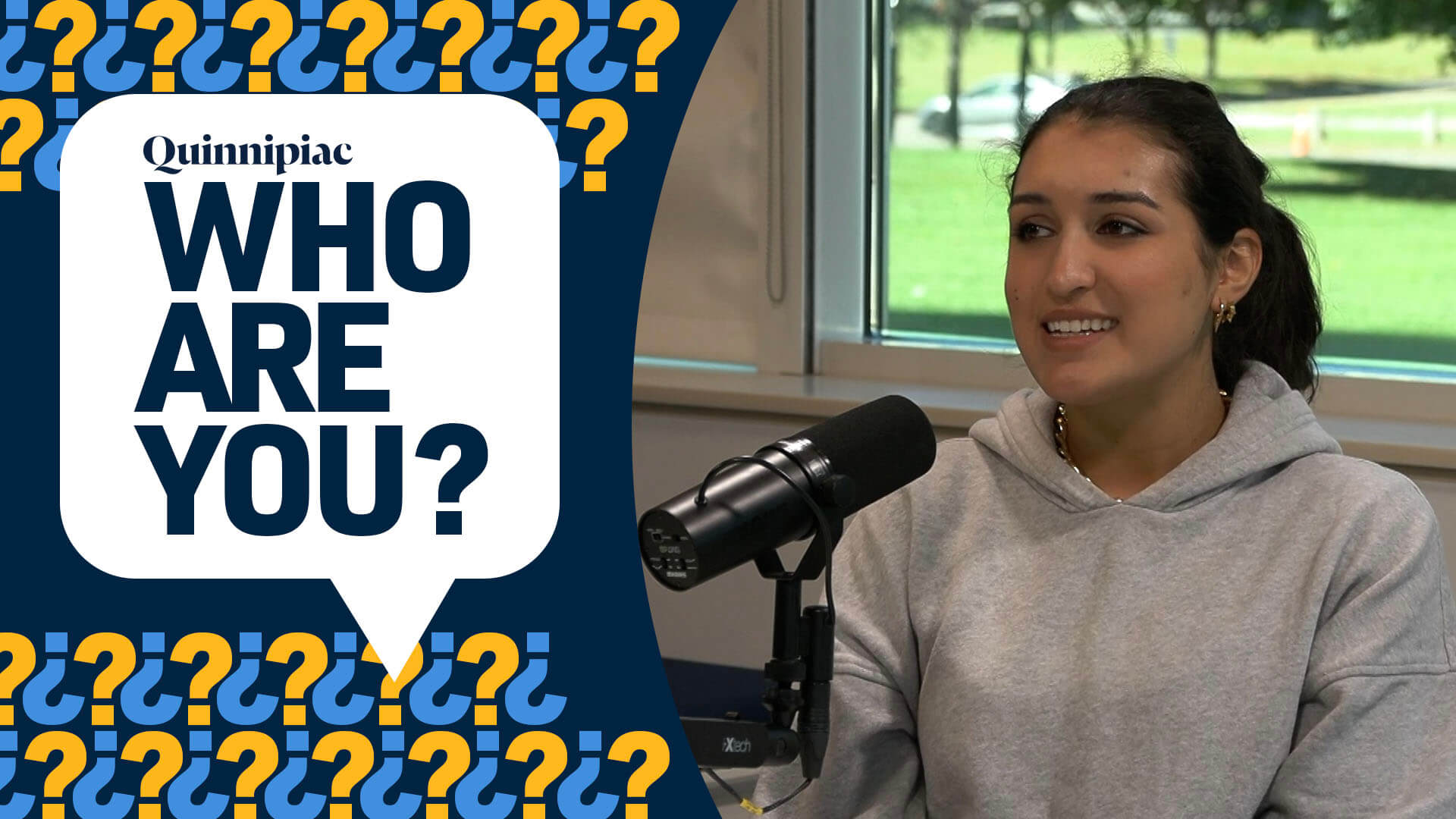
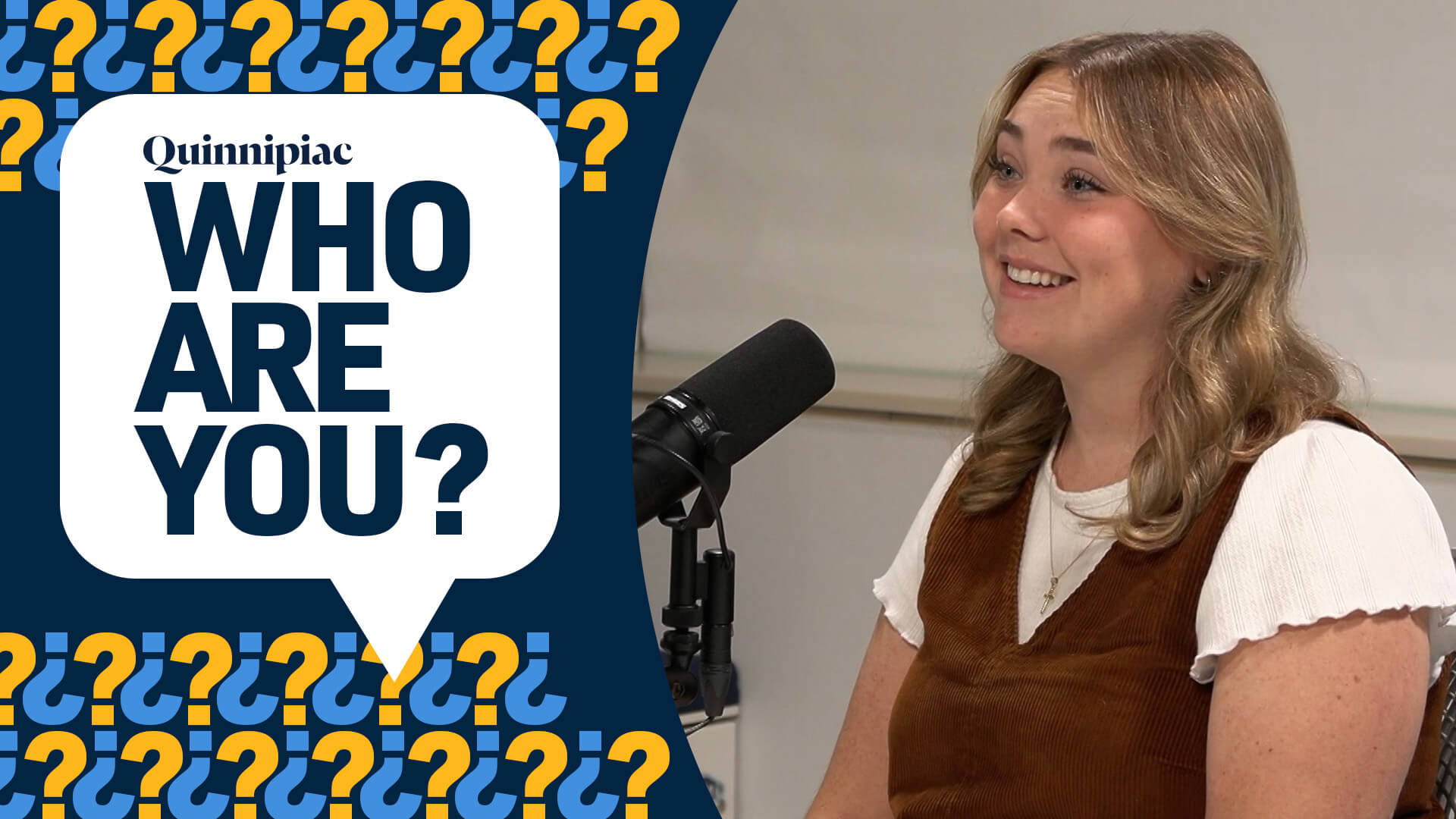
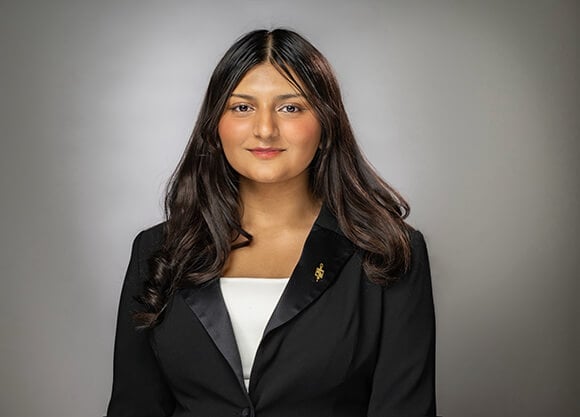
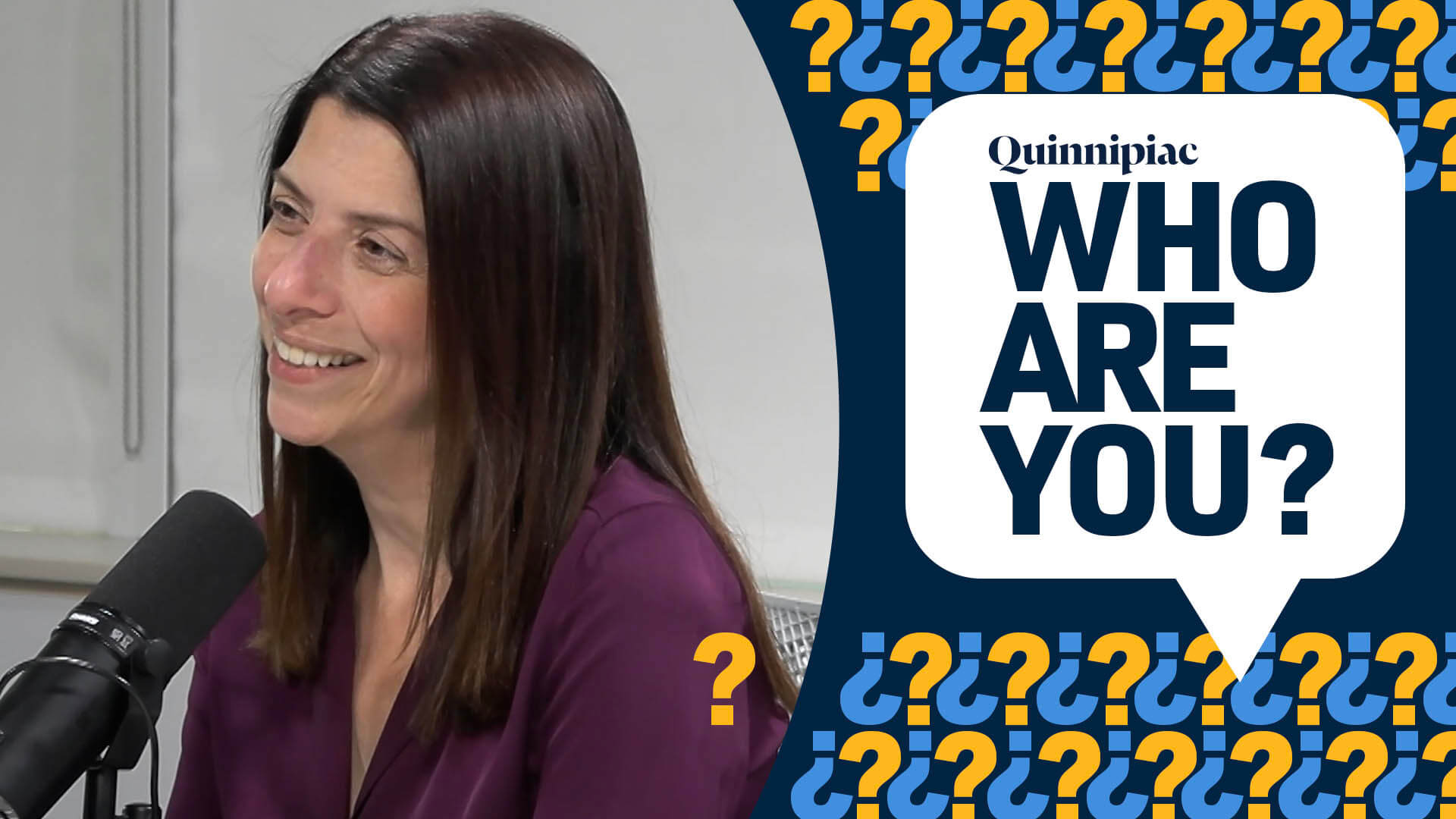
‘Who Are You?’ podcast with guest Maya Chattoraj ’28
How transferring to Quinnipiac helped her find her potential in biology
How transferring to Quinnipiac helped her find her potential in biology
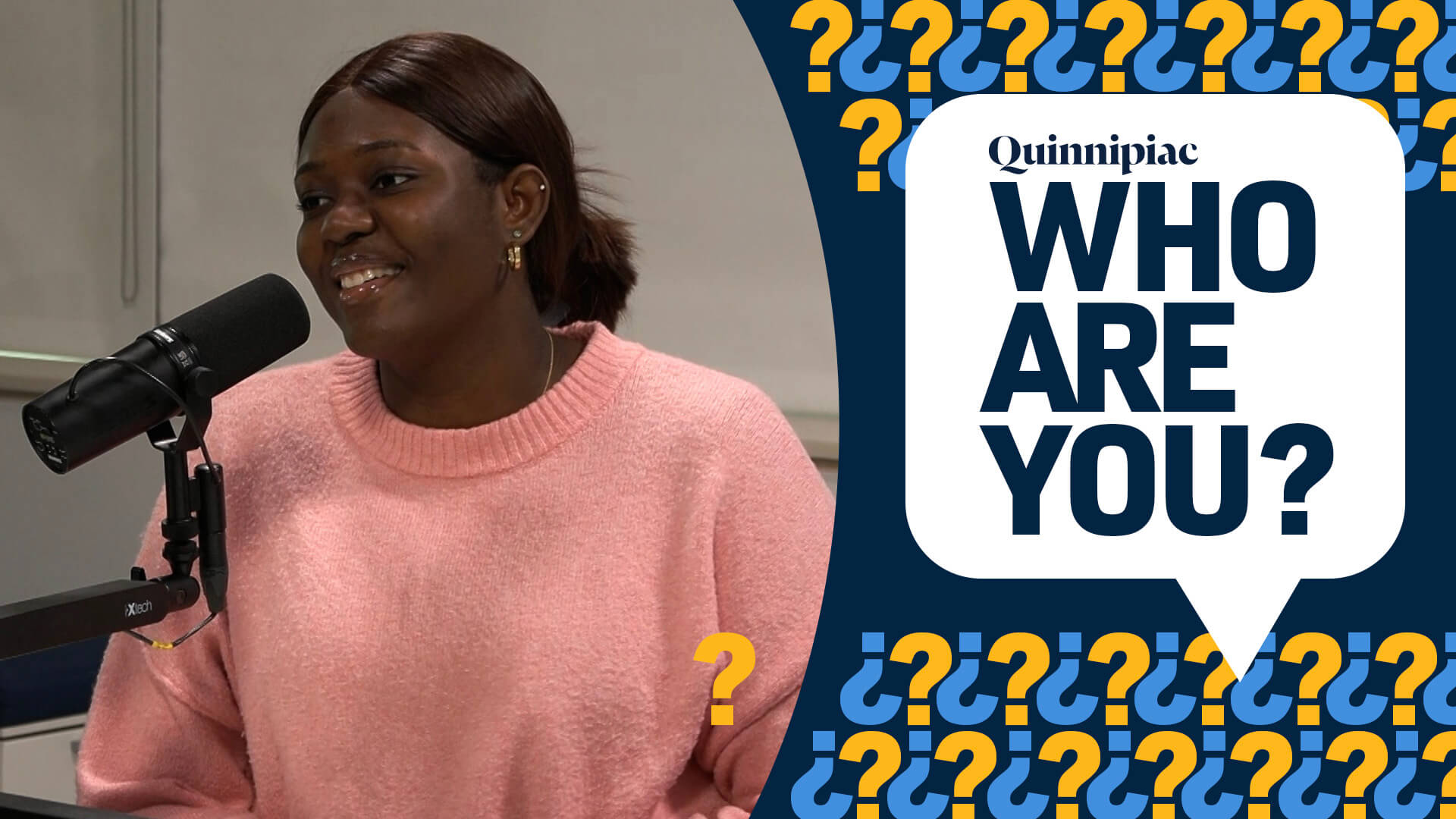
Joel Vanner: Hello, and welcome to ”Who Are You?,” the bobcats you know, the stories you don't. I'm your host, Joel Vanner, inside the podcast studio at Quinnipiac University School of Communications. And I'm joined today by my guest, Maya Chattoraj. Maya, welcome to the show.
Maya Chattoraj: Hi. Thank you so much for having me. I really appreciate it.
Joel Vanner: I'm happy you're here and happy to dive into your story and to learn more about Maya. So to get us started, tell me, who are you?
Maya Chattoraj: Um, my name is Maya. I am a biology major here at Quinnipiac and, you know, just, you know, here, a student.
Joel Vanner: Just here at Quinnipiac. Maya, we were talking before the show a little bit about your background and growing up. Your mom was an artist, a painter, and that kind of surrounded you as you were growing up, right? Tell us about Maya growing up. Where are we, and what were your interests and passions at that time?
Maya Chattoraj: Yeah. I grew up in Greenwich, Connecticut. My mother was, you know, is a painter. My dad, a lawyer. I kind of grew up in a very humanities-based household. I was a very creative kid. You know, I would do a lot of art. I was involved in a lot of theatrical pursuits, I would say. I always had an interest in the sciences. They kind of tend to overlap a lot, I'd say, which, you know, isn't really touched on, but biology was always sort of in the background of my mind. But, you know, growing up was musical-oriented. I did choir, you know, I did theater. I did art club. So growing up, I was a very artsy kid.
Joel Vanner: Finding all of your areas of passion, and your grandparents kind of introduced the sciences to you, right? A little bit of influence there as you were growing up.
Maya Chattoraj: Yes, definitely. My grandmother was, like, MD, PhD. She was a doctor, and my grandfather was a biochemical engineer, was a geneticist, essentially. So it was always interesting having that external influence of that besides my immediate family. They were both very passionate about their work. They did a lot of work in women's health. My grandmother was an OB-GYN. My grandfather worked on the in vitro fertilization project. So having that kind of mix with the artistic side of things growing up, it was very interesting to see.
Joel Vanner: So when you were in high school and looking for colleges, were you looking for the arts? Were you looking for biology? Kind of where did you get started? Because your story of how you came to Quinnipiac is an interesting one. But where did we start first?
Maya Chattoraj: We definitely started more in line with looking forward towards studying the arts or humanities. I didn't really think, for me personally, that STEM in any capacity was an option. I didn't—I wouldn't say I was stifled by my environment, but I definitely felt like, in some ways, it was such a—I looked up to people who did science so much. It was like such a grandiose—
Joel Vanner: Could never be me.
Maya Chattoraj: Could never be me. It's so difficult. It's so complicated. I didn't think that I was capable of doing it. And I love the arts, and I love humanities. So I was looking forward to studying in, I believe, at first, it was psychology and philosophy, and I did some art on the side. Yeah, that's really where I started out.
Joel Vanner: So throughout high school, finding your passion areas in art with your mom maybe as your mentor along the way, when it came time for colleges, was it art that you were looking to pursue, or was it another field? What was on your mind then?
Maya Chattoraj: At the time, I was very interested in art. I still am in humanities and the arts. You know, it is such a big part of my life. So actually, when I was looking at colleges, I ended up applying to and attending another smaller liberal arts institution. At the time, I really didn't think that I was capable or that I had the capacity to pursue sciences or STEM in any way because I, again, look up to people who pursue it so much because it's difficult; it's just a different endeavor.
Joel Vanner: Couldn't be me moment.
Maya Chattoraj: Yeah, no, exactly. It's difficult. It's hard. It's long. The path is, like, very direct. It's daunting. It's intimidating. I never thought I could, but I was always very interested in it. But no, I ended up in a different institution. I pursued psychology and philosophy, and I did some art on the side, a very conceptual pursuit. But eventually, as time went on, I believe I got to my sophomore year, just before that, I got really into sciences. I took an anatomy class for a semester, and I fell in love with it. I think that it really showed me that I was capable of pursuing it and that it was possible and that, you know, I did have the capacity to learn it, understand that stuff without feeling like, you know, like I wasn't good enough. So I actually eventually, you know, started looking at other institutions because the one I was at was a very free-flowing curriculum that didn't have a lot of, you know, funding put towards the sciences, and I wanted to give myself the best opportunity.
Joel Vanner: So with that new confidence after taking that course, right, pivoting, transfer student, looking at other options, what drew you to Quinnipiac and the biology program that we have here? Did you visit campus? Did you speak to faculty? What was your first introduction to Quinnipiac?
Maya Chattoraj: Well, first of all, it was the, you know, proximity. I grew up in Greenwich, Connecticut, and I wanted to, you know, stay closer to home. So that was the first thing. But what really drew me to Quinnipiac, first of all, I did actually visit campus. I actually had been here once before, not realized it. I hiked Sleeping Giant on Mother's Day when I was, like, 13. I didn't realize that this is where campus was.
Joel Vanner: Mom remind you of that, or did you.
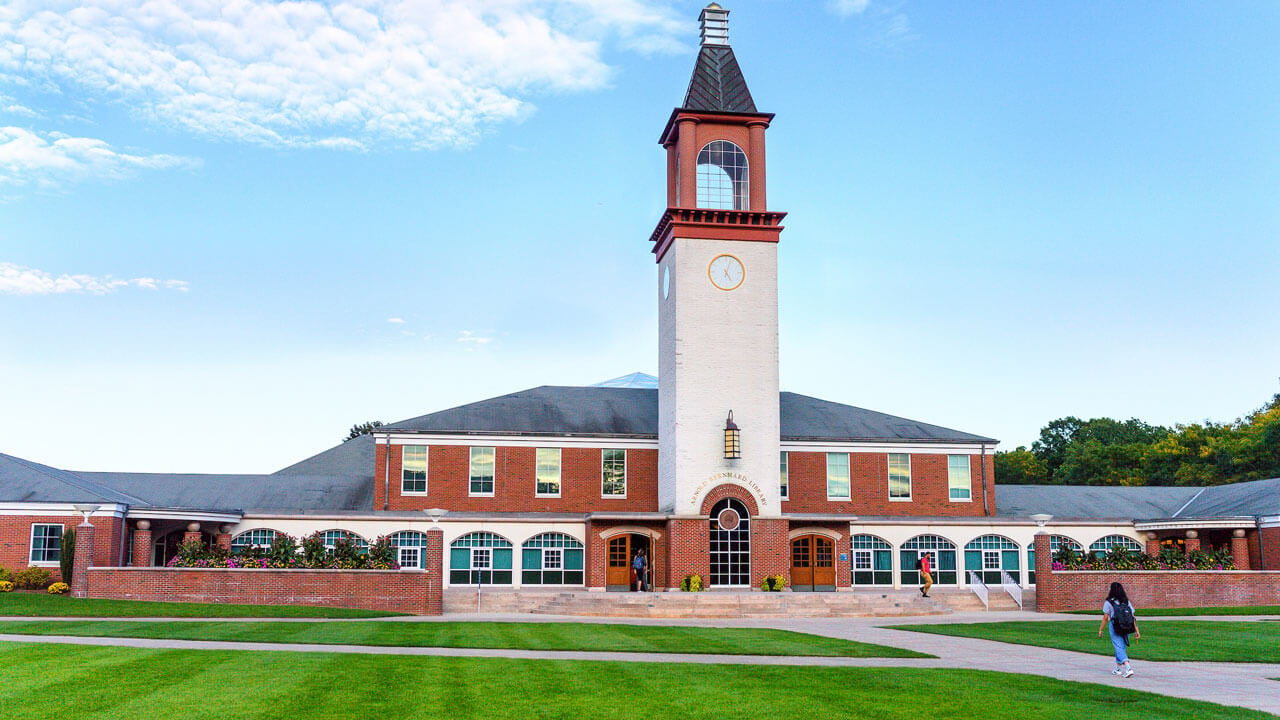
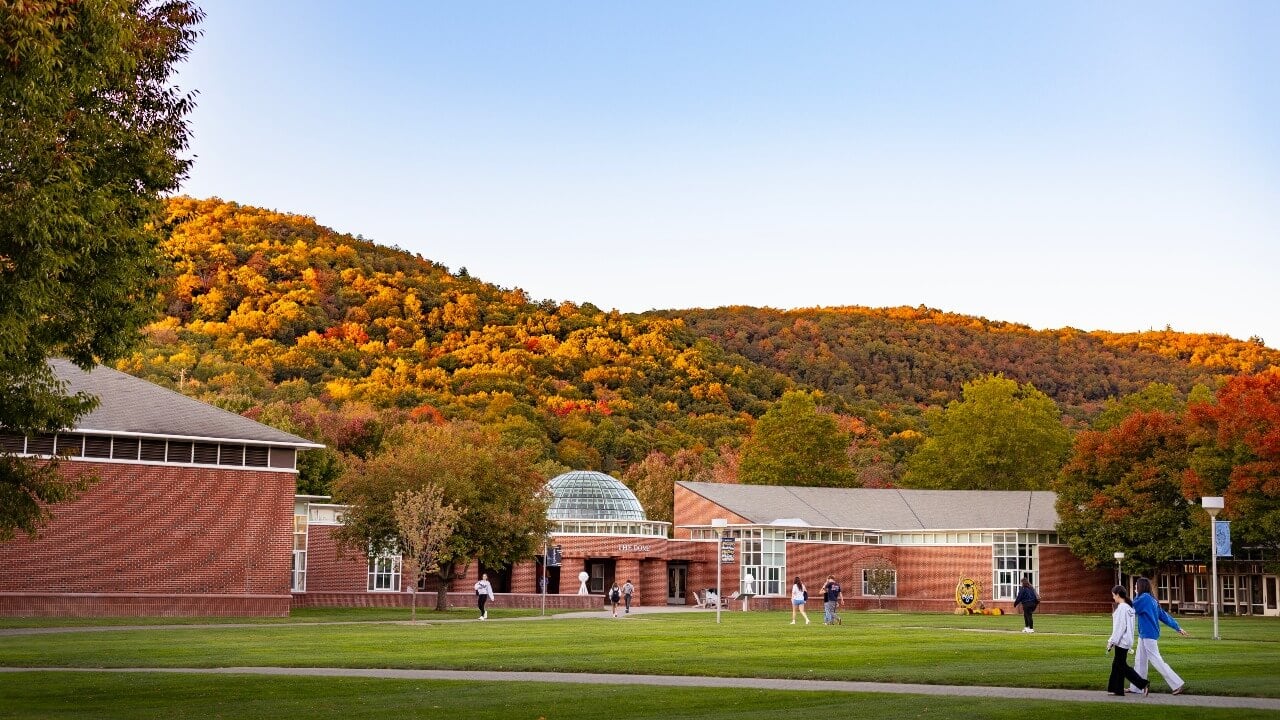
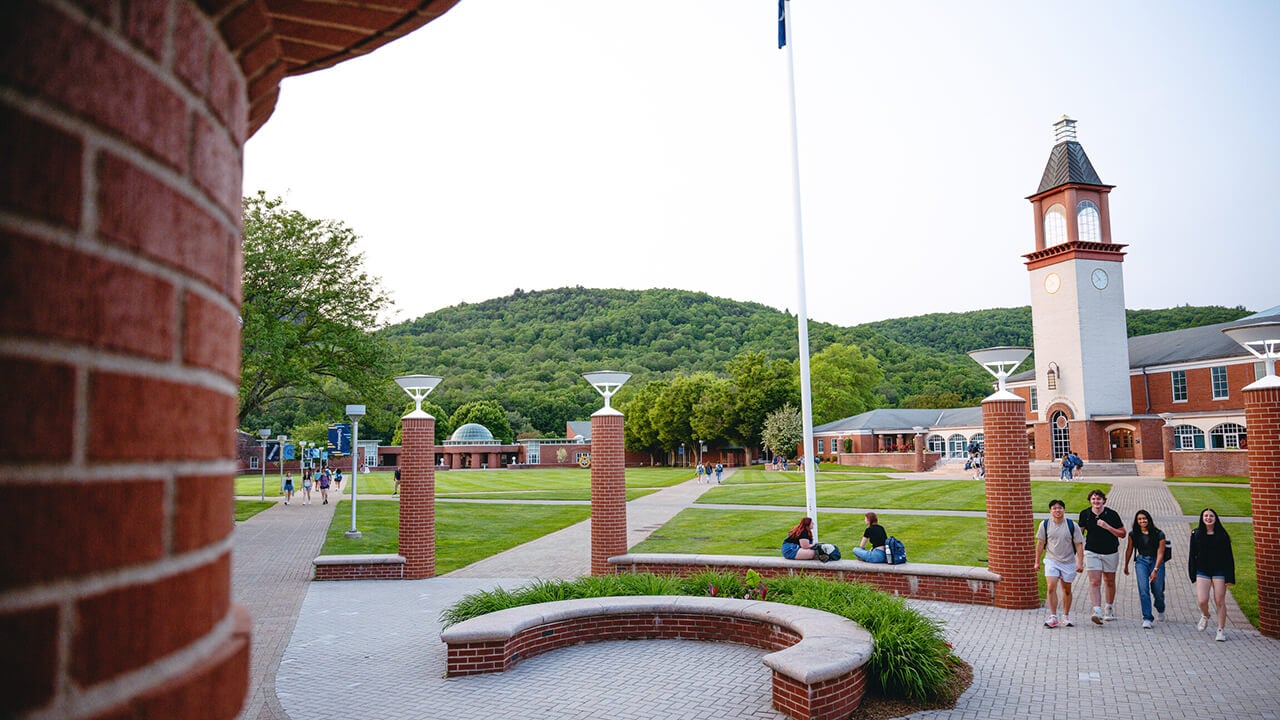
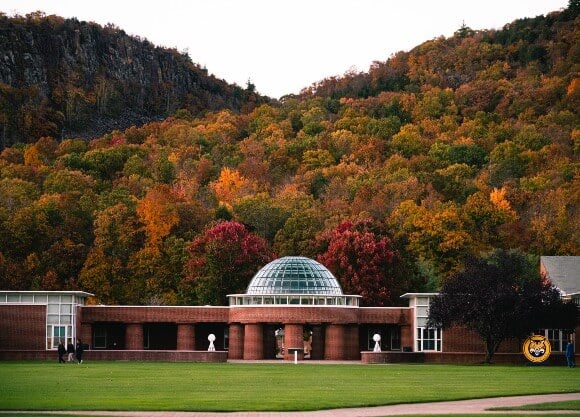
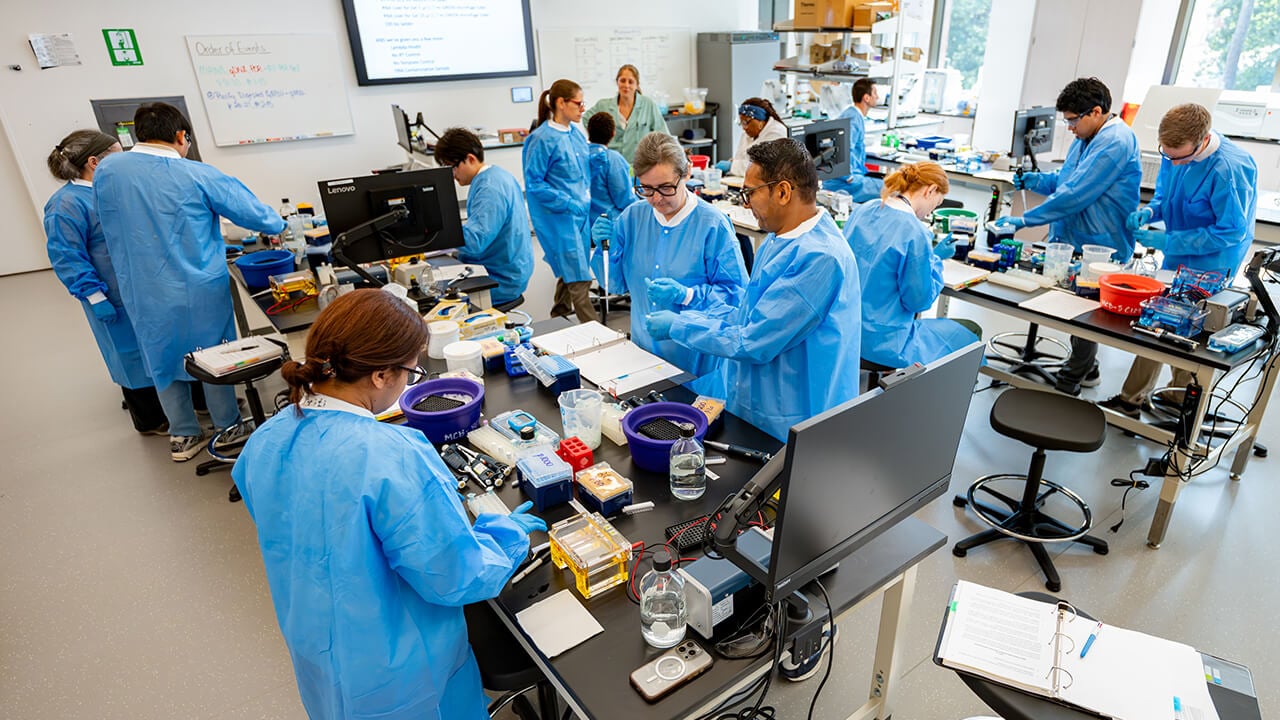
Maya Chattoraj: She totally did. She's like, "We've actually been here before." And so I visited campus. It's absolutely stunning here. It's massive. It's, you know, in the mountains. It's gorgeous. But, you know, what drew me into the biology program specifically was, well, you had so many options when you were, like, transferring in. I wasn't used to the idea of one university having multiple, you know, colleges. Like, they have the School of Nursing. They have the School of Business, College of Arts and Sciences. That was a completely foreign concept to me. And in a way, even though it wasn't like a free curriculum, having that structure with that specificity, um, it was really enlightening. And I really got drawn into the biology program because not only did they focus on, you know, what you'd expect out of, like, a science program, you know, the exams and, like, the classes and whatever, they also had other opportunities, like the experiential learning BIO 385 class is something that we do. And I thought that was really cool. So that's really what drew me.
Joel Vanner: So your transition from your previous institution here to Quinnipiac, you met with an academic advisor, and they probably helped plan out your courses, right? You mentioned the breadth of the schools and colleges that we have here at Quinnipiac. What was that process like? How was the guidance from your advisor in trying to figure out how you could obtain a biology degree, right, after not that long ago thinking that couldn't be me, right? So what was that transition like for you, and what support did you get along the way?
Maya Chattoraj: Quinnipiac was extremely supportive in my, like, endeavor to transfer. I knew going into it that it would be difficult because of how the credits were going to transfer over, but I knew that would be the same for any institution. However, you know, the people here at Quinnipiac, my advisor, everybody in the College of Arts and Sciences biology program really took it in stride and met with me multiple times over the summer before I came here. I was able to, using the credits I have, you know, complete some requirements for graduation. But they basically sat down with me, and they made me, like, a three-year plan. Like, okay, this is what you're going to do. This is how it can work out, or it doesn't have to work out like this. It's really, like, a collaborative experience, which I thought was really great because I had been so used to, like, a week before the semester started, you pick your classes, and, like, that's what you do.
Joel Vanner: Sounds like they kind of customized the program for you to fit what you were coming in with and then probably also your areas of interest and then the courses you needed to actually, you know, complete the program here at Quinnipiac. And it's not just that academic support, either. You lived in the transfer student living-learning community in our Mountainview residence hall as well. What was that like, having the academic support, but then after classes, going back to a residence hall where you were surrounded by other students who are also acclimating to Quinnipiac after being at another institution?
Maya Chattoraj: It was, it was a really great experience. I'm still friends with everybody, you know, that lived on my floor. That was something that I was really worried about, you know, as someone who's not a freshman. I had to come for orientation, and, like, what was that gonna look like? I'm older than everybody else. I've done these classes, but not these classes. And then to find out, oh, I'm in a room with all transfer students, and the people down the hall from me are transfers. It was really great to have that. Everybody, you know, had the same struggles and the same, you know, experience going into it. I think because of Quinnipiac, that process was just expedited, that, like, insertion and acclimation. It was really great. I'm friends with all those people.
Joel Vanner: And though you're not too far from home, having that community here definitely helps on those long days and, with biology, those hard classes that you have to get through. You mentioned earlier BIO 385, Explorations in Biology, which is a course where students in the biology program do internships or other experiences in the course, and then they create a digital story narrative media presentation. That class was transformative for you because it helped you explore a specific field that you may want to pursue. Tell us about that class and what you did for your internship and how that has helped you kind of narrow in on what your future may be.
Maya Chattoraj: Yeah, so for the BIO 385 experiential learning class, I did an internship or a shadowing experience, more specifically, at a dentist's office in my hometown. I didn't know that I wanted to pursue dentistry. I came here actually as pre-med. I didn't know pre-dentistry was, you know, an option, again, because I wasn't used to that.
Joel Vanner: Which we have an advisor, Anna Gilmore, who advises pre-dental students here, as well as pre-medical school students here at Quinnipiac, so that they can help with the application journey. But go ahead. I interrupted you.
Maya Chattoraj: No, totally okay. I did the Merit and Medical mission. It's—Anna Gilmore sent out an email that had, like, this volunteer opportunity, and I went, and I did it, and they had a dental section. And that's kind of what got me into it at first. And so I wanted to explore that more. So when the 385 opportunity came up, I had already gotten the offer for a shadowing program, and my advisor, Professor Michael Midgley, actually told me, "I know your credits are a little off. You haven't completed this prerequisite, but you've done other biology classes at this other institution. I think that you should do the program. Like, I'm going to see if we can get you into it." And I was like, amazing, because I was already going to do the shadowing. I might as well get my experiential learning, you know, settled with. So I did that, and it was an amazing experience over the summer. I got to work with a dentist who not only was just a general dentist who specialized a little bit in implantology, not using a lab, using their own equipment. And I did a digital narrative based on the patient and, you know, practitioner communication side of things, but also I involved a bit of anatomy and the implantology side of things, which was very interesting to see. I wouldn't have been able to do that, or I wouldn't have known I wanted to even do that if I hadn't come here.
Joel Vanner: And the customizability, right, for lack of a better word, of the program allowed you to have that experience through your advisor, Michael Midgley. The digital narrative is part of the course. The internship is also part of the course that you're getting credit for. What was the course like? You had other students in the course? What did you do? And how did the course operate?
Maya Chattoraj: I think that it was a way—it was great because it kind of held everybody accountable to think of it, you know, not as just, like, a clock in, clock out, like, do this thing, and be done with it. It really allowed everybody to analyze what they were doing. Every week, we had, like, a discussion board, and, like, the first half of the summer was really talking about observing what we were doing, how we were doing it. What were these steps taken to do those things? For me, it was the ins and outs of, you know, the dentist's office and the administration side of things versus the clinical side of things. And eventually, you know, halfway, kind of get more into the preparation for the digital narrative. So it was scripting it and, like, blocking out how you're going to do it, the music, the recording, all that stuff.
Joel Vanner: So it's very guided along the way. And then at the end of the course, you have something you could maybe show to a potential employer or add to a portfolio or just have for your own record of, I did this experience, you know, and I can share it far and wide. How do you think that experience, your experiences in biology overall, and your passion for dentistry have prepared you for your next steps after Quinnipiac?
Maya Chattoraj: I think that it's prepared me quite well. I think Quinnipiac offers students the opportunity to integrate not only what they want to do, like, as a student on campus, you know, that lifestyle, but they also integrate, you know, possible career opportunities, the future. Like, what does that look like without it being super overwhelming? I think that for me personally, going into, you know, this new environment, this new place, all these new experiences, it's really prepared me for dental school. It's also a huge endeavor, but they've also introduced me to a new program that they're developing right now, a bio four-plus-one program with an MBA, specifically for students who want to either go into medical sales or the administration side of things, which, of course, a private practice would have. So it's all just conglomerating into one central idea, even though it feels like a lot of little things at once.
Joel Vanner: Was that something—so it's four years, you earn your degree in biology, and then your plus-one year, your Master of Business Administration, your MBA. Was that something that you ever thought you might be interested in, or you even knew was possible before you came to Quinnipiac?
Maya Chattoraj: I knew medical sales was a career that you could go into. I had always imagined it would be, you get your bachelor's, and then you apply elsewhere, two more years, you get your MBA, so on and so forth. So the answer is no. I didn't know that Quinnipiac would have a program that would allow you to expedite that process and integrate it with your bachelor's experience. It's kind of like a new thing that's up and coming because a lot of students would, you know, want an expedited process instead of, okay, then I have to apply to the master's program, and then I have to do two years instead of one. So again, they're coming up with new programs, like, yearly. This was just discussed last spring. So it's amazing to see when you go to an institution that they are being innovative, they are coming up with new things because of what students ask for.
Joel Vanner: That sounds like an awesome opportunity. Looking back on your time here at Quinnipiac, what advice would you give? We'll start with students who may want to transfer to Quinnipiac or just transfer schools generally. What advice would you give them as they're starting to maybe think about that and maybe a little bit overwhelmed?
Maya Chattoraj: Um, I think that a lot of times you think of the social compared to the program. I personally, my social life was a secondary thought to me when coming here. So I just really liked the programs here, but I think that Quinnipiac does a really great job, like, integrating you, like, a social group, like, your friends and your classes. Like, the way that they handled it was great. I don't think that anybody that transfers here should worry about, you know, really making friends. Like, I made so many memories just in my first week.
Joel Vanner: The living-learning community, the transfer student orientation that you go through before you even come to campus as well, and then your academic advisor helping you out along the way. There's a lot of support. My second question to you about advice would be advice for someone who is considering studying biology, but maybe they don't know if it's for them. You overcame that "it's not for me" moment, right, when you took that anatomy course. What advice would you give them to actually give biology a serious consideration if it's for them?
Maya Chattoraj: Yeah, I would, you know, suggest taking it slow. Like, if you have that interest, especially depending on the program you're in, like, if there's a way to take, like, a one-credit class, which is what I did, just to kind of see if you like it, I would try to talk with your advisor when making your schedule, just to try it out, see how it goes. Like, if it doesn't work out, withdraw from the class. Like, it's totally fine. But if you end up really liking it, I think that it's really just about self-advocating. And everybody here at Quinnipiac is very, you know, they will help you. They will get you where you need to be. If you want something, they will try to make it happen. That's what I've experienced personally.
Joel Vanner: And nothing good in life comes without a little bit of hard work, someone once said to me. So, Maya, thank you so much for joining me on this show. I really appreciate it. It was great to hear your story here at Quinnipiac and look forward to your future successes.
Maya Chattoraj: Yeah, thank you so much. I really appreciate it.
Joel Vanner: If you enjoyed today's episode, be sure to subscribe and share, and find other episodes on Apple, Spotify, and YouTube. Until next time when I ask my next guest, "Who are you?" I'm Joel Vanner. Bye for now.


Quinnipiac Today is your source for what's happening throughout #BobcatNation. Sign up for our weekly email newsletter to be among the first to know about news, events and members of our Bobcat family who are making a positive difference in our world.
Sign Up Now