



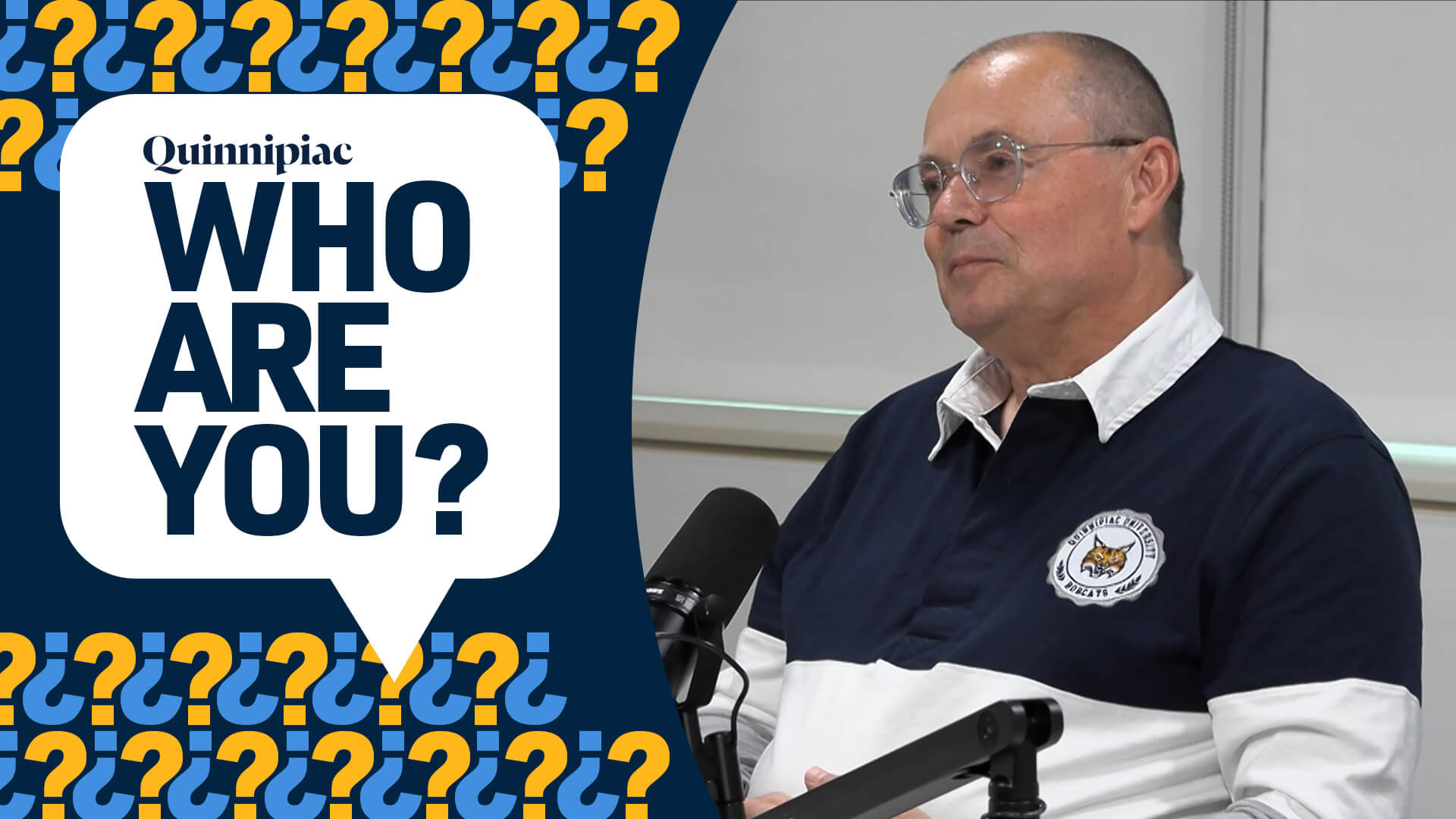
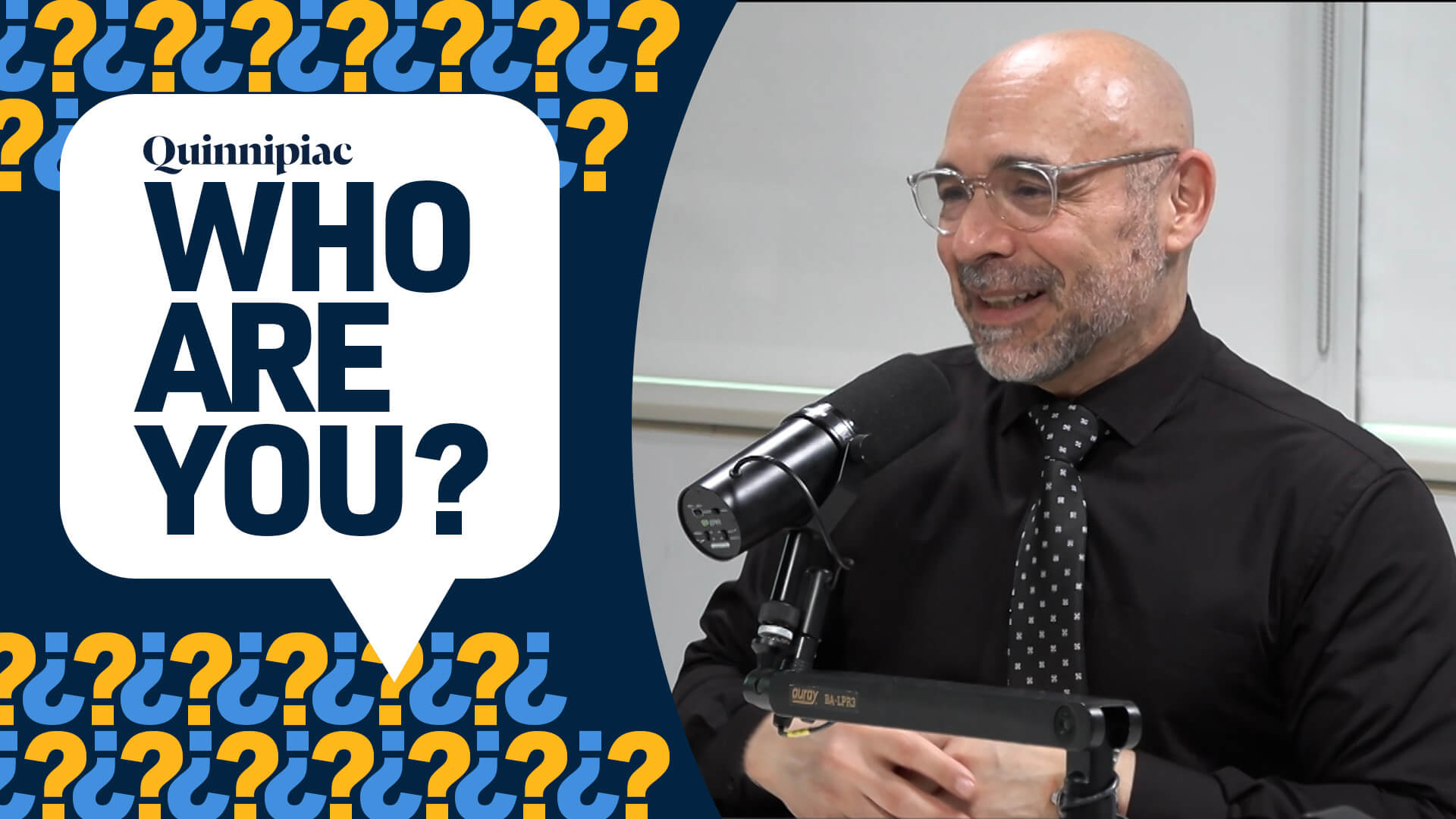
‘Who Are You?’ podcast with guest Professor Alan Bruce
The impact criminal justice students have in and out of the classroom
The impact criminal justice students have in and out of the classroom
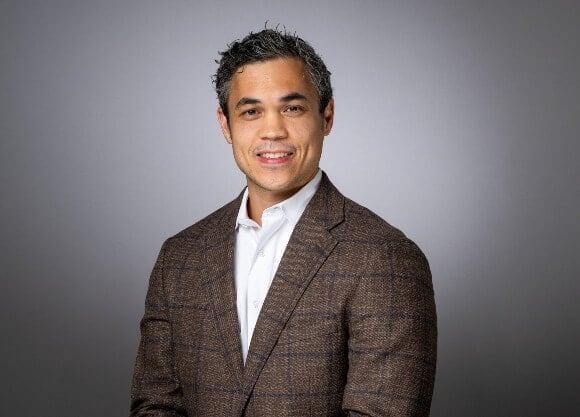
Hello, and welcome to ”Who Are You?,” the Bobcats you know, the stories you don't. I'm your host, Joel Manner, inside the Podcast Studio at Quinnipiac University's School of Communications, and I'm joined today by my guest, Alan Bruce. Alan, welcome to the show. Thank you. It's very good to be here. I'm sure you could guess by the name of the program, what my first question to you is going to be. And that is it's a hard one. Yep. Who are you? Good question.
So well, I am Alan Bruce. I'm a professor of criminal justice in the Department of Justice and Law. Um, I have been at Quinnipiac since 2001, so I've seen our criminal justice program grow over considerable time. I'd also say I'm a musician, father, pet owner. But those are non Qu things. What instrument do you play? Just I play bass guitar.
Okay, cool. Yep. I used to play the trumpet, but I gave it up. I was no good. Oh. But anyways, back to you, 'cause you're the guest. Um, take me back. How did you get interested in criminal justice and law? What was your first experience like?
Yeah. So my interests come from so I grew up in Scotland, and I have this sort of distinct memory of being brought up in a family where you know, you respected the justice system, you respected police, and there was never any question that things weren't done properly. And I've got a really distinct memory, and I looked it up before I came so I could pinpoint the year. So it was 1989, and it was the release of a group called the Guilford Four. And they were, um, Irish men who had been wrongfully convicted of two pub bombings in Guilford, London, and they were convicted. They had been sentenced to, I think it was 15 years before they were shown to be wrongfully convicted. And I remember watching TV and watching these guys come out of court and thinking, well, that can't be right, and come to find out that the police had beaten them. They had fabricated evidence, had done all sorts of things to coerce wrongful convictions. So I've got this really clear memory of, well, the justice system's not what I think it is. And so that was what really got me interested.
How did having that experience, how did that take you to the next step to pursuing an education in the field?
So I then began to, you know, generally be more interested in criminal justice issues, and I became interested in not only, as I've said, reactions to crime, and the fact that incredibly, we would manufacture evidence to convict the wrong people. But then I also got interested in, you know, causes of crime. And so that led me to university I did a bachelor's degree in Scotland, University of Aberdeen in Scotland, in psychology. And even though that wasn't crime focused, it was always in the back of my mind that it was related to crime. And so as part of my psychology degree, one of the things I was involved with was a project one of my professors was doing at the time to create better eyewitness identification kits. So they were in the process of moving from kind of the old jigsaw purtle type identification kits to the sort of more video type kits that we're used to seeing today. So that was something that I was interested in and got a chance to do just a tiny bit of work on while I was an undergraduate.
Along the way, as you were getting this experience in education, did you think you would return to the classroom to be a professor? Where did you think that path was going to take you?
So all I knew was that I wanted to study crime, and I got my bachelor's degree, and I applied to a number of schools in the United Kingdom. And at that time, criminology had not really become discipline in the UK. And so, you know, the obvious place to go if you're looking to study for crime, excuse me, if you're looking to study crime outside the UK would be the United States. So I applied to universities over here that had criminology programs and was fortunate enough to be accepted into one. So came over initially to do a master's degree, not really thinking about teaching, but came to do a master's degree, fell in love with it, decided to stay, do a PhD, was doing some teaching while I was there, enjoyed it. And so that's how I got into the teaching.
So you've been at Quinnipiac since 2001. How have you seen our criminal justice program grow since you first joined it?
Oh, boy. So when I was hired, I was hired as the second person in the criminal justice program. And one of the things that attracted me to Quinnipiac more than anything was the opportunity to build a program at a university that had a commitment to the program and also had resources, you know, for that program. One of the things that we've been very deliberate about with our criminal justice program is to take the approach that we're, we're not a training program. We are about educating people to think about the justice system, think about the different roles within the justice system, so that when people go out into the field, they're going to be able to be more effective at whatever position they take. So one of the things that we've done is we've developed a lot of unique opportunities for our students that address areas of the justice system that they might not get access to at other schools. So while you're here, you know, you're going to be exposed to, you know, the courts to policing and, you know, sort of traditional criminal justice issues. But one of the most rapidly growing areas in the criminal justice field is the area of re entry, and this comes about because we know that over about a ten year period, the research shows that around 80% of offenders are arrested within ten years after they're released from prison. So one of our problems with crime is that folks are coming out of prison and they're getting involved in crime again. So one of the questions is, well, why is that the case? And so we have got heavily involved in the area of re entry, which is trying to work with people to find out what the obstacles are that they face that leads them back into crime. And so that's one of the things that we do. And so if you are, let's say we have a student that wants to go into policing, what better way to improve your policing mind than to interact with people who are trying to return to society, finding out about their challenges, finding out about, you know, how to navigate the world with a criminal record?
Are some of the programs that students can participate in while they're studying criminal justice here at Wini pack that kind of help them get that real world experience while they're here?
Right. So one of the things that we've been doing for a number of years now is we are part of the National inside out movement, which is an educational program that takes outside students into a prison and teaches a seminar with prisoners who have the necessary education to take college level classes, and we place the students and the prisoners together in the classroom. They complete the class together. And the students, they describe that as transformative. And so that's one thing that we do. We also, you know, we do field trips and things like that. More recently, I've developed a program that deals with pardons. So in Connecticut, in recognition of the fact that people return to crime to a large extent, because of the challenges of living with a criminal record, Connecticut has been very progressive in passing legislation that allows people to get an absolute pardon three years after a misdemeanor, five years after a felony, which allows them to say that legally, they've never been convicted of a crime. And what we do here is we work with our students through a course I teach called the Power of pardons. In which students are taught by a member of the State Board of Pardons and Parole on how to complete a pardon application. And then subsequently, I have contacts in re entry organizations who will refer indigent people who are eligible to apply for pardons to us, and our students can then provide them with free assistance on how to complete a pardon. And so what's in it for the students? Well, again, it's skills that they're not typically going to get. So they will be handling, you know, arrest reports. They will be looking at criminal background histories. They will have practice navigating, you know, the pardon board website. And then, ultimately, they will spend probably about an hour in one on one. Well, I should say two on one because I'm always there, but I try to have the student lead, if I can, a meeting with the pardon applicant to get the final details about their pardon. So that's one of the, you know, unique programs that our students can get involved in.
So you're having real world experience, and you're actually making an impact, too, while you're still studying here at Quinnipiac criminal justice program.
Right. And it doesn't with the pardons, it doesn't go. I never goes, you know, it's never a straight line. Okay? So somebody can start a pardon, someone can be working on their application, and then all of a sudden, they just stop you know, they just stop communicating and goes away. But we've had we've only been doing it a little over a year. It takes about six months to put together an application in about six months to have that go through the Board of Pardons and parole. And we just had a couple of weeks ago, we just had our third pardon granted. And that's life changing. So like you said. It is. It's transformative. In fact, the last one I had the pleasure of she had an expedited pardon, so she didn't actually have to go in front of the pardons board. So because I submitted the application, I got notified, so I actually had the pleasure of calling her and telling her, Yeah, you've just been granted a pardon. And it is it's absolutely transformative.
I think when we turn on the TV and we pick one of our favorite crime shows, right, it's in 1 hour, start, middle, and it's very procedural, right? There's a process to it. What are some of the ways in your courses you help students recognize that the field of criminal justice is not what you see on TV. There's many different aspects, and it's different.
That's a good question. And I spend a lot of time in especially my intro criminal justice class. Also a class I teach called crime and Media. We spend a lot of time basically answering that very question. And so we, you know, students encounter people who are either justice involved or they work in the justice system, so they hear directly from practitioners about what it's like. And then we also spend some time looking at mass media and media coverage of crime and address questions about, well, why, as you say, why are all those crime shows the same, right? And then, people begin to realize, Aha, there's a formula that doesn't represent what's actually happening.
For students who are interested in criminal justice, what would be your recommendation to take the first step and find out if that is the field for them? What do you think they need to come in with the mindset of?
I think that they have to come in with, you know, this sounds like a cliche, but they have to come in with an open mind, right? And one of the things that I talk about in my classes is, if you've studied physics, right, you've studied it in high school, how do you learn physics? Well, you learned it from a trained teacher that knows about physics, et cetera, et cetera. And even although you might not like studying physics, you don't hate atoms, right? You don't hate gravity. Whereas with criminal justice, how do people learn about it? Well, they typically don't learn about it from, you know, a qualified instructor, excuse me, instructor who's objective. And crime is very emotional. So they come in, and, yeah, they hate quote unquote criminals, or they hate quote unquote the police. And so you got to have students that are willing to have an open mind when they come into this so that they can actually look at material and think about it objectively. And one of the things that we really stress with the program is sort of asking the question, why, right? So you could, you know, you could take almost any aspect of the criminal justice system. But, for example, you know, why did we respond to, you know, drugs in the 1980s, as a crime problem. Why did we not see it as a public health problem, where, you know, in the same way that we see the opioid crisis more as a public health problem today. So we really encourage anybody that's coming in. We hope they have an open mind, and we encourage them to be prepared to think about how they've come to know about the justice system.
I think, too, in the age of AI and the different ways it's changing the world, in the criminal justice program, it sounds to be very person centric developing those people's skills through the inside out experience, and then also your part in class two, learning how to interface and interact with different people and just growing those skills that you have.
Right, you know, to that point, we are very, um we're very deliberate in breaking down this idea that there's an Ocen to them, right? It's, you know, obviously, there are outliers. There are people that commit, you know, utterly heinous crimes. However, when we're talking about the most typical crime, we're not talking about an OSN to them. And in fact, I do this in my intro criminal justice class. In some instances, when I do anonymous surveys, what you actually get is you get people that have done some of the same things but didn't get caught. I could be them. Exactly. Right. So we really work hard to make people understand the sort of the human part of it. And I think that to go back to the inside out program that Professor McGuinn deals with that experience of going into a prison. And if you think about it, the money that we spend on prisons in this country, but yet, most people have absolutely no idea what we're getting for our buck because they never visit a prison. And just the actual experience of going into a prison by itself is transformative.
What is a typical journey of a criminal justice student through the program?
So when students come into the program or they declare a major once they've been here, they're going to start off. They're going to take some core classes that everybody everybody in the major takes. And as part of those core classes, we have a research methods requirement, which, you know, emphasizes the scientific approach for study of crime. So, you know, we need to make decisions that are based on data and, you know, not assumptions. We need to we need to be able to measure accurately and so forth. Then once they get beyond the core classes, or while they're completing core classes, they can begin taking electives. So we've got one group of electives that's called criminal justice in practice. And this is a group of courses that focuses on all kinds of different areas within the criminal justice field. So for example, correctional counseling, um, you know, women in the criminal justice system. And so there's a lot of opportunities for people to pursue their interests in that area. And then we have a group of courses under the heading of crime typologies, where people study different types of crimes, so that can be sexual violence, it can be organized crime. There are all kinds of different courses within that. And then students are required to do two electives. And again, we provide a lot of choice. So things like everything from crime and media to restorative justice, it really does give students a wide variety of choice. Um, when a student gets into their junior year, they are eligible to take an internship. We do provide require, I should say, an internship preparation course, which we found to be very valuable for our students. And students that are interested in an internship, what they would do is they would contact our internship coordinator. We have a conversation, find out what the students' interests are, and then we help identify sites that really fit with a student's interests. What we don't do is we don't place people. And so one of the examples I always use is, years ago, I had a student that was interested in criminal investigation, also interested in working with people with disabilities. At that time, I was the internship coordinator. So we sat down. We had a meeting, and we came upon the Connecticut Office of Disabled Advocacy. Well, what does that office do? One of the things that they do, I don't know if it still exists, at that time, one of the things they did was investigations into allegations of maltreatment for people with disabilities. So we were able to set that student up with an internship that have checked the box for investigative work and checked the box for working with people with disabilities. So we take the internship, we take it seriously.
Program, it offers something for someone who may know the field of criminal justice they want to go in but it sounds like if somebody's just interested, overall, they can really personalize it to what they would like to learn and experience.
Right, absolutely. And one of the things that, you know, I think is really important is if you want to go into a particular area of criminal justice. So let's say, for example, you know, you just decide, you want to go into police say, Well, it's a really good experience to take a course in corrections. We try to encourage people to get exposed to what they're gonna be dealing with when they graduate.
Well, Alan, thank you so much for joining me on the show, sharing the Criminal Justice program and the ways you've impacted it and the different opportunities there for students. It was great to have you on today. Oh, thank you. It's a pleasure. If you enjoy today's episode, be sure to subscribe and share and find other episodes on Apple Spotify, and you do podcasts. Until next time when I ask my next guest, who are you? I'm Joel Vanner. Bye for now.











Quinnipiac Today is your source for what's happening throughout #BobcatNation. Sign up for our weekly email newsletter to be among the first to know about news, events and members of our Bobcat family who are making a positive difference in our world.
Sign Up Now