


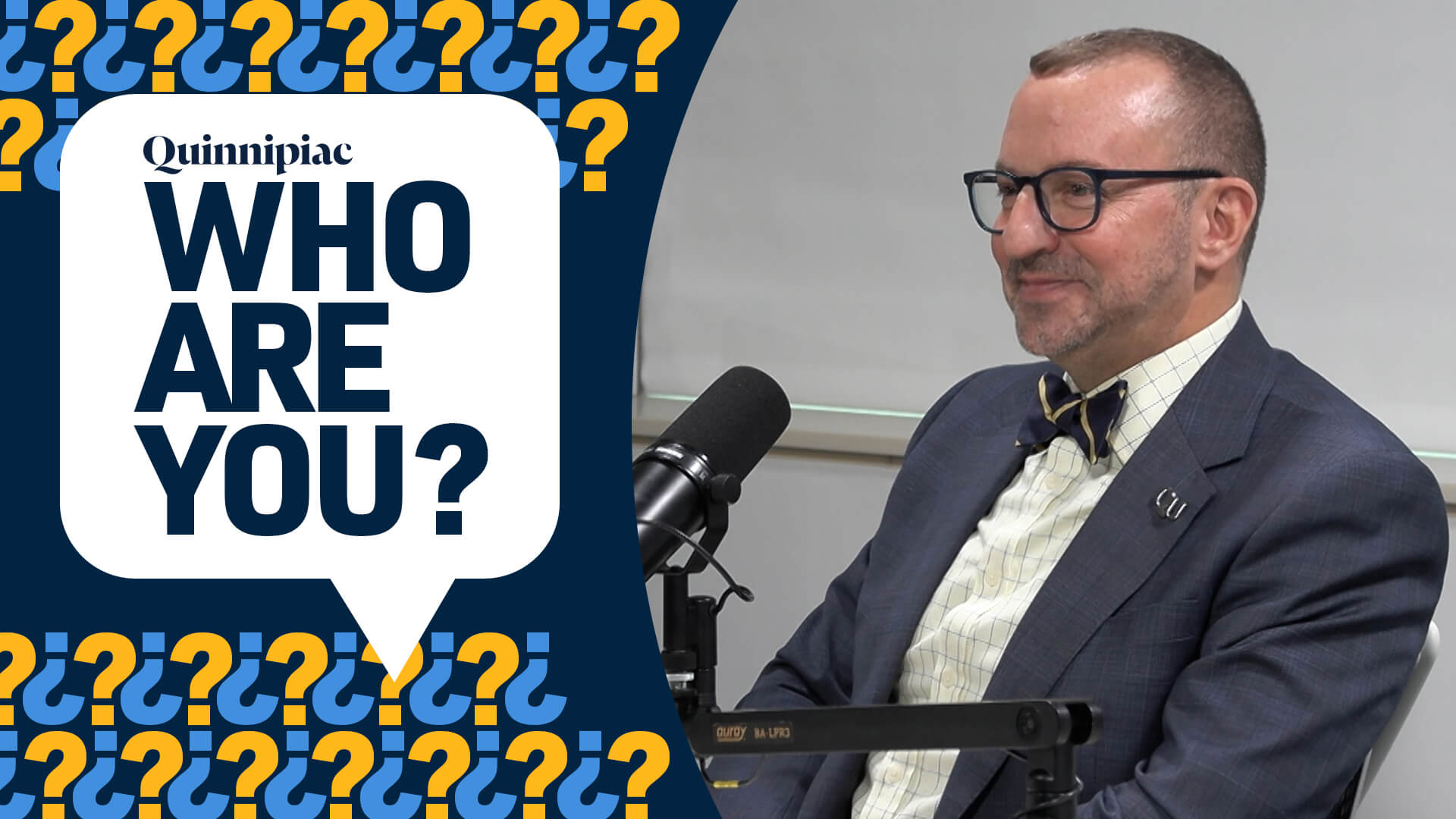
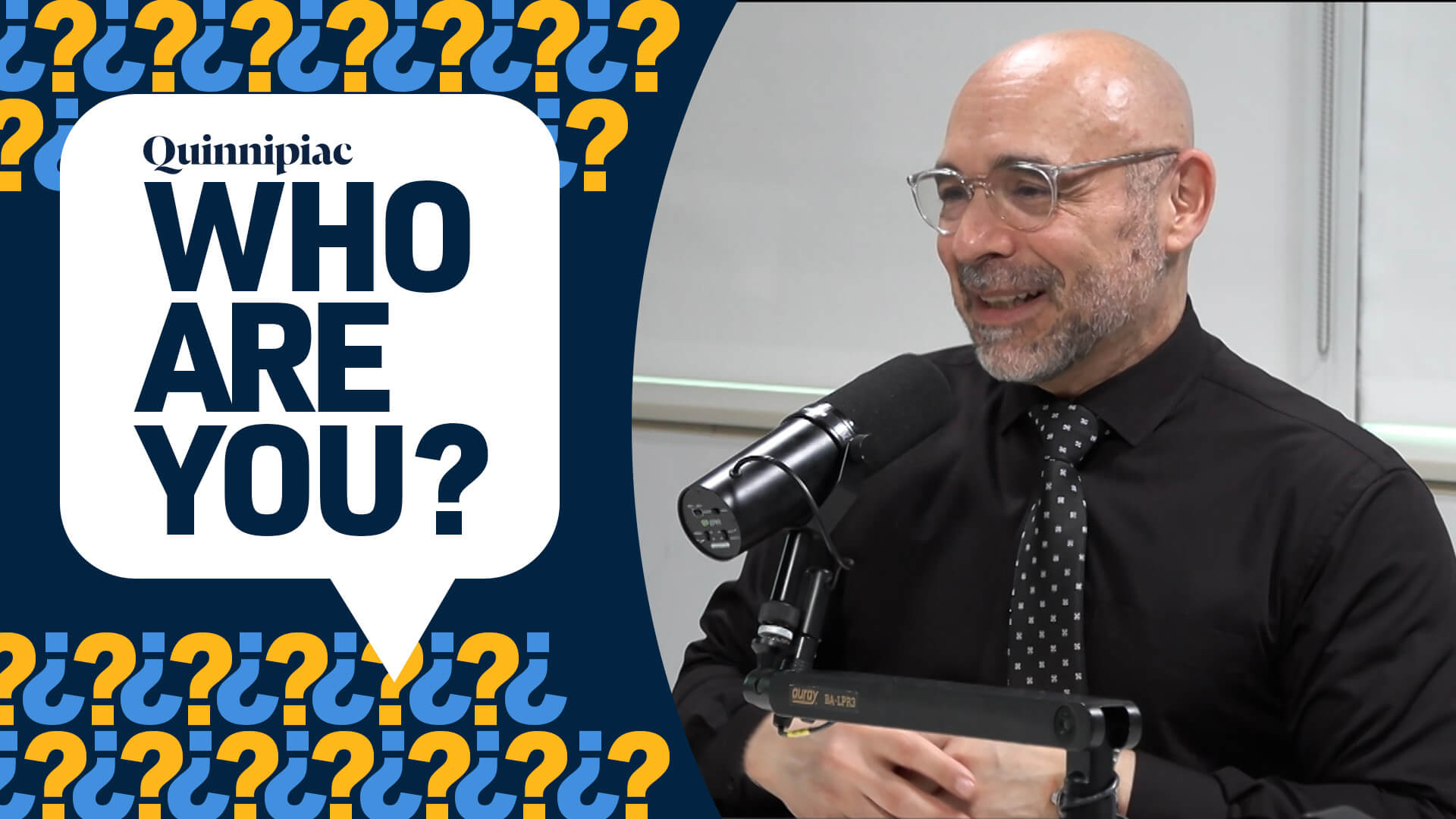
‘Who Are You?’ podcast with guest Dean Larry Slater
What makes Quinnipiac’s School of Nursing unique
What makes Quinnipiac’s School of Nursing unique
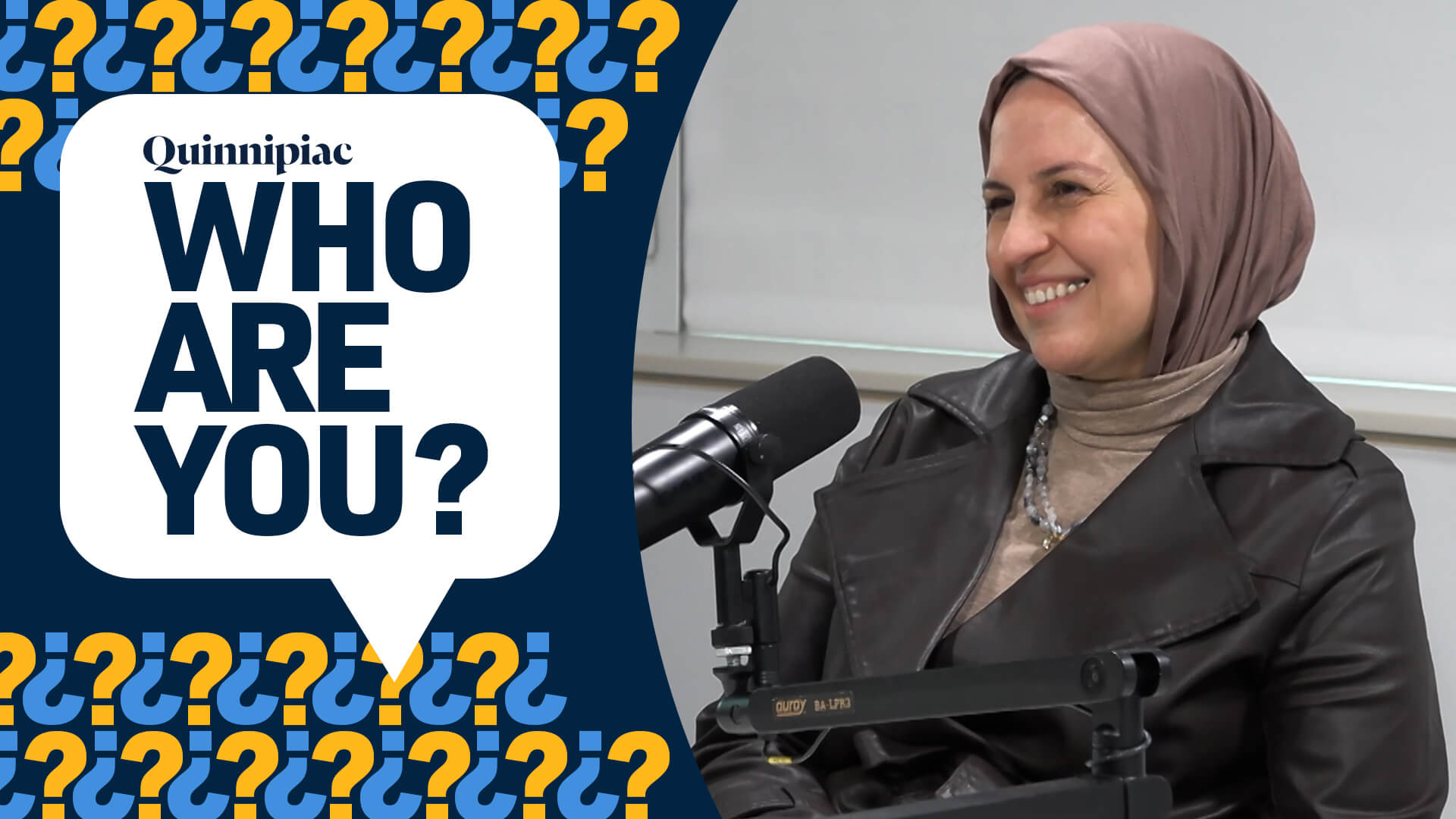
Joel Vanner: Hello and welcome to ”Who Are You?,” the Bobcats you know, the stories you don't your host Joel Vanner inside the podcast Studio at Quinnipiac University's School of Communications, and I'm joined today by my guest, Dean Larry Slater. Larry, welcome to the show.
Larry Slater: Thank you. It's great to be here.
Joel Vanner: So, I introduced you as Dean, but I didn't say what school. So for our listeners, here's my first question to you. Who Are You?
Larry Slater: I am a nurse at heart by profession. I've worked as a nurse for a long time, now a nurse educator and happy to be the dean at the School of Nursing here at Quinnipiac.
Joel Vanner: Dean of our School of Nursing here at Quinnipiac. You mentioned you are a nurse, but nursing wasn't something that came into your life until a little bit later, right? And we'll unpack that when we get there. But, tell me about Larry growing up. What It wasn't nursing. What was Larry interested in growing up? And where are we?
Larry Slater: Where are we? So, I was born in Mississippi but left when I was about six months old. So I grew up in Maryland until I was in about tenth grade. And me growing up, I think I've always been an entertainer at heart. I've always liked I loved music. I played the viola growing up. I did theater, show choir, and choir. I've just always loved to entertain. And I think that even now as a nurse educator, that entertainment aspect always comes out and everything I do. I made a conscious decision after graduating from high school, which was back in Mississippi. I moved from Maryland back to the south in tenth grade, which was a culture shock for me, I can tell you. That's where my mom was from. But as I went to college, I had a desire to outperform my father, who was an electrical engineer. So I went through the list of careers and said, What makes the most money after graduation? And at the time, it was chemical engineering. So I chose chemical engineering, which I successfully did as an undergrad degree, but the entire time, I still did theater. I was in show choir. I was in Choir, always had that that wanting to be on stage kind of mindset in the center of attention. I'm a Leo. Maybe that's part of it. I've done my enneagram. I'm a seven slash eight, so that's also the entertainer in me for those that know what an enneagram is. You know, so after graduation, I worked as an engineer for three years. I was an environmental consultant, responsible for ensuring that places were keeping track of their air and water emissions and making sure they were abiding by laws and regulations, and it sounds just about as boring as it actually was as a career.
Joel Vanner: And you landed on that just picking what would make the most money, weren't quite sure went into it, wanting to outperform your father in that way. There's got to be some things you've learned along the way in that experience, right?
Larry Slater: Yeah, so I wanted to do better than my dad because he left when I was young. And so I was raised by a single mother who was working was latchkey kid generation anyway. So, you know, even at the age of six coming home from school by myself, well, I had three siblings, so not totally by myself. So I think that's what's given me my drive to succeed, my drive to create environments where everybody can succeed. It's not just about me, but it's about everybody. So at the time, it was, you know, myself, my siblings, my brothers and sisters. How are we all go to thrive in this environment? How can we all continue to grow even with limited resources because we did not have much income. We were probably the poorest family on the block, so to speak. And so, even you know, as I sought a degree where I could make a lot of money to make sure that I'm succeeding and I'm outpacing my father, I kept that drive to help everybody else around me succeed, as well. And my entertainment side, also, you know, when we put on a show, unless I'm doing a one man show, we all got to succeed, we all got to work together. So I think that has given me my collaborative spirit and my desire to really support others.
Joel Vanner: And I'm sure it's their role. It helps in in the classroom, being able to command the room, inspire others, connect with them to things, you know, you would learn as an entertainer. But you discovered engineering wasn't where your passion was, kind of, definitely not interested in that. Had the entertaining for a bit, where did that kind of take off for you before we get into nursing?
Larry Slater: So after working those three years, I was just bored. And I will say, it's not that I disliked engineering, not to say anything about my School of Engineering colleagues here, Computing in Engineering. I probably just picked the wrong job to start with. It just wasn't passionate for me. And since I had other passions, I'm like, I'm going to go towards the entertaining career. I had a lot of friends from college that were doing that, and I was always a little envious of them as I was doing my nine to five job. It for example, I was six months at a hazardous waste incinerator up in the middle of nowhere in Oregon in my hotel room that still had shag carpeting. I mean, it wasn't a life that I had really wanted.
Joel Vanner: You got to practice in the hotel room, at least, right?
Larry Slater: Yeah, you could say that. But after three years, I decided, nope, I'm making a total shift. So I auditioned for what was Sumerstock in Birmingham, Alabama. That's where I was working and got that. And that's really basically a whole summer, I'm living in a dorm and rehearsing and doing three different shows over the course of the summer. I'm like, Yep, this is the direction I'm going. So after that, I just started auditioning for things and getting jobs here and there.
Joel Vanner: Some time on cruise ships, traveled the world. There was a point where you discovered a pivot into nursing. How did nursing become a field on your radar?
Larry Slater: It was purely accidental, I would say, so after.
Joel Vanner: A happy accident?
Larry Slater: Yeah, it was a very happy accident. I mean, it's been the longest career I've had in my life. So, you know, as an entertainer, I got hired mostly as a dancer, which I thought was interesting because I never had any formal dance training initially. And I started always getting hired as a dancer. I figured I needed to really work on that. I lived in New York City, worked at Broadway Dance Center for a long time and got jobs as a dancer. My last one was on a ship.
Joel Vanner: Oh, wow.
Larry Slater: So you said cruise ships. And so I was older at the time, and, you know, as a dancer, as you get older, you just can't do as much as you used to. And that was on a world cruise, and I'm like, you know, I don't know how much longer I'm going to be able to do this dancing thing, but I had never traveled much. And so that gave me an opportunity. It was a world cruise. I'm traveling literally around the world, and I'm like, Gosh, I really need to see the world more. And I got lucky after that contract to get a job on the ship. And I worked as a tour manager, so selling all the shore side tours. And did that for about four years, and it was great. I got to continue traveling the world. Since you're bringing all the money ashore, they treat you like royalty. I got to see and do so much. It was awesome.
Joel Vanner: Also probably saw different perspectives in addition to cultures, et cetera, that you got to experience over there.
Larry Slater: Well, seeing just how people live around the world is truly eye opening, and I think that's really what helped me succeed when I became a nurse, as well, because you get an idea of how people live, how their healthcare systems are, even though I wasn't purposefully looking for it. Like, for example, I fell down the stairs at a train station and broke my ankle in Switzerland. Didn't know what their health system was gonna be like, and the hardest part was the 2 hours it took them for them to figure out how I was actually gonna pay them.
Joel Vanner: Oh, wow.
Larry Slater: Which I thought was interesting. But after four years of that, I felt like I needed a real life on land, a real social life. We could spend a whole podcast going into the details of what it's like to live on a ship full time?
Joel Vanner: There are shows about that.
Larry Slater: Yes, there are. And I knew I was going to go back to school. I was going back to Alabama where all of my friends were, and I had no idea what I was going to do. And right before I got off the ship, I got a text from my friend about an article in the Birmingham News that said, There's a nursing shortage. And so he's like, Why don't you think about this? And I'm like, Oh, that sounds like a good idea. So I'm like, Yeah, I'll go to nursing school.
Joel Vanner: So, where was your start in nursing school? What kind of program did you go into? And what was it like having all of those experiences and then seeing that there was a nursing shortage and committing yourself to that? Because it is a lot of schooling. You have a lot to learn and experience and go through. What was that transition like? Where did you start?
Larry Slater: Well, I went into it with the attitude that, if I don't like it, I'll just find something else to do because that's been my philosophy in life. I've just kind of moved in the direction I wanted. At the time, they didn't have any what we have, like accelerated or second degree programs where you can come in if you already have a degree and do it pretty quickly. So I basically was going to school as a new undergrad student at my age at the time. They had to do all of the prerequisites and then get those completed to even apply to the nursing school where I was going. And being a chemical engineer, I did have all the chemistry and stuff, but I did not have, like, the anatomy, physiology, the microbiology, and some of the other requirements that you need to get into nursing school. And so when I did that and I applied, I did get into the nursing program there, which was then a five semester program. So it probably took me three years, I would say, counting the prerequisites I needed, whereas, you look at some of these accelerated programs now they can do it in 15 months. Right. But I did find as I was going through, I enjoyed it, and I do think being an entertainer and always wanting to be out in front of people, there's an aspect of that personality. And I said before that I always want to help people around me. So I think it ended up being a natural fit for me, which was good and serendipitous, so that the, yeah, it just worked. It clicked.
Joel Vanner: And then you finished your Bachelor of Science in nursing, right, was the degree. And then you also went on to get your PhD and kind of a combined experience. Was it because working in academics was on your mind or kind of what was your perspective there, and how did you end up working in academics?
Larry Slater: Yeah, my initial goal, I went straight into my PhD program a BSN to PhD right after I graduated, and I was encouraged to do that by a few of my mentors because they saw I had a propensity for doing research, and I had done some research as an undergrad, yet an older undergrad student. And so I'm like, you know, I really think I might be interested in a career that is more research focused. I did start working right away. I passed my license exam, started working right away in a neurosurgical intensive care unit full time, while then I started my BSN to PhD degree full time. And my research was focused on older adults living with HIV because at that time, you know, I It was about ten years out from the advent of antiretrovirals, so people were actually not dying from HIV. They were having longer lives. And so it was interesting to look at their quality of life and was impacting them as they got older because now they could live to an older age. And so that was my focus, and I was really excited on that. While I was working as a nurse, I also did courses on teaching and then started teaching at the same time while I was doing my research, which kind of I realized I had a passion for and ended up changing my trajectory from a more research focus to a more teaching focus.
Joel Vanner: And you're here now at Quinnipiac as the Dean of our School of Nursing. Tell me about the School of Nursing here at Quinnipiac and what makes it unique?
Larry Slater: When I was applying here and looking to come to Quinnipiac, there was a lot about the community when I did my interview with the faculty and staff and students at the School of Nursing. Their focus on holism and holistic care, treating not just a person that's in the bed for their medical illness, but really mind, body, and spirit and their family and community and how do we get them to the highest levels of health in their life? And that's kind of the philosophy of the School of Nursing and has been for some time. So that all attracted me and, you know, the universities vision at the time, being a university of the future and its current strategic plan really resonated with me and my desire to be constantly looking to the future and learning and growing. And I felt like I saw that when I was looking to come to Quinnipiac. And it was confirmed when I got here, so I've had an opportunity to really learn and grow with my faculty. Probably too much, if you ask them, I like to really push the needle and really try to progress and move forward.
Joel Vanner: You mentioned change is a word and a theme you embrace, and things have changed in nursing education from what I've learned from talking to you. What has changed in the curriculum the nursing curriculum here at Quinnipiac emphasis on competencies, right? Tell me more about what students can expect from that change.
Larry Slater: So, in 2021, our overarching organization, the American Association of Colleges of Nursing, came out with what they call the essentials, a new version that was really focused on building durable, transferable skills that are going to set somebody up for a life in nursing. We have found over the course of the last few years since COVID, about 30 to 40% of new nurses leave the profession altogether after one to two years.
Joel Vanner: That's a high rate. It is.
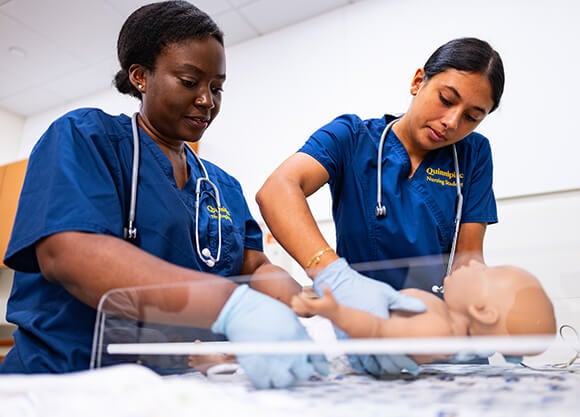
Larry Slater: And it's sad, given the time that they spend. Nursing education is pretty rigorous, especially on the new nurse side, the pre licensure side. And so this came about to try to address some of that. And it's really focused on, as you said, competency based education. How are we building the competencies, not just teaching somebody the material in a lecture format and giving them a multiple choice test. And if they do that and pass their license exam, they're ready to go practice as a nurse. Our clinical partners, where they go work, are also telling us that across the board, across the country that graduates are not ready to practice, and it's taking them a lot longer on orientation or getting them up to speed and upskilling them to make them ready to be prepared. And so we wanted to design and develop curricula that we feel like truly makes them practice ready, makes them have the durable skills like resiliency, communication, advocacy for their patients, but also themselves in their work environment that will really set them up for long term success. So we've done a massive transformation across all of our curricula, from our baccalaureate degree through our masters and our doctoral degrees.
Joel Vanner: So, you kind of alluded to it. What types of programs undergraduate graduate and also summer experiences are available in the school of nursing?
Larry Slater: We looked at how we can really address the nursing workforce pipeline from beginning to end. And really, it starts before people enter the profession while they're in middle school or high school and understanding what a career in nursing could look like and how they're going to set themselves up for success. What kind of coursework should they take in high school? How can they have experiences that'll introduce them to the profession, which is why we launched our Explore Nursing summer camp last year. We'll have the second iteration this summer for them really trying to explore what a career in nursing could look like, as well as what the education of a nurse looks like. So that'll help prepare them to come into nursing school and through the scientific rigor. So I mentioned before the anatomy, physiology, the microbiology, the biology, the sociology, the statistics.
Joel Vanner: A lot of ologies.
Larry Slater: A lot of STEM that is required for a career in nursing and making sure they are prepared to do that and then get into the nursing portion. We're also looking while they're here, how can we give them additional experience? So we launched last year a certified nurse aid program that a lot of our students, not just in nursing, but in health sciences in psychology and other degrees have taken so they can get some of that experience while they're actually here. In addition to their required clinical hours, they're going to have to do. And then we've also designed the rest of our curricula for them thinking about the future. So to make it seamless for them to transition from our baccalaureate degree to our master's programs, if they want to be a nurse educator or they want to be a nurse practitioner to our doctor of nursing practice program, and then working with lifelong learning here, what are opportunities we can continue to develop them as alumni in their career through lifelong learning? So we're really looking at, you know, running the gamut of the resources that we can provide to current, our future, current and past students across their career.
Joel Vanner: In addition to those programs, what programs are available in the school of nursing for working adults that want to transition into nursing and have a moment kind of like you had?
Larry Slater: That's always been a critical pathway for me. So we've always had an accelerated program. Quinnipiac was an early adopter in this state of having accelerated programs for students that are seeking a new career in nursing. So we have a 15 month accelerated program that we're excited about because it is focused on our new competency based curriculum as well that we think is going to set them up for success. They're a great group of learners. They're adult learners. They've had experience in college. They've had work and life experience, which we think really helps them become great nurses. One of the issues we found is that a lot of people can't drop everything and go back to school full time because it's a full time program. So we've also started a part time program. We started last spring with one of our partners where they can continue to work part or full time, maintain benefits where they're working, potentially get tuition remission from where they're working, if it's a healthcare setting to help them become a nurse and still support their family, because, again, working full time and then going to school full time is very difficult, especially for a nurse in a career.
Joel Vanner: Sure balancing all those commitments that you have in life and then wanting to pursue education and become a nurse, being able to mix those together and make both of those possible. That's an awesome experience. There are those academic experience and then extracurricular experiences here, too, for students, whether it's Quinnipiac University EMS Program, QThon which benefits Connecticut Children's Medical Center, the annual dance marathon that they have here on campus. There's tons of other interest groups and organizations. There's over 100 student run clubs and organizations that students can join. But speaking of the students, what kinds of students, do you think succeed the best in the nursing field? Is there some particular trait that maybe someone said, I kind of fit that. Maybe I should explore a career in nursing?
Larry Slater: That is really a great question, and I would say there is not anything specific because it really depends on what their interest and passion is in nursing. I have a colleague that wrote a book way back when it was called 201 Careers in Nursing. When they did the latest edition, they had to make it 301 careers in nursing because there are so many opportunities and options. Once you have built that competency, those durable transferable skills, then you could step in anywhere. So if somebody wants to be a pediatric nurse, I might say something different than somebody that wants to work with older adults or if somebody wants to work with, birthing mothers or somebody who wants to work with people at the end of life. So there's not one specific skill set other than the desire and the compassion to help others. So a lot of people are worried about doing a career in nursing if they're introverted. Now, I'll give that as an example. And we see this in students when they're going to their first clinical and they're afraid to walk in the patients room and start having that conversation. Even the thought of that is difficult for them. But even for those, once they really get into it, we find that they're extremely successful because even the introvert is somebody that really thinks about things at a deeper level and brings that meaning into the relationship that they develop with the patient and their families. So yeah, it's tough. There's not one specific thing.
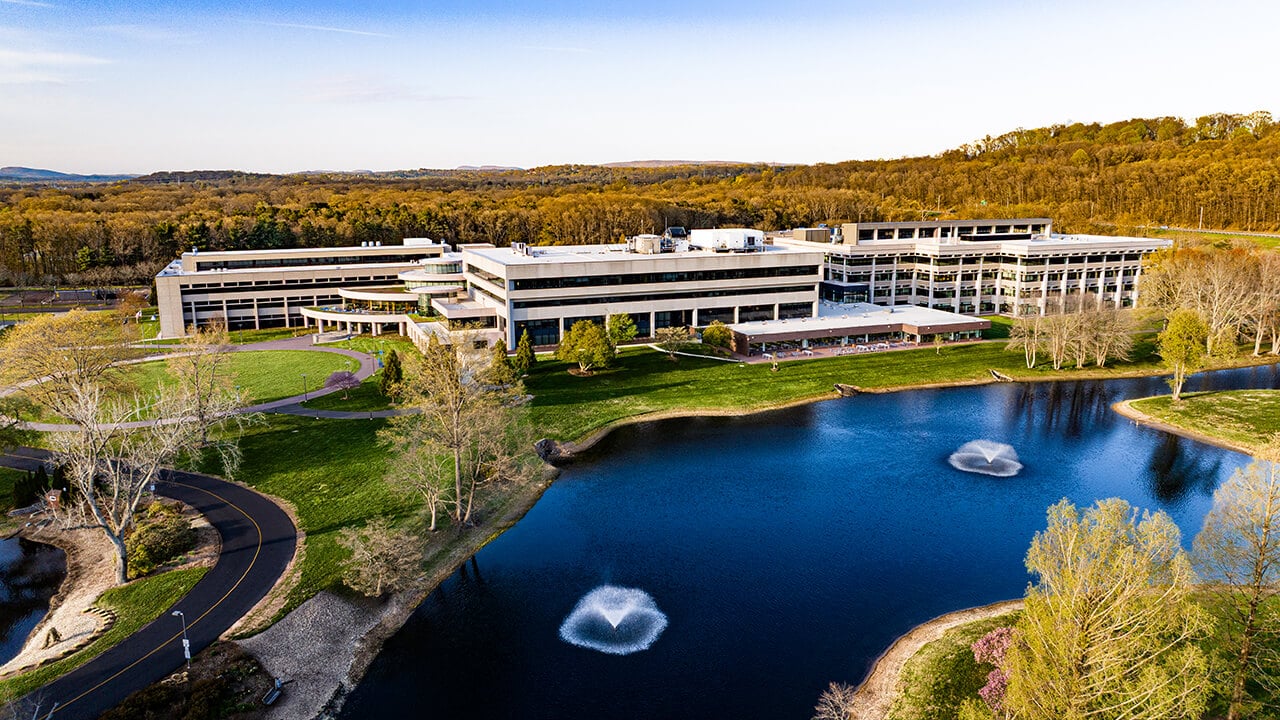
Joel Vanner: It sounds like there's a lot of growth opportunities for someone to come as they are into the nursing profession, learn all there is to learn and develop themselves as a professional in the field. And I guess I would say our best advice would be to come visit campus, reach out to admissions, reach out to maybe even be a Bobcat for a day in the School of Nursing. It's on our beautiful North Haven campus. There's also facilities over here on Mount Carmel, as well, and just maybe experience it for a day and talk to some current students, reach out to alumni, or maybe even sit down and chat with you.
Larry Slater: Absolutely. And if they want to talk to specific faculty about areas of passion they have, we have our faculty, our experts across the board, whether it's the lifespan or different types of specialties like psych mental health. We have plenty of people that can talk to somebody that wants to find out additional information about any of our programs. And if they're alumni or current nurses on the graduate side as well are looking to advance their career, we have opportunities for them, and we'll be happy to talk to them, as well.
Joel Vanner: Well, Larry, thank you so much for your time today. It was great having you on, and we'll catch up soon after this.
Larry Slater: Thank you. Appreciate it.
Joel Vanner: If you enjoy today's episode, be sure to subscribe and share and find other episodes on Apple, Spotify, and YouTube. Until next time when I ask my next guest, who are you? I'm Joel Vanner. Bye for now.











Quinnipiac Today is your source for what's happening throughout #BobcatNation. Sign up for our weekly email newsletter to be among the first to know about news, events and members of our Bobcat family who are making a positive difference in our world.
Sign Up Now