



When the world changed on 9/11, Americans turned to the media
September 04, 2026
September 04, 2026
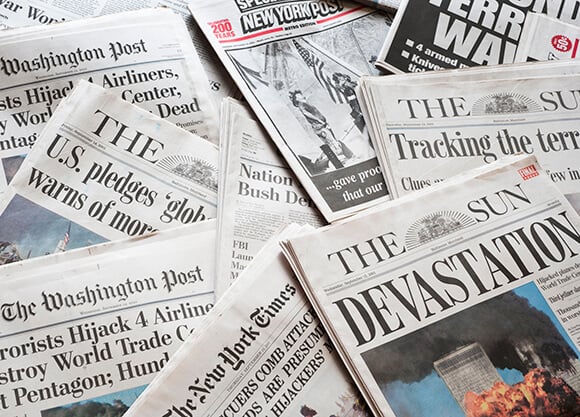
For many Americans, the media became more than a source of information. It became the way they experienced the attacks and individually processed what was happening.
For Ben Bogardus, professor and chair of Quinnipiac’s department of journalism, the journalists covering the attacks demonstrated one of the fundamental responsibilities of the profession: public service.
“With all of the journalists I talked with who were covering 9/11, the common thread was that they really did have a sense of public service and public duty,” Bogardus said. “They did this even though they were scared. They were frightened and didn't necessarily want to be there. They wanted to be home. Like so many of us, they wanted to check in with their friends and family.”
Journalists also had to make difficult decisions about what audiences needed to see that day, and, almost as importantly, what they didn't.
“Most journalists on that day were thinking ‘I have an obligation to tell the story, but I also have obligation to protect people from undue emotional trauma,’” Bogardus said. “Just because you have something on video or in a photograph doesn't mean that you need to show it for public viewing.”
Television also created something that was becoming increasingly rare: a common experience for millions of Americans.
Nancy Worthington, professor emerita and former chair of media studies, said the media landscape was already changing in 2001.
Cable television had given audiences more options about what to watch and where to get their news — and those choices increasingly allowed people to seek out information that reflected their own views.
“With the 9/11 coverage, there were about four days where it was just wall-to-wall network news,” Worthington said. “Everybody was watching the same footage, and the coverage became a shared experience that was a throwback to when we had the three main television networks with nightly news programming. It was a way of life that had been breaking apart with the rise of cable and broadband internet service.”
The attacks changed more than what Americans were watching.
That day also changed the way the media industry approached its audience with a shared sense of responsibility for the public’s well-being especially during the immediate aftermath.
“There was a definite before 9/11 and an after 9/11 in the media, and it’s a sensitivity that I find really fascinating,” Worthington said. “There was an industry-wide understanding that ‘we need to be respectful here,’ and that changed the way they approached programming and ultimately what they chose to put in front of audiences.”
From a historical perspective, the coverage also became part of how Americans would remember the event.
Lisa Burns, professor of media studies at Quinnipiac, focuses her expertise on how societies remember and make meaning of the past. For those who lived through 9/11, the memories of that day are often interwoven with where they were and the images they were watching on the news.
“It was days of nonstop coverage,” Burns said. “I remind students each year that every channel including MTV, ESPN, everything, had news on. There was no other news being reported during the days that followed 9/11. It was unprecedented.
The coverage was difficult to escape. But its reach also meant that the images and stories Americans saw that week would become part of how the country remembered 9/11.
“Media became something you really couldn’t get away from,” Burns said. “It was everywhere, and it really shapes how not only we viewed the event at the time, but also how we continue to view it. We turned to media to not only find information, but to help us to grieve. It was something that really brought us together because no matter where you were at the time, you could share in this collective mourning.”
Eventually, the news wasn't the only thing Americans needed from television. As the world slowly began returning to entertainment as a way to try to feel normal again, those outlets offered something the news could not: a way to begin moving forward.
“When I think of 9/11, I think of the collective mourning, but I also think of the patriotism and how it brought people together,” Burns said. “Sports and music and movies really become a way for us to heal after these types of events.”
The entertainment industry had largely stepped aside as the country absorbed the attacks. Television shows, movies and sporting events were postponed or altered. When entertainment began to return, however, the industry had to figure out what was appropriate for a country still absorbing what had happened.
Blythe Frank, assistant professor and chair of the department of film, television and media arts, describes the period as one of cultural hesitation.
“The media initially became this place where we tried to construct a narrative around something that felt impossible to comprehend,” Frank said. “There was this kind of cultural hesitation, where we had to figure out what it meant to make entertainment in a world that had irrevocably changed.”
Entertainment did not immediately address September 11.
Frank said productions initially retreated from the subject, then gradually approached it through stories about terrorism, national security and a changing world.
For Frank, that shift mattered because entertainment serves a different purpose from journalism.
"I think news helps us understand what happened, but film and television can help us understand it more fully as human beings,” said Frank. “They give us a way to process an event emotionally and viscerally — to see ourselves, our fears, our grief and our hopes reflected back to us. That’s a different kind of understanding, and it can be an important part of how we begin to process trauma."
Twenty-five years later, coverage of that day remains central to how Americans encounter 9/11, especially those who were too young to remember it themselves.
As Bogardus encourages, preserving those stories also means remembering what journalism can mean in a moment of crisis.
“Today when journalists are not always held in very high esteem, it’s important to remind people of the best of the industry and the value it holds in providing accurate and verified information,” Bogardus said. “Journalism is crucial in times of crisis. No matter how you get your news, you will always need a trusted voice to turn to when things are so chaotic.”
Hear firsthand accounts from journalists who covered the attacks from the World Trade Center, Pentagon and Shanksville, Pennsylvania, in Quinnipiac University’s Reporting on 9/11 podcast.
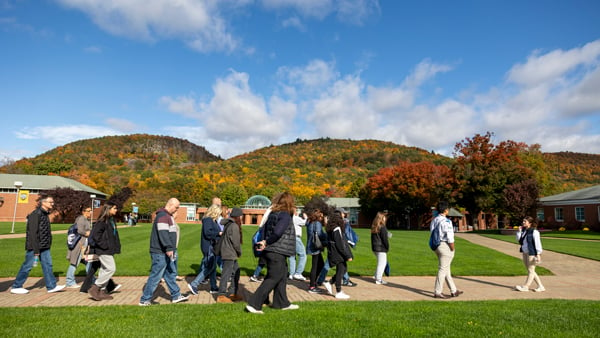
Want to learn what Quinnipiac is all about? We invite you to join us at an Open House, where our students, faculty and staff will introduce you to life as a Bobcat through a variety of sessions and tours.








Quinnipiac Today is your source for what's happening throughout #BobcatNation. Sign up for our weekly email newsletter to be among the first to know about news, events and members of our Bobcat family who are making a positive difference in our world.
Sign Up Now