



Evolving media landscape inspires expanded programs at Quinnipiac School of Communications
July 28, 2026
July 28, 2026
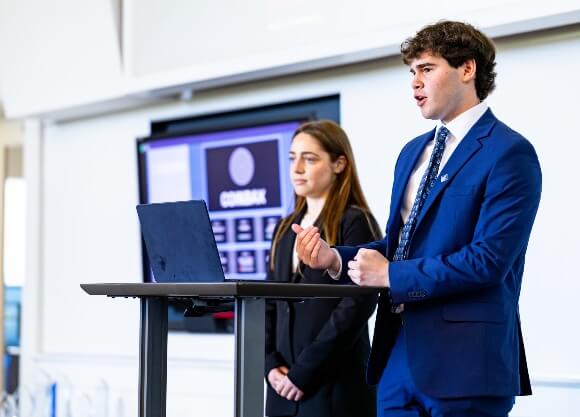
The School of Communications now offers undergraduates a new minor in Content Creation and Influencing and a new Certificate in Content Creation and Influencing. The school’s graduate program now offers the renamed master’s in Digital Content Creation and Strategy (formerly Interactive Media and Communications) and a new Graduate Certificate in Digital and Multimedia Journalism.
“The School of Communications is constantly evolving our curriculum to meet professional demands, both in the media fields themselves, but increasingly, across all industries,” said Senior Associate Dean Terry Bloom. “These new programs are designed to be sure that Quinnipiac students enter the workforce prepared to take on the kinds of tasks that will be asked of them.”
School of Communications Dean Nadine Barnett Cosby said content creation is no longer just a niche area in the traditional communications framework — it’s an important component of communications work.
“The creator economy isn't just a topic. It's actually an industry,” Barnett Cosby said. “What we’re doing in the School of Communications is building programming that treats the creator economy as a primary ecosystem in and of itself.”
The new minor teaches students to ethically evaluate, create and distribute content and to develop social media strategies, audience engagement and personal branding with hands-on learning and real-world application. With grounding in both the practice and critical study of digital content creation, the certificate equips students with the creative, technical and analytical skills necessary to succeed in today's digital content economy. Students can follow the general Content Creation and Influencing pathway or choose the Health and Wellness track, which is designed to ensure students both understand the media ecosystem and produce content grounded in sound evidence-based health and wellness principles.
Bloom said content creation is already generating a great deal of energy among high school students.
“They get to be creative, be technical, think about analytics and data…there’s a lot for them to explore there. Meanwhile, the creator economy is a $400 billion to $500 billion global economic driver. So there are plenty of opportunities for students to pursue careers in this space. It’s our role to spark their curiosity, fine tune their skills and help them spot the opportunities. It’s a great place to be within that ecosystem,” Bloom said.
Chair of Media Studies Kearston Wesner said the School of Communications has a track record of positioning students for success in the rapidly shifting world of media by shaping curriculum around critical thinking and adaptability and not just tools.
“Our faculty members bring distinct lenses and perspectives on the media landscape. We have expertise in a range of areas, including streaming platforms, social media, sports media, political communication, celebrity culture, digital culture and game studies and media law,” Wesner said. “What this means is that our students don’t get a narrow view of ‘content creation.’ They’re learning about it from multiple angles simultaneously, in courses taught by professors who are actively researching and writing about platforms and industries as they’re evolving in real time.”
Wesner said the new minor is a direct reflection of this practice.
“Students build foundational frameworks around audience, ethics and storytelling while developing practical content creation skills. They also learn about industry shifts as they’re happening, from faculty who track these shifts as part of their own scholarship,” said Wesner.
Enrollment in the undergraduate content creation and influencing minor or certificate program is available to all undergraduates and will complement many types of majors such as business, marketing, film, journalism, sports studies and others.
Barnett Cosby emphasized that all university students — not just communications students — will need communications and creator economy skill sets for their future professions.
“When I think about the skills that we teach — storytelling, visual communication, content production, audience analytics — those are not communications-exclusive competencies. They’re actually 21st century fluencies. They’re not considered soft skills for very specific disciplines anymore. Now, those are the durable skills and the infrastructure for every profession,” Barnett Cosby said.
Renaming the master’s program and folding journalism into it as a graduate certificate pathway meets the changing needs of the communication industry, said John Powers, digital content creation & strategy (DCCS) graduate program director.
The master’s in Digital Content Creation and Strategy is designed for professionals seeking leadership roles in communications, marketing and media. The program focuses on digital-first storytelling, content strategy, social media, UX/UI, audience research and AI. The new Graduate Certificate in Digital and Multimedia Journalism responds to the growing need for journalists working across multiple platforms and formats by deepening skills in digital storytelling, multimedia production and audience engagement.
“It is crucial for digital media professionals to be fluent across disciplines, as practitioners and strategists. They need the essential writing skills, the creative production to make content across every platform and the strategic thinking to know why that content matters to an audience or a brand,” said Powers.
The DCCS program is made up of mostly electives with no pre-requisites, so students can choose their path to match their career goals.
“We are educating versatile communicators who can move fluidly between storytelling, strategy and production because that's what the field actually demands now,” Powers said.
School of Communications Journalism Department Chair Ben Bogardus said today’s journalists need to be versatile and skilled multiplatform creators.
“It’s really thinking about where people get their information currently, and what are the tools that our students need in order to reach those people,” Bogardus said. “If you want to be a communications professional, we’ll teach you how you can actually make a difference with these modern communications methods.”
Barnett Cosby said the expanded programs continue to support the School of Communications’ development of bold communicators who are prepared to lead and innovate in a rapidly evolving media landscape.
“Earning a degree from the School of Communications has always been distinctive in that it meant hands-on, production-forward, real-world training,” Barnett Cosby said. “But I think a communications degree from Quinnipiac today means you graduate as a multiplatform content strategist — not just a practitioner in one lane. You understand storytelling across formats whether it’s long form, short form, visual, audio or data-driven, and you understand the business infrastructure underneath it all.”












Quinnipiac Today is your source for what's happening throughout #BobcatNation. Sign up for our weekly email newsletter to be among the first to know about news, events and members of our Bobcat family who are making a positive difference in our world.
Sign Up Now