



‘Who Are You?’ podcast with guest Dean Brian Gallini
What sets Quinnipiac University's School of Law Apart

What sets Quinnipiac University's School of Law Apart
Joel Vanner: Hello, and welcome to ”Who Are You?,” The Bobcats you know, the stories you don't. I'm your host Joel Vanor inside the podcast Studio at Quinnipiac University School of Communications, and I'm joined today by my guest, Dean Brian Gallini. Dean Galini, welcome to the show. Thank you so much for having me. It's a pleasure. I'm happy you're here. I should say you're the dean of our School of Law, and you're also a professor of law here at Quinnipiac University. But my first question to you is one that I ask every guest on the show, and that is, who are you? How much time do I have? That's a deep question.
Brian Gallini: I know, right? Get right in. Let's see where it takes us. So I'd like to think that on my best semilucid day that I'm first and foremost, a people first relationship driven leader, somebody who really thinks about empowering others to be their best version of themselves. And sort of the way I think about it is, like, everyone's 100% is a little bit different. Sure. And so my job is to figure out each individual's 100% and help them reach that on a consistent basis.
Joel Vanner: And that's kind of what makes the world unique, right? Everybody brings themselves, their full selves, whatever that looks like. Let's take a step back in time. So you're dean of our School of Law, also professor of law here at Quinnipiac. But was law always the area that you thought you would be in when you grew up and were an adult as a kid? What did you think you'd be something else? What was that? What were you like growing up?
Brian Gallini: No, I thought, well, I was deep into athletics, and at the time, I mean, that was sort of my focus and my passion and, like, academics was just transaction that I needed to complete in order to do whatever the sport Djur was. What was your favorite sport? I mean, literally anything that I could play early on. And then as the kind of road narrowed, it definitely became ice hockey. One of the lesser known things about me is I also skied gates in college. I did both of those were kind of my focus, but that didn't happen until kind of, I realized maybe I wasn't quite as good at some of the other sports that, you know, I had hoped to be. So baseball sort of fell off the map, and tennis fell off and other sports along the way. But I think as I moved more into undergrad, I was still in that mindset. I was like, the person who I didn't have a major, and I distinctly remember getting a note back when you would get paper mail in a box lest I inadvertently reveal my generation and age. But the registrar said, Look, if you don't pick a major, and this was by now my fourth semester in college, we're not going to let you register. So I was definitely still in a headspace, but I just want to keep doing whatever it is that athletically I can do. And finally, I was pre med at the outset. And although I loved the hard sciences, my grades would tell you that they didn't love me back.
Joel Vanner: Okay. And so a pivot moment for you there to make a decision, grades not really speaking.
Brian Gallini: Let's call it, an involuntary pivot, right? And so, at the wise age of what a second year in college, I was really guided Jokes aside by just a deep desire to make an impact. I wasn't exactly sure what that looked like, but helping people was something pulled me into medicine. I would ultimately pull me into law, and trying to think about what those values were and how they would translate was a great fit. I mean, looking back when I moved into law school, I definitely had this moment where I'm like, Oh, I'm where I'm supposed to be.
Joel Vanner: So you were in your undergraduate experience, got the note, you need to pick a program. What did you pick at that time?
Brian Gallini: Oh, this is a phone one. If I gave you roughly 300 choices, my guess is, you wouldn't pick this. So I was a Russian major. Oh, wow. And I wish I could tell you that I had a really good reason for it, but it's just the number of credits that had accrued in high school that I got credit for in college, made it the most straightforward major. But I didn't really find my academic. Like, what was I engaged in until a little deeper, and that was definitely history. So I would pick up a minor in history, and that's where I fell in love with writing.
Joel Vanner: What about history drew you in that way?
Brian Gallini: Was it a class you took or the same thing that would draw me to the criminal law much later, it's the humanity. It's the human stories and the decisions of leaders and how one person can make such a transformative difference in one direction or the other, alongside what drives people to follow in the writing. How do you tell that story? That is a really packed way of putting what was a multi year process. And I had some great faculty along the way, who not just invested in me, but were unafraid to tell me no, this isn't good work. You know, you think you put a lot of work into it, but you need to go back. And I learned that there's really no good writing. There's only good rewriting. And all of that happened and I'd say a compressed period of, like, my junior and senior year where my grades really went north and my focus really narrowed in on what the path would be after I graduated college.
Joel Vanner: Sometimes it's hard to hear, right? At that age, with all of those decisions and the things you want to do may not turn into the things that you end up doing. They can still be passionaras. Maybe you still play hockey and ski now, but it's just a passion area at this time. So after graduated college, Russian history, we've covered, what was next for you? Did you go off to law school? What was your first exposure into the legal system?
Brian Gallini: So I had a good friend and a teammate whose dad was a faculty member at a law school, who was kind enough to take me on a tour. I may have sat in a class. I don't remember exactly, but certainly the engagement of what a law school classroom would look like, the sort of conversations that you would have in class. I didn't and I don't really have anyone who's a lawyer in my family. So it was definitely a get outside your comfort zone moment. But at the same time, from an academic engagement standpoint, by that point, I was hooked. I mean, the idea that we're really going to get knee deep into the questions that impact just every one of us every day, and we'd have an opportunity to pull the curtain back and figure out what are the legal questions that drive how we think, how we move, how society is set up, and the degree to which I could make an impact within that infrastructure? That was definitely of interest to me. And so, no, I didn't take a gap year. I also looking back, had an insecurity that if I took a gap year, the academic momentum that I had built over those roughly two to three years would drift. I felt like I knew myself well enough that I needed to stay I needed to capitalize on that momentum and stay in that groove.
Joel Vanner: And you had found history as a space that you were really interested in at that time on the academic side?
Brian Gallini: I still am, but with a particular lens these days.
Joel Vanner: So off to law school, what was your experience like in law school? And then after that, where was your first experience outside of school?
Brian Gallini: So, in law school from more of a humor standpoint, and I think this still holds true to this day. The second you go to law school, everyone in your family thinks you know everything about law. So I definitely remember on holiday break, roughly this time of year, during my first year, people asking me questions that like, Well, you're in law school, you must know I had no idea.
Joel Vanner: Not on that page of the textbook.
Brian Gallini: I haven't gotten there isn't don't even know if I've gotten there to this day, but humor aside, I remember definitely feeling like the questions like, you go in, and I think to some degree, this is human nature. And I see this today in our students, it's so reasonable. Like you go in, you want the answer. But so commonly, it's a bit of a joke, but so commonly, the answer in laws, it depends. It depends on how good your argument is. It depends on how good of an advocate you are. It depends on how articulate you are on paper. So you can have an understanding of whatever the topic is. That's great. That's sort of the cover charge that gets you in the door. But that doesn't answer anything about the position you'll take, how you'll advocate, and where ultimately the conversation will end up. That process, which definitely holds true in legal education today was and remains fascinating to me.
Joel Vanner: For law school, did you go right into an academic setting related to law? Did you practice? What experiences did you have?
Brian Gallini: Kind of all of the above to get into academia. So my first job out of law school was I was a judicial clerk for the Maine Supreme Judicial Court. So in Maine, there is no intermediate Court of Appeals. Typically, in a state like the one we're sitting in, there's three levels. There's the trial court, intermediate, and then there's the State Supreme Court. Maine's Supreme Judicial Court is the Supreme Court and everything goes from trial court to them. And my justice had a thick Maine accent that I will not try to replicate for you and was in Lewiston Auburn. And there was a movement on the court at the time to consolidate it into Portland. He said, No, the court needs to have seats around the state, believe deeply in that. And it was really to my advantage for so many reasons. But one of them was that there was a trial court attached to his chambers. And his view is, as long as I got my work done, I should go take in whatever proceedings that interested me. And through that, I got to see arraignments, sexual assault trial, a murder trial, a robbery, and just about everything you can imagine in between. On the civil side, too, but I gravitated, as I did in law school, to the criminal side. And I definitely learned transformative. I learned pieces of attorney style that I thought, Oh, I'll definitely use that. And correspond or conversely, oh, goodness, I wouldn't go anywhere near approaching a jury that way or talking to a judge or co counsel that way. So I'm deeply appreciative of that experience, and his mentorship, not just by letting me have that time, but also, you know, the role of a judicial clerk is to make a recommendation in the first instance as to how the State Supreme Court could rule or should rule, rather. And I distinctly remember I just sat for the bar. I sat for the Massachusetts bar and I moved to Maine, and I had no idea if I'd passed until I think it was deep into September. So for about a two month period, I wasn't licensed, and yet he walked in my office in roughly week two and dropped a file on my desk and said, you know, write a recommendation. And I remember feeling awestruck by the amount of responsibility. I had no license. I'd been out of school two months, and here I was to make a recommendation for the entire state of Maine and the people in it. And that in hindsight, was tremendous for me because it definitely makes you sit up straight in your seat, dot all the Is, cross all the Ts, and take very seriously the work that you're about to turn back over. So I was deeply appreciative of that first experience.
Joel Vanner: In that moment, you are the person. Yes. The light is on you. You had what sounds like awesome mentorship and opportunities to observe, to build that confidence and get those skills, which, you know, we'll talk about how that is here at Quinnipiac School of Law in just a minute. Where did you find your love for teaching and working in an academic setting? What was your journey like to that side?
Brian Gallini: Well, it's always been I've always been grounded by the desire to help people. I mean, that part is held true. And I think at each iterative step of my career, the question is, is for me, how many people? So from the faculty perspective, I could help a classroom, from the associate dean perspective, I could help a unit, the law school, and now from the dean's perspective, I can help not just the entirety of the school, but also advocate for the school's interests at the university level through alums, through donors and external stakeholders.
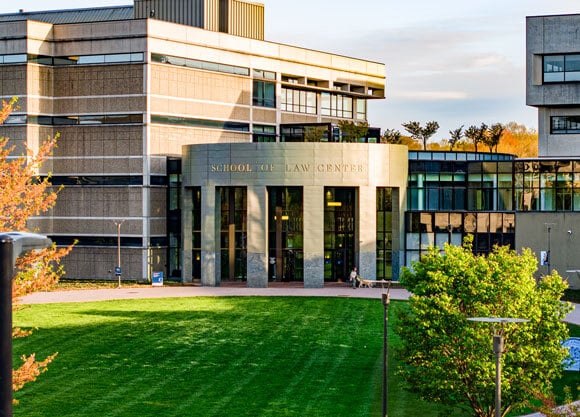
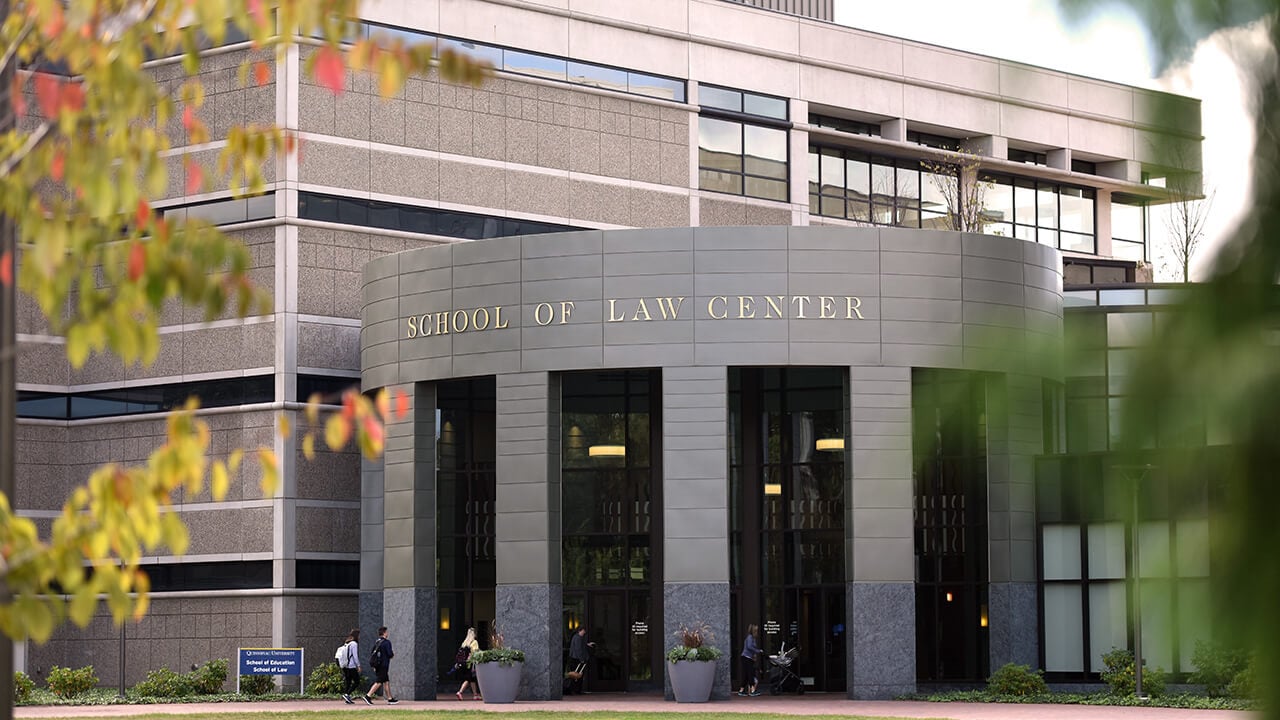
Joel Vanner: But again, the guiding principle is rooted in those values around helping and our school of law is on our beautiful North Haven campus school of law, education, medicine, nursing, health sciences, et cetera, over there. It is beautiful. Besides the picturesqueness of it, what sets our school of law apart from other schools of law, in your opinion?
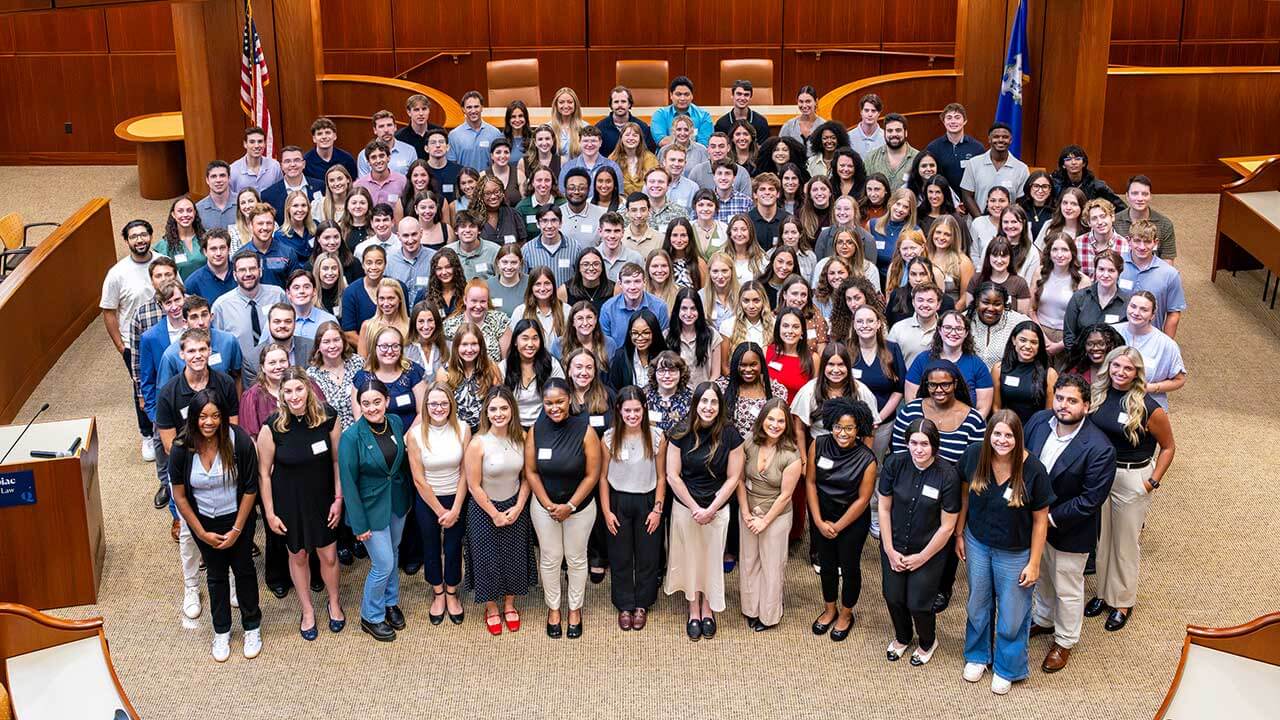
Brian Gallini: Well, we should start with the university, in my opinion. I'm lucky enough to be we are lucky enough to be led by a terrific president, an extraordinary provost, and I'm surrounded every day by extraordinarily talented deans so I'm privileged to work with on really complicated questions. But then more locally at the law schools, I mean, it really is a team effort, whether, you know, in admissions or career or student affairs or academic affairs in our clinics, our experiential learning, we just have extraordinary leadership across all facets of the law school. So the short answer is, it's the people. It's the people, and it's their dedication to our mission and to our students.
Joel Vanner: It takes a village community. Really, it's all here. One of the phrases I've heard you say a lot is educate the whole lawyer or teach the whole lawyer. What does that mean when you say that in relation to the experience that a student has here at Quinnipiac?
Brian Gallini: I think our goal in the law school is for people to not check their personalities and themselves at the door. So we want that authentic sense of self to come with them into law school and then to bring that with them into the profession. I try to remind our students, and, frankly, I remind myself that commonly in law, you're dealing with someone once you graduate and have a license who may, within a space of three to 5 minutes have had the worst three to 5 minutes of their lives. It is transformative in the sense that there's no going back. And they're looking to you in that moment where perhaps a family is broken, their liberty is at stake, finances are at stake to address that high need moment. And to meet that moment, certainly being well educated and having a firm understanding of the doctrine. That is a pre wreck in that moment. But who you are and how you'll meet them in that moment, that's the part I don't think we talk enough about in legal education. The humanness of it.
Joel Vanner: Yes, but I'm proud that we do at our law school. What are some student experiences that one would have here at Quinnipiac School of Law that is maybe unique?
Brian Gallini: So first, I'd love to take three things off the table that we love to think about for our students. So I call them the big three graduation, bar pass, and first job.
Joel Vanner: Those are three big things.
Brian Gallini: That's why they're the big thing off the table. And the reason I like to take them off the table is that one thing I would want our prospective students to know, and I hope our current students feel with a sense of pride is that when you come to our law school, we've put so much thought into those things that we literally take them off the table. I sort of aspirationally think of it like I'm not a chef, but like a cookbook, right? Follow the recipe, and these three things are off the table. That frees you up, we hope to explore what it is that you want to do, where you want to make your own impact, and where you find the energy and the passion for what that might look like. One thing that I think is important for students is to not feel the pressure of, like, you need to know that walking in the door. Instead, I think it's our job to clear those decks to let you have a wide backyard to explore what that might look like. So what could that experience look like? Let's say, roughly at a big picture level four things. You might have a traditional sort of doctrinal class that the way that faculty member taught has you thinking differently about an area of law that you thought you knew something about, maybe you had a family experience or a lived experience that now you're thinking about differently. Second would be a simulation based course. So you'd work with a mock case file or a mock client. You actually staff to step into the role of a lawyer that really forces you to put the doctrine in action. The third way would be through one of our legal clinics, which is literally practicing law as a student. We have a fully functioning law firm at the law school. And then the fourth way is our field placements outside the law school, through our externships. And we are proud that we guarantee every single student an externship or clinic experience. So that pride in learn by doing is one that runs deep for us.
Joel Vanner: And the career development office in the school is just incredible. What makes someone a good fit for law school? Say, you know, we took the big three off the table. We understand what the experience is here at Quinnipiac. What would you say makes somebody a good fit? Is there a specific characteristic? We talked about humanness. But what would you say to someone who's, like, I don't know if I'd be a good fit for law school.
Brian Gallini: So I think a deep sense of intellectual curiosity mixed with a little bit of grit. I think those two things, you know, just as a basic level, you don't do hard things and stay comfortable. And law school's hard, and it's going to be uncomfortable. So if you're curious enough to tackle some of the big questions that face our city or state, or region, the country, the world, that's sort of the first big piece. But then when you bump into whether it's academic hardship, you have a challenge at home or in your family, and there's that kind of roadblock that comes up. How are we going to continue in our academic studies while we meet that moment? That's where having a little bit of grit mixed in is really helpful because life doesn't stop either in law school, nor will it stop when it's time to study for the bar, nor will it stop when you're an attorney? The more we can kind of work that into your day to day and build some confidence in law school, the better I believe that'll serve you in practice.
Joel Vanner: And for Quinnipiac School of Law, what do you look for in students who are applying into the school?
Brian Gallini: So I think, first and foremost, we're looking for folks who are going to contribute to our community. And I think I mean, that's broadly defined. We've got folks who speak different languages, who come from completely different careers, who come from different countries, different states, you name it. I mean, in terms of their backgrounds. But what unites our incoming class and what unites our current students is they each make their own unique contribution to our community. So I think if you ask just about anyone in our community, whether it's students, faculty, staff, I think other law schools might talk a good game in terms of the strength of their community, but I think what they would say is we really live it. So we want to be competitive to see how good we can be in our various areas, but we're not competitive with one another. Instead, we push one another to try to see how good can we be in those various facets of the law school's world.
Joel Vanner: Supportive. We had a student on a previous episode of this podcast, Bill Oleos. He was a part time law student talking to the supports that are available for full time law students, but also for working professionals who are going to school part time at the school of law, the support is there for students.
Brian Gallini: That's right. Oh, I think, and that's something and Bill is terrific. A trying to in my first year as Dean, trying to understand what does student support look like for the various programs and kind of meeting students where they are. He was, and many of his classmates were terrific voices and helping me better think that through and how we could strengthen student support in those areas.
Joel Vanner: Then just lastly, getting your perspective. Law is one of those things, I think, comes up in many different areas of life as something that is always changing, and maybe keeping up with it, I'm not sure, but maybe keeping up with it is a bit difficult sometimes. So just curious your perspective on the field and then also how the Quinnipiac School of Law is considering that and continuing to grow.
Brian Gallini: Well, you're quite right in the role of Dean, it is difficult to kind of find a way to run the school and then keep up in your discipline. My own discipline is in criminal law and criminal procedure, and my specific sub focus is in interrogation methods and perhaps a story for another day, but I became a certified interrogator, and that's sort of my um, academic jam, teaching criminal law and criminal procedure. So I do what I can to keep up there. One of the goals I have for myself is to try to get back in the classroom by roughly this time next year. But outside of me, I am lucky enough to have a faculty that is extraordinarily talented, whether that's in terms of substantive knowledge disseminated through their scholarship or on a day to day basis in the classroom. So I'm lucky enough to leave it to them to be the subject matter experts across the many disciplines that we proudly teach across the curriculum.
Joel Vanner: If you're curious, come for a campus visit. See it for yourself. Meet the faculty.
Brian Gallini: No, come for a tour. I'll certainly sit down with a prospective student. I do it regularly, and absolutely we'll put you in a class that you're most interested in.
Joel Vanner: Well, Dean Gollini, thank you so much for joining me on the show, sharing your background experience and perspective on the School of Law here at Quinnipiac.
Brian Gallini: Thank you for the invitation and the time.
Joel Vanner: If you enjoy today's episode, be sure to subscribe and share and find other episodes on Apple Spotify, and YouTube podcasts. Until next time when I ask my next guest, who are you? I'm Joel Vanner. Bye for now.



















Quinnipiac Today is your source for what's happening throughout #BobcatNation. Sign up for our weekly email newsletter to be among the first to know about news, events and members of our Bobcat family who are making a positive difference in our world.
Sign Up Now