



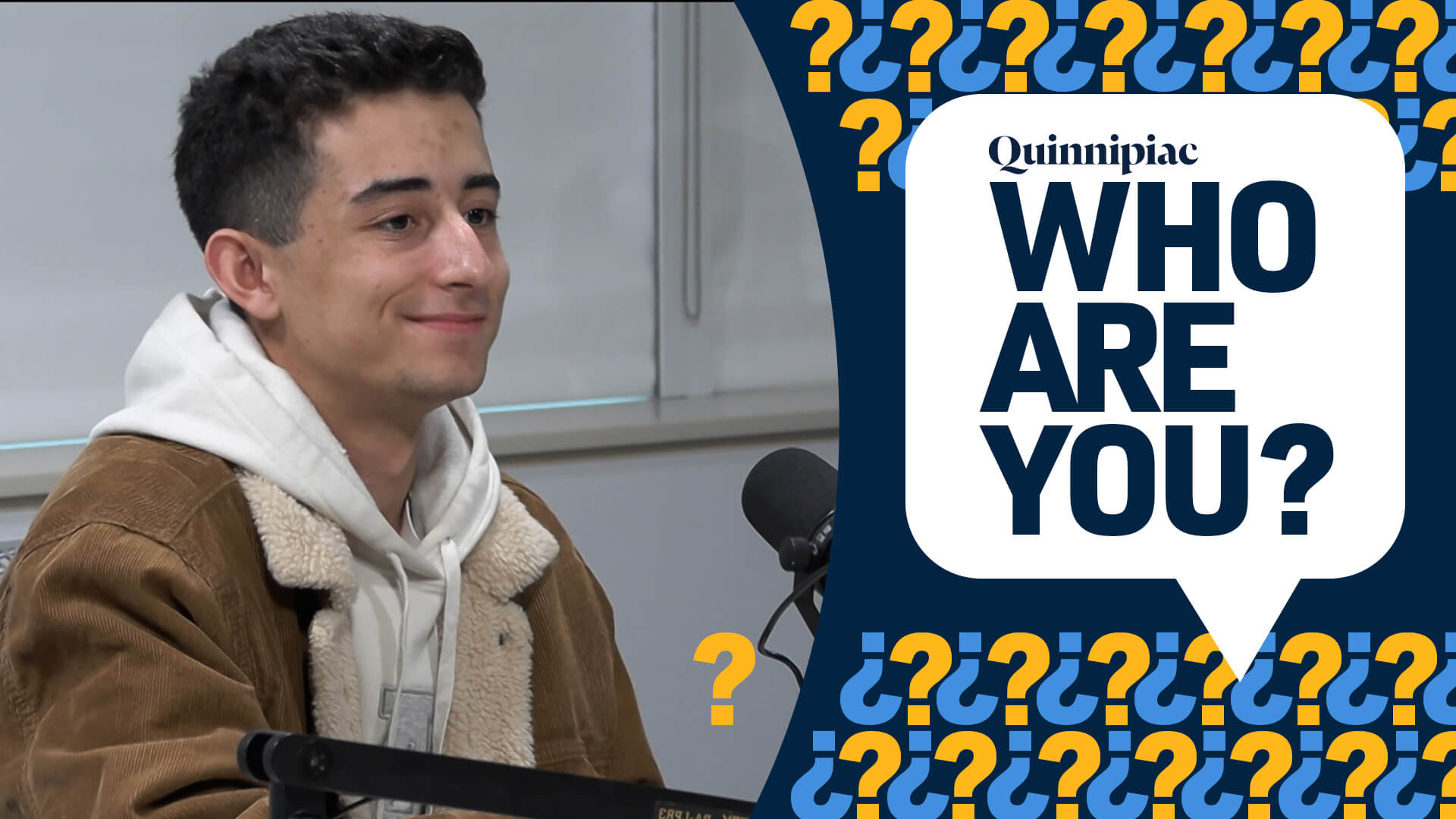
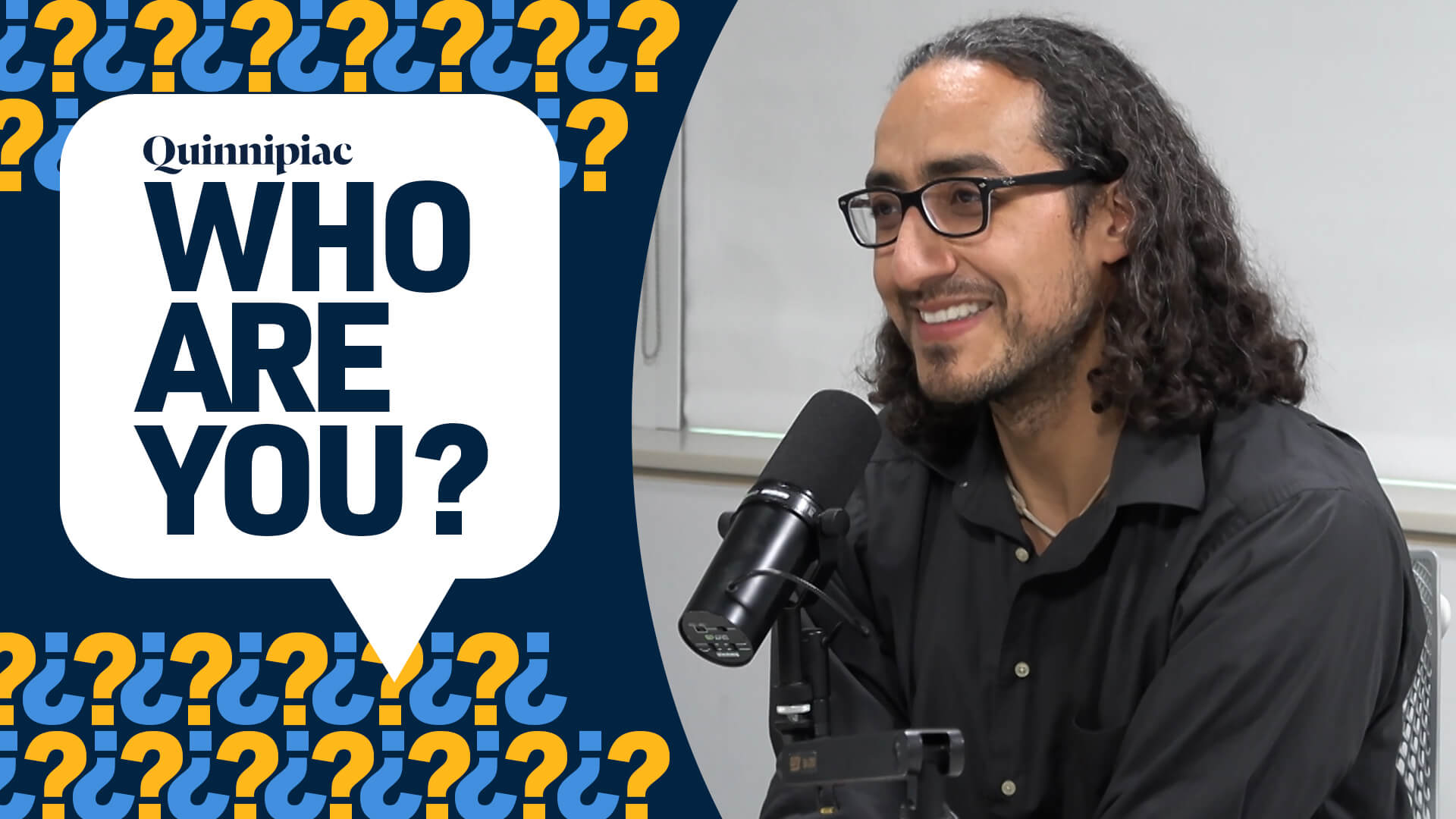
‘Who Are You?’ podcast with guest Anouar Benbrahim ’28
How a passion for problem-solving led to mechanical engineering
How a passion for problem-solving led to mechanical engineering
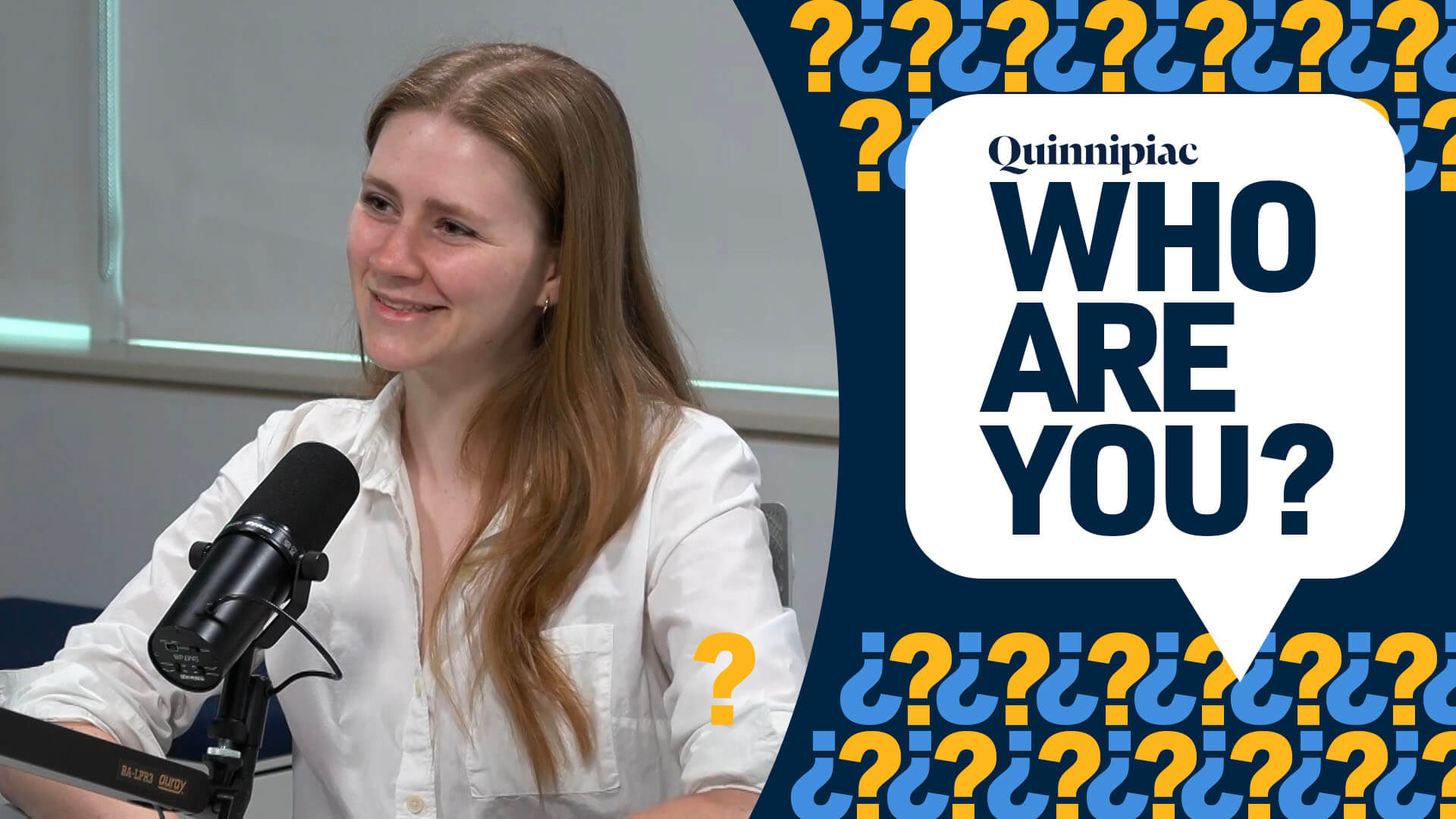
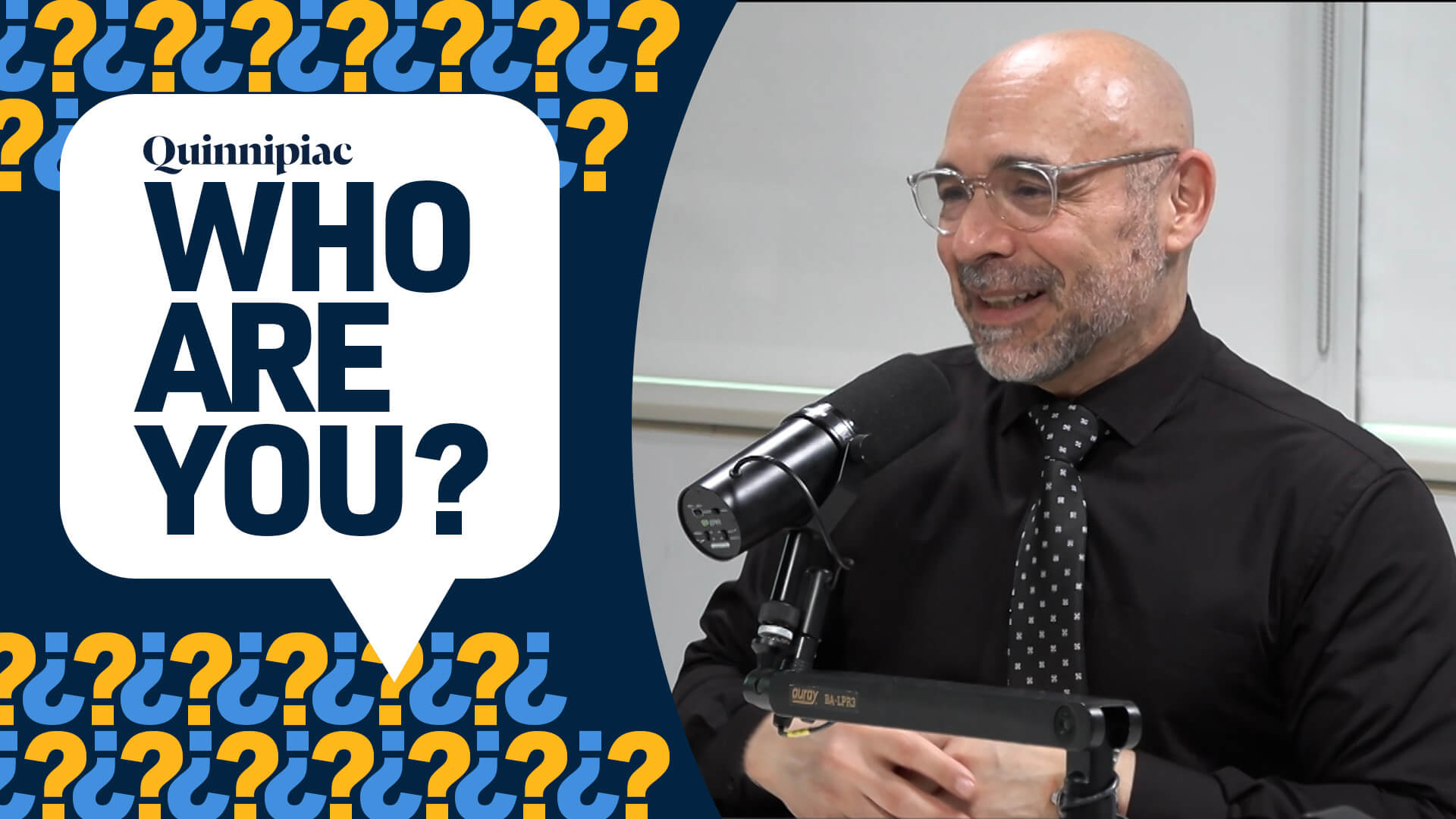
Joel Vanner: Hello, and welcome to ”Who Are You?,” the Bobcats you know the stories you don't. I'm your host Joel Vanner inside the Podcast Studio, at Quinnipiac University's School of Communications, and I'm joined today by my guest Anouar Benbrahim Anouar, welcome to the show.
Anouar Benbrahim: Thanks it's good to be here.
Joel Vanner: It's good to have you on the show. So I ask my guests the same first question every time, and that is tell me, Who Are You?
Anouar Benbrahim: Well, to start things off, I am mechanical engineering student at Quinnipiac. I'm from Hamden, Connecticut.
Joel Vanner: Not too far away.
Anouar Benbrahim: Not too far. Literally, like 10 minutes away, so it's convenient, too. I have three. I'm part of a triplet. So it's me, my brother Eunice, Benbrahim, and my sister Sophia.
Joel Vanner: Who are all bobcats.
Anouar Benbrahim: All bobcats got accepted here. And I also have an older sister, Anisa, which also, she's a graduate student at the moment.
Joel Vanner: Alright. Strong Quinnipiac family. We love to hear that. So Anouar mechanical engineering, is what you're studying here at Quinnipiac. Something separate from what your siblings are studying, right?They're all in the healthcare field.
Anouar Benbrahim: Yep, that's true.
Joel Vanner: Where did you find your passion and interest in mechanical engineering? Was it technology that kind of introduced you to the field? What was it for you?
Anouar Benbrahim: So, for me, I never was, like, really interested in what is, like, the medicine and all that. So and ever since I was a kid, I was always I had, like, always this interest in, like, technology, and, like, for example, I don't know, I was like 7 to 10-years-old when I went to my neighbor's apartment, and I helped her with her technology. And I feel like dealing with, like, technology and things like this, it's been throughout my entire life.
Joel Vanner: Sure.
Anouar Benbrahim: And even in the construction side, like, when I was like, what? 12 or something, I used to make, like, just giant pyramids of cards. So it's been present a lot, and I basically just decided that it was a good choice, yeah.
Joel Vanner: So your mom was maybe socializing to the neighbor, Hey, my son's really good at technology. He can help you fix anything on your computer, and that's kind of where you discovered that love for technology and building things. How did you decide on mechanical engineering? Was it something that you knew of before coming to Quinnipiac or when you were in high school, how were you, like, analyzing colleges to find out if it was the right fit for you?
Anouar Benbrahim: Yeah, so I was really interested. To start, I was very interested, like, computing at first. Like, I self taught myself how to code and all that. So I was really interested, like, the computer side of things. And I thought, Okay, let me try software engineering. Software engineering, I looked it up, I researched, and it was really interesting for what it looked like. But then I asked my mom for some counseling because you always want to do that.
Joel Vanner: Sure.
Anouar Benbrahim: And she was like, This is great, but you don't want to spend, like, the entire day, like, stuck to a computer screen. You want to do something that moves you and like, makes you be more creative in that sense. So I began searching more, and I found that mechanical engineering was just, like, the perfect choice for me.
Joel Vanner: And Quinnipiac, we mentioned family ties to the university, but what specifically about the School of Computing and Engineering here drew you to it? Did you come for an open house? Did you tour the facilities? What was that moment that you were like, This is where I want to be?
Anouar Benbrahim: So that was that mainly happened in orientation because I already applied as a mechanical engineering student because I already had it decided. But orientation and when we went to, like, the maker space to make, like, simple, like, heat pressed mugs and all that, I really liked to do things, I really like to build things, and that's where I fell in love.
Joel Vanner: So the maker space is in the bottom floor of the School of Computing and Engineering.
Anouar Benbrahim: Yes.
Joel Vanner: What kinds of equipment are in there? You said heat press mug. I know there's, like, three or four other pieces of equipment in there that are open to anyone who gets trained on it to use inside and outside of their classes, too.
Anouar Benbrahim: Yeah, so there's a bunch of really good I think they actually brought new ones, new 3D printers. There's heat presses. There's, what else? There's laser engravers, all those types of things that you could use or, like, a project or something. Obviously, you cannot go by yourself for safety reasons, so a super user always has to be there for you to use the machines. But if a super user is there and you can just, like, go crazy and just design what you want to do and build your project. It's really interesting, too.
Joel Vanner: Yeah, sounds like an awesome hands on space. And Professor Lynn Byers oversees the maker space here at Quinnipiac. She's the one that guides it all. I know you have a connection with Lynn Byers from your mechanical engineering 110 class.
Anouar Benbrahim: Yes.
Joel Vanner: Tell us about Professor Byers and what you like most about her in that introductory class.
Anouar Benbrahim: So for me, like, when you're like, a freshman in college and you go to, like, your first class, it's always like this, like, scary feeling?
Joel Vanner: Am I doing the right thing?
Anouar Benbrahim: Yeah.
Joel Vanner: Am I siting in the right place?
Anouar Benbrahim: Yeah.
Joel Vanner: Did I read the right stuff?
Anouar Benbrahim: Yeah. Like even from, like, to go to the actual classroom. Like, you don't know where you're going, but you get to that class and you pray that it's the correct one. But when I got to that class, Professor Byers, she has this, like, very bright energy. And to see that and to, like, be able to, like, work in that class with her, it's just it made me fell in love more with mechanical engineering because she gave up this energy that was like she motivates you. She pushes you to work forward, and she just she makes a class that might be hard for, like, a freshman, make it really, really fun and easy.
Joel Vanner: What was the class that you had her for?
Anouar Benbrahim: It was introduction. It was like, introduction to, like, Solid Works or something.
Joel Vanner: So what is MER 110, and what are some examples of things you learned in that class?
Anouar Benbrahim: So, MER 110 is like the introductory course when obviously for incoming freshmen or to someone who switches their major and wants to get started in engineering, we do we start off by, like, explaining, like, the principles of engineering, what it's like to, like, build something, create things, and problem solving specially. And then we start to get on the programs we're going to use, like Solidworks, which is, like, a computer AD design program that basically helps you, like, create stuff and, like, build things that you later going to print in the maker space.
Joel Vanner: Sure.
Anouar Benbrahim: If you were going to do, like, a project or something.
Joel Vanner: Right.
Anouar Benbrahim: And yeah, that's basically pretty much it. And she Professor Byers, who was teaching the course, she helped us a lot to get started because when you're facing, like, a program that's completely something you've never seen before, she guides you. She makes you do the tutorials, and she pushes you to be like the best added in that class.
Joel Vanner: It can be a little overwhelming, I'm sure, especially knowing you have to master it right in the class. The pitch competition, you probably use the skills from MER 110 in the pitch competition that Professor Byers inspired you to participate in. Tell us about what the pitch competition is and then what idea you pitched in the competition.
Anouar Benbrahim: So it all started because I'm part of the honors program. So you're required to you're required, obviously, to take, like, honor specific credits. And when I joined MER 110, they moved me to that credit alongside two other of my students or classmates. And Professor Byers said, Okay, if you're in the honors program, you have to join the pitch competition to complete that honors credit. And me, I have no idea what that was. Like, I have no clue what it was. And I was just clueless with two of my classmates. Like, What are we going to do? But Professor Byers, obviously, she helped us. She guided us. She said, Okay, so the final project that you're going to do on MER 110, that's going to be the project that you're going to go pitch. So, me and two other classmates, we came up with the task, I mean, the assignment for that final project was to, like, go to an employer to those on, like, the Tator Hall because sometimes in Tator Hall, they have, like, this tabling.
Joel Vanner: Yeah, they have vendors that are selling differ things.
Anouar Benbrahim: Yeah. So the mission was to go talk to a vendor and be like, Hey, how can I make your business better?
Joel Vanner: Find out what they need.
Anouar Benbrahim: Yeah, so they give you, let's say they give you a problem. And I talked to this lady and she said, Okay, yeah, it would be nice to have, like, a stand where I can put, like, my perfumes and my makeup products and all that.
Joel Vanner: Okay.
Anouar Benbrahim: So that was the idea that we foresaw, and we just began building that. It was like a stand. We didn't have time to print it, obviously, because we also didn't know that we could use the maker space for that.
Joel Vanner: But you built it in solid works.
Anouar Benbrahim: Built the design in solid works, obviously, to turn it in later. But it was, like, a stand with, like, three levels, and each level had, like, tiny cavities where you put, like, the makeup and stuff. Yep. And then after that, once we were done, it was time to actually figure out the pitch. What were we going to do?
Joel Vanner: That's probably a little nerve wracking.
Anouar Benbrahim: It was a nerve racking.
Joel Vanner: Relate some of Professor Byers traits in the classroom, right, when you're giving your pitch with the inspiration and energy. So you have this idea, and how did you become acquainted with what the pitch process involved?
Anouar Benbrahim: So, Professor Tomczyk he was the one who ran the program. So we went to informational sessions about it, and then he was like, Yeah, you should join you should come to my office, so you can try to practice pitch with me after you write your script, and I can help you guide you. So we wrote our script, and I went to his office, and I basically tried to pitch them to him. And then the first thing he said was, like, the pitch competition is not a presentation. So you're not trying to memorize your script. Your script is just a guide for you because for a pitch competition, you want to tell the audience and the judges that you really know what you're talking about. So if you memorize everything, you're just going to be like monotonously, talking.
Joel Vanner: Very robotic. You would know. Right.
Anouar Benbrahim: So the idea of the pitch competition is that has to be like a conversation between you, the audience, and maybe the judges. So that was the main thing that helped me and, like, guided me, and I appreciate him for, like, telling me this. And then I just try to practice it, not obviously reading off and memorizing, but actually, like, talking it. And then the day of the pitch competition came.
Joel Vanner: How did it go?
Anouar Benbrahim: We obviously didn't win, but we got an award for participation. But more than winning the money and all that, I feel like it was a great, great experience for me to, like, actually do things like this because in my future career, I'm going to be designing a project. I have to maybe show my boss, and I have to, like, try to pitch it.
Joel Vanner: Right. You have to get buy in all your stakeholders. And to have that experience in MER 110 in your first year in the mechanical engineering program, your first year at Quinnipiac is awesome applied experience to what you're learning in the classroom. What are some of the other engineering courses you've taken? Like, are they as hands on using the maker space, creating different things, learning different programs? What's another course that you like a lot?
Anouar Benbrahim: So I'm recently taking a new added course. It's MER 399, which is making a mechanisms. And my advisor, Professor Riofrio, he is the one who teaches the course. And when I talk to him in the advisory meeting, and he told me I should join this class, because this class is like a class that it's going to, like, push you to when you have to do, you're seeing your capstone or your senior projects. And it really helps you know like, Okay, how am I going to design this and how am I going to build it in sold work so that I can print it? And this class is indeed hands on because we learned like two weeks ago or three weeks ago, we even made, like, a fidget spinner.
Joel Vanner: Nice.
Anouar Benbrahim: So that was pretty cool. And yeah, we've been going to the maker space. He's been showing us how to use the 3D printers and how to, like, even from, like, the beginning, like, you have a problem and how can you solve that problem in the most efficient way? Like, even in just like Solid works, which I mentioned it was the computer add design program, how can you make it so it's efficient and it works?
Joel Vanner: Right.
Anouar Benbrahim: Like using the least amount of material, for example.
Joel Vanner: And you mentioned this class was with your advisor, Professor Riofrio. How has your advisor helped you map out your program here at Quinnipiac so that you could take new courses like MER 399?
Anouar Benbrahim: So the first actually on my orientation, he introduced himself. He said he was going to be my advisor, and he gave me a flowchart. Based on my obviously my placement test for math and English. He gave me a flow chart, and it's like, all my four years, all semesters just planned out. All mapped out.
Joel Vanner: Yeah, piece of paper.
Anouar Benbrahim: I know.
Joel Vanner: There you go.
Anouar Benbrahim: And it was, like, really great to have that. And to take that MER 399 course, I had a spot for an elective. So he said, Yeah, maybe you can take this elective here, and it'll be convenient and better for you. But, you know, he's been amazing. He's been guiding me a lot, and I really appreciate his help throughout.
Joel Vanner: And to have that guidance ensures to you that you have the requirements met, but also shows you where you can have freedom to take other courses and other things you want to.
Anouar Benbrahim: He even puts in, like, the blank spots where I can, like, put, like any other course I want, like, a UC course or which is a university curriculum requirement course and all that. So, yeah, to have that even, like, I have a Powerpoint of it. So to have that is, like, really, really good and helps me, guide myself better.
Joel Vanner: And takes the stress out of.
Anouar Benbrahim: Definitely Definitely.
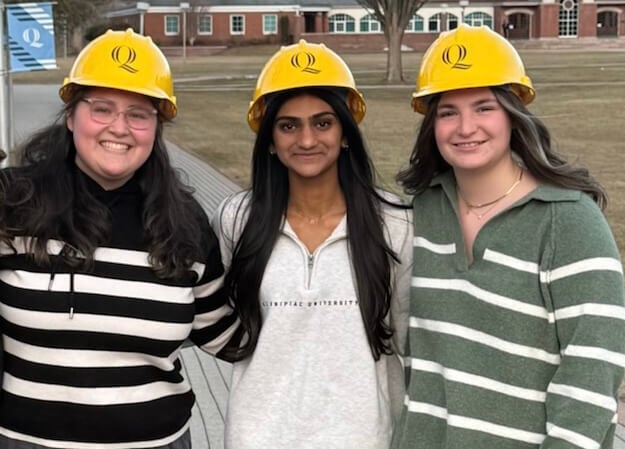
Joel Vanner: One thing you didn't bring your hard hat today, but the hard ceremony is a big part of the School of Computing and Engineering. I have a hard hat here. Tell us about the tradition and what it was like to receive your hard hat. And what it means.
Anouar Benbrahim: Yeah, so the hardhat ceremony obviously is a thing been going on throughout the years, and it basically it's like a ceremony, and they award students who have completed, like, certain credits and all that, their own hard hat. So obviously, this goes by requirements. Like, for me, for example, I had to take engineering materials, but every engineer who goes to mechanical engineering or even civil engineering takes that materials course. And then for that, you get the hard hat, and then you can get stickers for Excellence and all that. It was finally my time. I was waiting since, like, I knew there was going to be a sophomore year that was going to get my hard hat. And it was actually a really, really special time. Like, I really felt really good about being there.
Joel Vanner: And it's a really great community ceremony. And on the hard hat are stickers, like you said, it's customized to you and the experiences you've had at Quinnipiac.
Anouar Benbrahim: Yeah, it basically, you can say, Okay, it's a hard hat. I can use it for my project. I can use it for all of that. But for me, it's a symbol.
Joel Vanner: Sure.
Anouar Benbrahim: Like, it shows your journey as a mechanical engineering major with the stickers, the classes you've taken, if you have academic excellence or any extracurricular, all that.
Joel Vanner: So it really tells your story.
Anouar Benbrahim: Tells your story, yeah.
Joel Vanner: How have all of these experiences, looking back from a family of siblings who went in healthcare, helping out your neighbor with technology, coming to Quinnipiac Mechanical Engineering, learning the maker space, all of the applied experiences you've had. How have all of these helped you grow and cement and just better understand that this is where you want to be in life and this is what you want to do after you graduate college?
Anouar Benbrahim: So, for me, always when I'm trying to pick, like, a career of choice or something, I my mom always taught me that you want to pick something that you like and you enjoy instead of just just the digits that you're going to earn, because there's no point of going through, like, a high paying job but you basically hate it. So I feel like mechanical engineering since the beginning has been just incredible. I've enjoyed it. Classes, obviously, they can get a bit, like, like, difficult and, like, kind of tricky. But as long as I just keep going and I just don't give up, it's really, really rewarding because I felt like throughout the years, ever since, again, I was a kid and I helped with technology, I always felt like this is the place I want to be.
Joel Vanner: And rely on your community in the school, in your community and student groups. We have over 170 plus student run clubs and organizations on campus. You can find your people that help you through those hard times.
Anouar Benbrahim: Yeah.
Joel Vanner: What advice would you give to someone who is looking to study engineering? You said in the beginning, you did a lot of research, the different types of engineering, what you were looking for. What advice would you give to them if they're trying to find where they fit in?
Anouar Benbrahim: So first of all, is obviously research, look through the different engineering programs, take your time. Don't just skim through them and really pick something that you enjoy and that you think that it's interesting for you. Obviously, you can switch later, but the idea is that your first choice has to be something that you like, I really like this. Maybe let's try it. And then, obviously, do not give up if one course is going to be hard. I really feel like if you just keep pushing and, like, keep on the good work, I feel like it's going to be really, really rewarding. And you're going to be looking back, and you're gonna be like, Wow, I'm glad I picked this.
Joel Vanner: And hop on LinkedIn reach out to alumni that have graduated too. There's a very strong network, and they're very great resource and connect with Anouar, too, and maybe they'll talk to you about your experience?
Anouar Benbrahim: No for sure, I'll be happy to.
Joel Vanner: Anouar is great having you on the show. Thanks for joining me and sharing your experience here at Quinnipiac.
Anouar Benbrahim: Thank you for having me.
Joel Vanner: If you enjoy today's episode, be sure to subscribe and share and find other episodes on Apple, Spotify, and YouTube. Until next time when I ask my next guest, Who Are You? I'm Joel Vanner Bye for now.


Quinnipiac Today is your source for what's happening throughout #BobcatNation. Sign up for our weekly email newsletter to be among the first to know about news, events and members of our Bobcat family who are making a positive difference in our world.
Sign Up Now