



Attend an Open House
Want to learn what Quinnipiac is all about? We invite you to join us at an Open House, where our students, faculty and staff will introduce you to life as a Bobcat through a variety of sessions and tours.
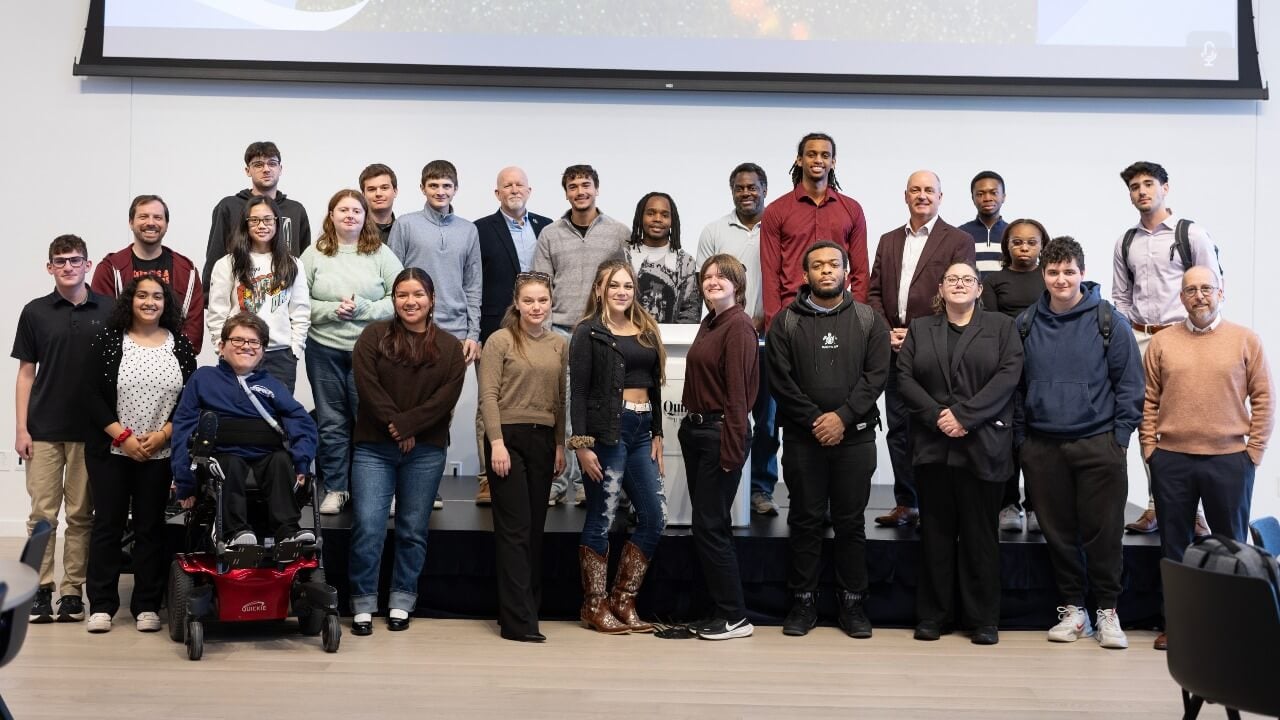
Held in the SITE auditorium on October 23, the immersive tabletop exercise gave two dozen students from diverse academic backgrounds the chance to step into executive leadership roles, including Chief Executive Officer, Chief Medical Officer, Chief Information Security Officer (CISO), Chief Legal Officer and Chief Communications Officer. Leading a fictional nonprofit healthcare conglomerate with a $40 million budget, each team developed 15 strategic initiatives for their company. Almost immediately, they were forced to begin navigating the larger implications of their operational decisions as the first of eight cascading cyberattacks hit.
Hartford HealthCare’s Kevin Hamel, CISO and vice president of IT operations and technology platforms, founded the competition in partnership with Quinnipiac’s School of Computing & Engineering and remains actively involved in guiding the event each year.
“Today, everything is done digitally, both from a consumer perspective and a business perspective,” Hamel said. “When computer systems go down, it’s not just a technology drain. There are so many factors that come into play in a ransom incident. It’s not just an IT problem.”
The annual program is organized at Quinnipiac by John Bau, assistant dean for student experience and career development at the School of Computing & Engineering. Conor Ross, Hartford HealthCare manager of incident response and David Tomczyk, associate professor of entrepreneurship & strategy, collaborated to design the day’s exercise.
Bau opened the event by introducing Hamel, who also helped mentor the teams and served as a competition judge. Reflecting on his own career path, Hamel shared that the mentorship he received early on inspired him to create this case competition opportunity. He also invited the students to connect with him on LinkedIn.
“I had a lot of people invest in me early in my career — people who took the time to share their thoughts and involve me in different activities, and I’m grateful for all of that,” Hamel said. “I want to give back to people who are early in their careers. Maybe you take away just one little thing from today and use it for the rest of your career. I encourage you to dive in, participate and ask questions.”
Designing an exercise that challenged tech-focused students while remaining accessible to other disciplines was essential to the organizers.
“We wanted to get a cross-section of students because there are a lot of roles that have huge input during a cybersecurity incident,” Ross said. “Certainly, there is a cybersecurity core to this exercise, but in the real world, it takes more than computer science experts to handle an incident. You need the expertise and advice of your general counsel to guide decision-making. You need an excellent communications director prepared to provide clear messaging both internally to the workforce and outward to the public. You need healthcare experts who can help evaluate potential impacts on patients during a crisis. And, obviously, you need top executive leadership to step in and make those final decisions. It really is a team effort in the real world, and we wanted to bring that exact experience to the students.”
Tomczyk added that crafting a scenario for such a diverse student body was both a challenge and a priority.
“The big challenge was striking that balance because we had students from the School of Business and other non-technical backgrounds who wanted to participate, while still ensuring everyone could engage in meaningful discussion and critical thinking about cybersecurity,” Tomczyk said. “Working with Conor was fantastic because he did a great job translating complex concepts, while I could help gauge whether we needed to push further so students fully grasped the context. IT security doesn’t need to be purely technical jargon for people to contribute meaningfully.”
The initiative’s broad interdisciplinary appeal is already proving its long-term value.
“The fact that we have returning students from two years ago who aren’t in IT at all speaks volumes about how this competition breaks down barriers,” Tomczyk noted. “They feel not only that they have something valuable to contribute, but that they have a real shot at winning, too.”
In addition to cool prizes for the winning teams, participants also walked away with a resume-worthy experience to highlight. Many students said the competition provided great hands-on experience and a fresh perspective on teamwork.
Computer science major Jaiden Palazzo ’27 was taking part in her second CyberCase Competition at Quinnipiac.
“The last time I did this, it was a really fun experience and I gained a lot from it, learning about how every area works and working as a team,” Palazzo said. “I feel like in our majors, we’re a little bit by ourselves. Here, you get to work together and make relationships with people you would not meet otherwise and learn about different aspects of what a career could look like in cybersecurity.”
“It’s really fun so far,” added Alexander Cohen ’27, a marketing major and social media strategy minor. “It gives me a hands-on real-world approach that you learn about in your classes, but you don’t experience in class. It’s really collaborative.”
Hunter Pageau ’27, MS ’28 is a dual-degree student who will earn his bachelor’s degree in software engineering and master’s degree in cybersecurity.
“It’s my first time working with people from other majors, so it’s interesting to see the variety of perspectives everyone is bringing to the table. This gives you a chance to understand how collaborative processes work in the real world,” Pageau said.
Computer science major Aditi Baghel ’27 said she signed up as a new way to learn more about cybersecurity and to get experience with working on a team.
“I signed up to be CISO, but if I end up with a different role, I think it would be good to try something outside of my major. It would help me to become more open to other roles and how they work,” Baghel said.
Ethan Mastrole ’26, MS ’27 earned his bachelor’s in computer information systems and is now completing a master’s degree in cybersecurity.
“My professor told me about this event, and I looked into it and saw it was a great opportunity for me and for my resume. I think it’s going to teach me aspects from the healthcare side of things as well as working with others from a C-suite perspective,” Mastrole said.
Jamar Paris, MS ’28 is also completing a master's in cybersecurity at Quinnipiac.
“I thought it would be a good way to work with other people and see what their perspectives are,” Paris said. “Our team just met and in the real world you don’t know who you’re going to work with. You’ve got to be able to work with a diverse group of people.”
Dual-degree student Kaab Dawit ’27, MS ’28 will complete his bachelor’s degree in computer science in the spring ahead of earning his master’s degree in cybersecurity. He said one of the things he wanted to experience as part of the competition was to take on a leadership role outside of his area of study.
“I signed up to be any position because I’m an avid learner, and I just wanted to learn about all the other positions and get an appreciation for each one and try something new,” said Dawit.
Hamel and the event organized said they were very impressed with the dedication of the students.
“To me, it speaks to their level of curiosity, their desire to learn,” Hamel said. “These are opportunities that may not come around all that often, but if a student is willing to show up and they’ve got a spark of interest, I think that’s noteworthy.”
Bau noted that the annual competition continues to deepen the diverse, strategic partnership between Quinnipiac and Hartford HealthCare while revealing a wide spectrum of career paths for students across all disciplines.
“When we’re working with students, we sometimes struggle with separating task and context, and this exercise provides that very clearly for them. It’s a really meaningful exposure for these students to help understand that whatever their expertise is, that the application of that expertise in the healthcare context is going to continue to be an enormous part of the potential job market,” Bau said.
Summarizing the event’s overall value, Hamel emphasized the importance of bridging classroom theory with real-world execution.
“Cyberattacks happen in the real world every day and have massive operational impacts,” Hamel said. “The ability to take what you’re learning in a classroom setting and apply it to a real-world scenario benefits any student.”
In addition to Hartford HealthCare, the competition was sponsored by cybersecurity technology companies CrowdStrike and ReliaQuest together with IT solutions provider and digital systems integrator Presidio.
Want to learn what Quinnipiac is all about? We invite you to join us at an Open House, where our students, faculty and staff will introduce you to life as a Bobcat through a variety of sessions and tours.






















Quinnipiac Today is your source for what's happening throughout #BobcatNation. Sign up for our weekly email newsletter to be among the first to know about news, events and members of our Bobcat family who are making a positive difference in our world.
Sign Up Now