


Engineering graduate reaches 100K subscribers on YouTube, expanding severe weather research
September 22, 2026
September 22, 2026
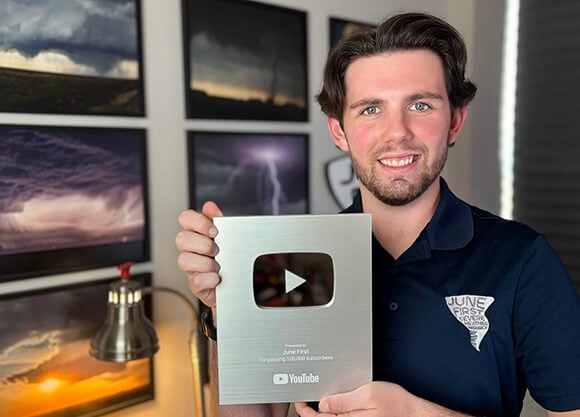
During his first semester at Quinnipiac in 2017, two major tornados devastated communities in Texas and Puerto Rico, reigniting Moriarty’s interest in natural disasters. He decided to complete his first-year seminar course assignments based on the research question, “How can people better understand weather to save more lives?”
At the end of his first year, Hamden and parts of the Mount Carmel Campus were struck by a tornado in May 2018. Moriarty said the moment had a profound effect on him.
“It was the second time in my life a tornado impacted a place I called home, spurring action on my end to create a project bigger than a guiding question in my first-year seminar class,” he said.
Moriarty started creating content for June First that summer to show the engineering-orientated projects he developed during the Quinnipiac University Interdisciplinary Program for Research and Scholarship (QUIP-RS). Moriarty developed a remote sensing prototype to verify the presence of newly discovered air currents that commonly precede tornados.
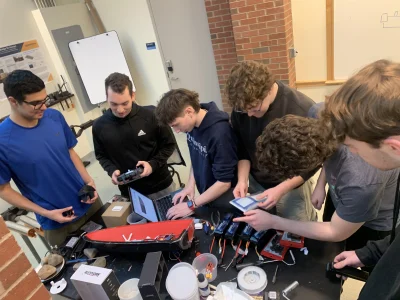
Moriarty further refined this project as part of his senior capstone project. With mechanical engineering classmates Seth Cornier ‘21, Alexander Gentile ‘21 and John Agosta ’21, he developed an Aerial Supercell Measurement System (ASMS), helping to produce more accurate and earlier tornado warnings.
After graduation, the June First YouTube channel continued to evolve.
“The YouTube channel took on more life as I explored tornado damage through the lens of engineering,” said Moriarty. “I showed how tornadoes exploited weak points in home construction, like garage doors or weak foundations, for example. This resonated with people and it emphasized the best practices for sheltering in a worst-case weather scenario to give the best chance at survival.”
Through his long-form videos, Moriarty combines both human stories and the science behind natural disasters, using animated visuals to reinforce important messages to his audience.
Several viewers have reached out to share the life-changing impact of June First’s videos with Moriarty.
“I had an email from a subscriber who lived in a tornado-prone area stating my videos were a primary factor in their decision to have a tornado shelter installed in their home,” he said. “Last year, a viewer in Arkansas, was under a tornado watch and decided to stay the night at a family member's house after recalling a video I made on how dangerous mobile homes are in tornadoes. Their mobile home was flipped by a tornado that night. That decision likely saved their life.”
The channel’s most popular video, viewed more than 2.4 million times, is titled “Why We (Almost) Never Saw Another EF5 Tornado,” and analyzed the Enhanced Fujita (EF) Scale used to classify tornados on strength from one to five.
“I went down an investigative rabbit hole, studying official tornado damage surveys, reading EF Scale training documents and talking to tornado damage experts to get to the bottom of why many post-2013 tornadoes that were on the cusp of EF5 did not get the rating. I came to the ultimate conclusion that within the guidelines and precedents of the current EF scale, an EF5 would not be assigned again unless something drastically changed in the rating process.”
The video, released in October 2024, reached 100,000 views within 10 hours of being published, said Moriarty.
“I was shocked because I thought it was a very weather-community-centric topic, but it turned out the general public really cared about tornado ratings as it continued to grow in views,” he said.
The video’s popularity plateaued around 1.5 million views until late 2025, when a tornado that tore through North Dakota became the first tornado to be upgraded to EF5 in over 12 years.
“As I predicted in that video, external considerations and calculations outside of the EF Scale were needed to allow for an upgrade,” said Moriarty. “The video launched back into the algorithm once again when news of the upgrade broke.”
Reflecting on his Quinnipiac experience, Moriarty says he is very grateful for the ways the university community prepared him.
“My education through the School of Computing & Engineering was exactly what I needed to succeed,” he said. “From the faculty that put the students first and the engaging structure of the classes, to the opportunities available that laid the groundwork for June First, it was the perfect experience for what I looked for as an engineering student that maximized my four years of college.”
Moriarty says the skills he gained at Quinnipiac have helped him in his career.
“It gave me four years in an environment that not only allowed for a transition from adolescence into adulthood, but also an opportunity to sharpen a lot of life skills,” he said. “Things like time management, asking good questions and capitalizing on available opportunities aren't exactly the most glamorous skills on paper, but learning how to use those types of skills effectively is what I've found to be key to achieving goals that I set in life, both personal and professional.”




Quinnipiac Today is your source for what's happening throughout #BobcatNation. Sign up for our weekly email newsletter to be among the first to know about news, events and members of our Bobcat family who are making a positive difference in our world.
Sign Up Now