



Student earns research award at international conference for advancing sustainability marketing practices
August 12, 2026
August 12, 2026
Brooks-Chapman presented his findings this summer at a conference held by the Principles for Responsible Management Education (PRME), an institute of the United Nations Global Compact.
His research explored whether products labeled as aligned with the United Nations Sustainable Development Goals (SDGs) influenced consumer purchasing decisions. The SDGs are 17 global goals that aim to address climate change and environmental inequality.
“Many companies align their branding with these goals, but whether that messaging genuinely resonates with consumers had not been thoroughly studied,” said Brooks-Chapman. “Using eye-tracking technology, I measured where consumers actually look on a product label, giving a more honest picture of behavior than simply asking people what they care about.”
The results of his research demonstrated that sustainability labels do make a real difference for environmentally-conscious buyers.
“Consumers with pro-environmental or socially-conscious values were significantly more likely to visually engage with SDG-aligned labels and choose that product over a generic alternative. The conclusion is that intentional, purposeful sustainability labeling works and that businesses should invest more carefully in how these claims are designed and communicated,” he said.
Brooks-Chapman believes this research will guide companies in how they advertise their products.
“This research addresses the well-known "attitude-behavior gap," where people say they care about sustainability but do not always buy accordingly,” he said. “Our findings suggest that gap may have less to do with values and more to do with how sustainability information is presented. For businesses, that is actionable: better label design can meaningfully influence sustainable purchasing.”
Traveling to Egypt and connecting with experts in the field was a unique opportunity that Brooks-Chapman says he will carry with him forever.
“It was an incredible experience,” he said. “Seeing the range of student research on display was inspiring, and I had the opportunity to connect with staff members from various organizations. The conversations were engaging and reinforced how much momentum there is around sustainability research globally. It was a collaborative and energizing environment throughout.”
Taskin Kocak, dean of the School of Computing & Engineering, said that the school is proud of Brooks-Chapman and the array of qualities that he demonstrated throughout the process.
“Conner's achievement is an outstanding example of Quinnipiac's commitment to academic excellence, innovation and global engagement,” he said. “Receiving the ‘Best Student Poster Award’ at an international conference reflects not only the quality of his research but also his dedication, curiosity and professionalism. His work on sustainable consumption demonstrates how computing and data-driven research can help address complex global challenges, aligning with Quinnipiac's mission to educate students who make meaningful contributions to society. We are incredibly proud of Conner and grateful to the faculty mentors who supported his success.”
Brooks-Chapman’s interest in sustainable marketing grew after taking a sustainability course at Quinnipiac that included a research trip to Tanzania.
“Seeing sustainability challenges firsthand sparked a deeper interest I wanted to pursue beyond the classroom,” he said. “Professor Charles Brooks, who led that course, became my research mentor, and together we developed the study from there. His expertise in business and consumer behavior was invaluable in shaping the research and I am really grateful for his mentorship.”
In addition to Brooks, professor of marketing and co-director of the User Experience & Behavioral Insights Lab, there were faculty who help prepare students for research. One of the most impactful for Brooks-Chapman was Brian O’Neill, associate dean of the School of Computing & Engineering.
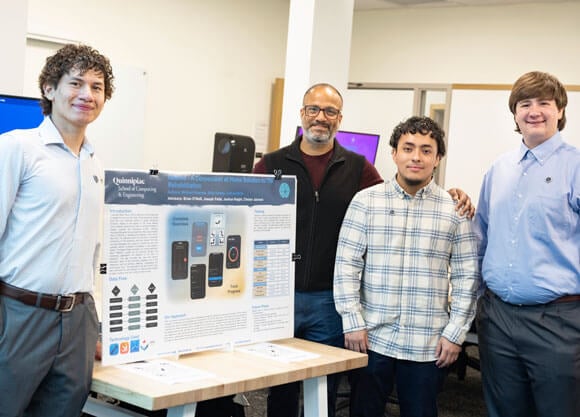
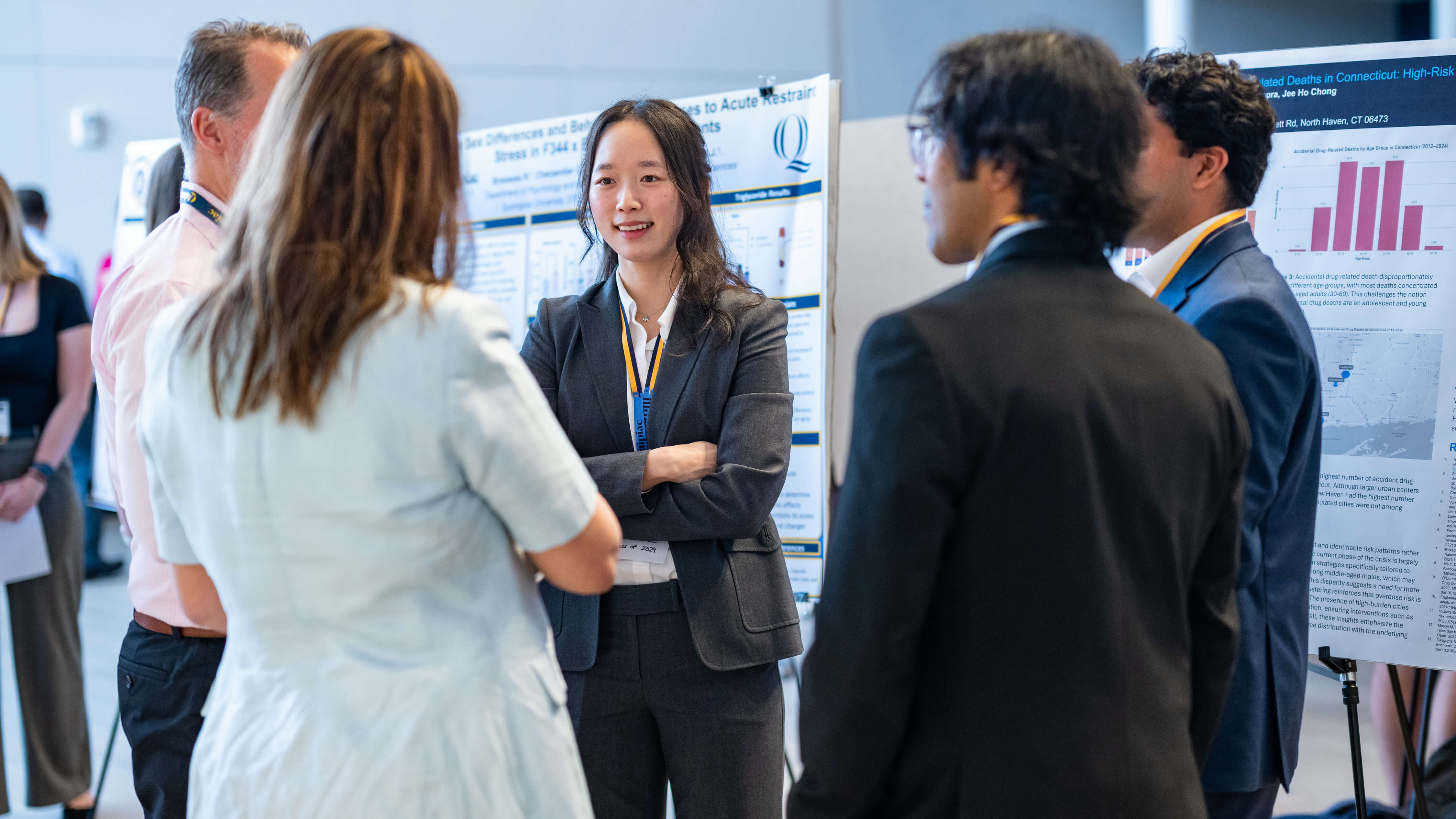
“Quinnipiac prepared me well, particularly through the culture around presenting research,” he said. “A class I took, Professor Brian O'Neill's senior thesis class, included a poster day that gave me hands-on experience creating and presenting a research poster in a high-stakes setting, and that translated directly to how I approached the UN PRME presentation.”
Quinnipiac prioritizes research opportunities for students to gain hands-on, real-world experience early in their academic journey.
“At Quinnipiac's School of Computing & Engineering, research is not reserved for graduate students or faculty — it is an integral part of the undergraduate experience,” said Kocak. “Our students work alongside faculty mentors to address real-world challenges using emerging technologies such as artificial intelligence, data science, cybersecurity and sustainable computing. Providing opportunities for students to conduct and present research on national and international stages distinguishes Quinnipiac and prepares our graduates to become innovators and leaders in the computing profession.”
Having access to research opportunities enhances student learning in numerous ways.
“Research experiences help students learn how to ask meaningful questions, analyze complex data, collaborate across disciplines and develop solutions to global challenges,” said Kocak. “Whether their work focuses on artificial intelligence, sustainability, cybersecurity or human-centered computing, student researchers contribute ideas that help shape the future of the field while developing skills that employers and graduate programs value highly.”
In addition to the research opportunities available at Quinnipiac, Brooks-Chapman enjoys being part of such a lively and engaged community at the university.
“There is an energy on campus that is hard to describe, and opportunities like this one feel like a natural part of the culture rather than an exception,” he said. “Quinnipiac has a way of opening doors when you lean into what is available to you.”
As Brooks-Chapman enters his graduate year, he is proud of the work he has done to earn the “Best Student Poster Award.”
“It was a really fulfilling moment [to earn the award]. Research is a long process, so having that work recognized at an international conference made it feel like it truly paid off and that the question we were asking genuinely matters to people,” he said.
The Quinnipiac community is excited to see what the future holds for Brooks-Chapman.
“His recognition demonstrates what is possible when talented students are empowered by dedicated faculty mentorship and provided opportunities to engage in meaningful research,” said Kocak. “We celebrate his achievement and look forward to seeing the impact he will continue to make throughout his career.”






Quinnipiac Today is your source for what's happening throughout #BobcatNation. Sign up for our weekly email newsletter to be among the first to know about news, events and members of our Bobcat family who are making a positive difference in our world.
Sign Up Now