



‘Who Are You?’ podcast with guest Alyssa Drumm '25
How Quinnipiac's theater program helps students find their voice
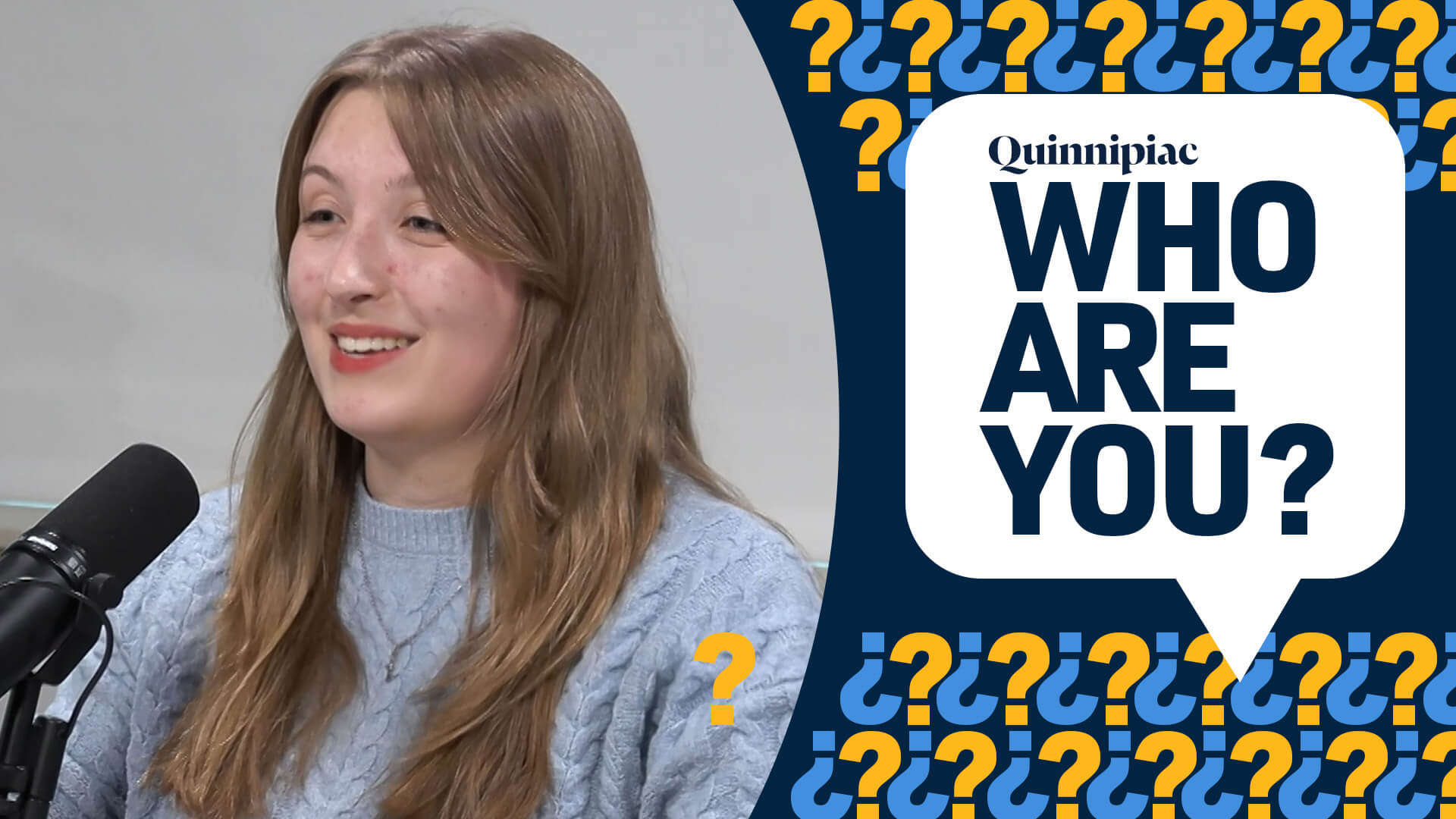
How Quinnipiac's theater program helps students find their voice
Joel Vanner: Hello, and welcome to ”Who Are You?,” the Bobcats you know, the stories you don't. I'm your host, Joel Vanner, inside the podcast Studio, at Quinnipiac University School of Communications, and I'm joined today by my guest, Alyssa Drumm. Alyssa, welcome to the show.
Alyssa Drumm: Thanks so much for having me.
Joel Vanner: So I'm sure you could guess by the name of the program, what my first question to you is going to be. And that is, who are you?
Alyssa Drumm: Well, as you said, my name is Alyssa Drumm. I am currently a fourth year in the three plus one film program. So my undergraduate degree was in Film Television and Media Arts. I graduated with that last spring, and now I'm in the Producing for Film and TV program with a concentration in writing for the screen and show running. It's a lot of words. Basically, I want to make movies. I'm also really involved on campus in the theater program and QFS, a lot of fun clubs like that.
Joel Vanner: QFS, Quinnipiac Film Society,.
Alyssa Drumm: Yes, Quinnipiac Film Society
Joel Vanner: We'll get to all the student involvement later in the show. You have a lot going on there.
Alyssa Drumm: Mm hmm.
Joel Vanner: With all of that experience that you've gained here at Quinnipiac so far, did you always think you were going to go into film and theater? Like, what did you do growing up?
Alyssa Drumm: Well, I always wanted to be a storyteller. I've always kind of been a little bit of a performer. I did cheerleading for like ten years, starting in the third grade. And so, that's- that was really fun when I was a kid. And then I sort of transitioned into, like, junior high, middle school, junior high. I started, like, performing. I actually, I played a Munchkin in the Wizard of Oz, and I was already five foot eight, so it was really hilarious.
Joel Vanner: Oh, there we go.
Alyssa Drumm: But through that, and my sister did a lot of theater and stuff growing up, as well, and I would always go and see her productions. And so, through that, I sort of discovered my love for stories and storytelling, and I always have loved, like, TV and movies. My dad and I always bonded over that. We always go and see the latest, like, Marvel and DC movies, and we watch a bunch of different TV shows together. So like, just learning through all of those performance experiences and viewing experiences. And also, like, as a kid, a lot of kids, like, write stories all the time. I was doing that. I have notebooks and notebooks full of just short stories that I would write. And so when I was thinking about what I wanted to do with my career and specifically wanted to do for college, I was really thinking about, like, where can I go? What can I do that will best support my dream of being a storyteller? And Quinnipiac was that place.
Joel Vanner: Sure. So use that imagination before you lose it right? Get it all down in the notebooks. So fast forward, picking choosing a college, right, coming to college. What drew you to Quinnipiac and what drew you to the three plus one program that you said you're in right now?
Alyssa Drumm: Absolutely. So what drew me to the three plus one program, particularly was the advantages of being able to have a master's degree in four years. It's like, Okay, I know I'm going to go to college for four years. That's four years of my life that I'm blocking off to get an education. I can have one degree in that time, or I can have two. Two for the price of one, essentially. And it was the advantages of that program. And also, I didn't do I actually didn't do a tour of Quinnipiac. I came here on a three plus one specific day. And so I got to talk to one of the film professors, Fritz Staudmyer and I believe the person who runs the graduate program, Blythe Frank was there as well. And I just got a big presentation from them about all of the advantages of the three plus one program and their industry experience and sort of the experiences and, like, I guess the faculty, also, as well, was a huge selling point for me, the fact that a lot of them work in the industry and they're able to give you real world experience that you can apply. And yeah, I think that's what really sold Quinnipiac for me was three plus one program and the advantages of the faculty and also the fact that Quinnipiac had a pretty strong theater program at the time.
Joel Vanner: Just coming in, making those connections the faculty right there when you were visiting campus was huge. And you mentioned the theater program. How have you gotten involved in the theater program, and what opportunities does the program have for students to get involved with it?
Alyssa Drumm: So there are a lot of opportunities there. I've worn pretty much every hat there is to wear in the theater program. I started with the student theater here, which is called Fourth Wall Student Theater, and I started off as a soundboard operator for the production of Alice in Wonderland the fall of my freshman year.
Joel Vanner: And these are totally student run.
Alyssa Drumm: These are completely student run, yeah. They're completely directed. I actually the spring of my sophomore year, I had the opportunity to direct a full length play. I had never directed anything before other than my short film projects for class. So it was a really big swing, and I'm so glad that I had the opportunity to do that because it taught me so much that I was able to apply to my future experiences, and then I'm going to be able to apply going forward in the work that I want to do. But back to the beginning of the student theater stuff, I was a soundboard operator for Alice and Wonderland, and I'm proud to say I have done something for every single fourth wall show every semester since. This is I think this will be my seventh, my seventh show with Fourth Wall. I've been a sound designer, soundboard operator, I've been an actor, I've been a set designer. I'm currently a technical director for a production of Macbeth. I'm also in that show. I'm having the opportunity to do Shakespeare, which is really exciting. And it's really just a wonderful community of students who are really passionate about theater. A lot of them, who, like me, did theater in middle school and high school, who are maybe not coming to Quinnipiac for the theater program, but the fact that they have it is such, like, is such a huge thing for us because it really notter thing no matter what you're coming here to get your degree in, there are advantages to, like, being a part of theater.
Joel Vanner: And you're getting that real world experience with all of those roles. And you also declared theater as your minor.
Alyssa Drumm: Yes, I did. Yeah, I was a theater minor. I didn't declare it until, like, fall of my senior year, I guess, fall of my third year. But I did declare it eventually.
Joel Vanner: What are some of the courses that you've taken so far, and how have those contributed to your overall experience in the theater?
Alyssa Drumm: So I took Acting One with Mariah Sage Seymour, who some students might know because she's been in a lot of Capstone films here at Quinnipiac and she is a working actor herself. So again, not only with the faculty in the school of communications, but with the faculty across the university, they're real working professionals who are, like, giving you insight into their real experiences. I also took Design for the Theater with a professor named Abby Copeland. She is so wonderful. I also took Directing One. I think it was called Directing One or it might have just been Directing with Professor Tom Schwanz who lives and works in the city, New York City and travels all over the country as a guest director, I suppose, would be the term. And again, his real working experience. There were only five people in that class. So it was a really small class size. They almost didn't run it, but I'm so glad that they did because taking that class taught me so much about not only directing in a theatrical or a film sense, but also communication, which is such a huge thing for any industry you're going to go in, being able to clearly convey what's in your head to someone and convey a creative vision is something that's going to be incredibly useful to me as I go into my career moving forward.
Joel Vanner: So, in addition to the mentorship that these faculty are able to give you, bring to the classroom from their real world experiences that they're having, right? There's also the New Play Lab in the theater department, which is another way you can connect with industry professionals. Tell us about the New Play Lab and how students get involved.
Alyssa Drumm: Absolutely. New Play Lab is, I think, my favorite thing that our theater program does every year. So in the fall semester, students, whether you've written before or not, students can write a ten minute play, which is about ten pages. Then they submit it to the theater faculty. They sort through all the submissions, and they usually pick about six plays to be produced. That gets picked around December, and then in January, you can also apply. Students can apply to direct, as well. And then student directors are chosen in a similar manner. And then student directors and writers are paired, and they are also paired with professional mentors who might not necessarily be faculty members, but are actually working professionals in the sense that we've had visiting we've had mentors from the Yale School of Drama. We've had mentors who are literally working in the city directing for off Broadway and Broadway productions, directing and writing, I should say, because each student director gets paired with a directing mentor and each student playwright gets paired with a playwriting mentor. And they help you work through any difficulties in the rehearsal process. They help the writers with rewrites and then the directors and writers work together and they cast the show with students. And there are also student stage managers. So it's sort of like Fourth Wall in the way that the writers, directors, actors, and stage management and crew are all students, but there are faculty members there offering mentorship and advising in any area that you're possibly interested in. You can ask your directing mentor any question. They will sit in on rehearsals a lot and guide you if you've never directed before, if you've never written before. And that's a really great opportunity, particularly for students who might not have been involved in theater previously, or they were maybe involved years and years ago and they want to find their way back to it or if they are just like me, if they're just a storyteller and they want to tell good stories, they want to bring stories to the stage, that's a great way for them to do it. I've written two plays for New Play Lab and I've also directed two plays for New Play Lab. The one rule is you can't direct the play that you've written because the whole point of it is the collaborative process with other students. And so you sort of have to work with someone else to again, communicate that creative vision.
Joel Vanner: What has your experience been like having something like the New Play Lab where you can bring your idea and your script, right, to this space and then have that produced into a play. What's been your experience? You said you've had two. What's been your experience so far? And what are you taking away from that and growing yourself as a professional that way?
Alyssa Drumm: So I think the biggest thing that I've taken away from it is the ability to collaborate with all sorts of different people with all sorts of different levels of experience. Like, if I'm working with someone, last year, the play that I wrote was directed by someone who had directed before. So she already kind of knew the ropes, and we were able and we were also friends. So we were able to communicate really well in that sense. But the year before, the play that I wrote was directed by someone who had never directed anything before. And so we kind of had to with our mentors, we kind of had to work through that together, and the final product, they learned a lot through that experience. I learned a lot having to communicate my creative vision for the piece to someone who may not necessarily know, all the theater lingo and things. And by the end of that process, we both grew a lot. And actually, that person who directed my first new play lab play that I wrote is actually now my roommate. And it was a really great connection that we formed there. And that's it's a really great experience to be able to form connections with other students. And it's honestly, you can kind of think of it as a networking opportunity as well. There are so many people because if you think about it, there are six student playwrights, six student directors, a mentor for each of them. Sometimes the mentors double up. So there are two directing mentors and two playwriting mentors. And then there's all the students who were in the plays. So you have a room of probably 40 plus people who all have the common goal. Of wanting to tell great stories, and a lot of them are going in the same directions with their careers. A lot of them are theater students, some of them are film students. We actually have a lot of nursing students as well.
Joel Vanner: Seems to run the breadth of.
Alyssa Drumm: Mmhmm, exactly.
Joel Vanner: nterest and experience.
Alyssa Drumm: Exactly.
Joel Vanner: And whether it's backstage on the set of the theater production or behind the scenes on a film shoot, you're learning similar things, right? Teamwork.
Alyssa Drumm: Mhm, absolutely.
Joel Vanner: Interacting with others, communication is all things you've said.
Alyssa Drumm: Yeah, absolutely. It's such a great experience, truly. I can't recommend it enough to anyone who's thinking about coming to Quinnipiac. I'm so glad we have it this year. New Play Lab is always just an absolutely wonderful time. It happens after the Main Stage show that we do in the spring, and I should clarify Main Stage is the faculty run theater. So Fourth Wall is the student run theater. What we call Main Stage is the one that professors and visiting artists will work on, and it's a full production that we do in the spring. New Play Lab happens right after that. It's a really quick turnaround time. Last year, actually, the play that I directed got a lot of rewrites on the Wednesday before the show the show went up Thursday. We got basically a whole new script on a Wednesday. So as the director, I had to work with my actors and my playwright and our mentors and sort of buckle down and say, "Okay, we have 2 hours to reblock this whole play. Let's do it. Let's just jump in and try it." And we tried things. We made a lot of new discoveries along the way. And the thing with New Play Lab is that you can turn in rewrites right up until your like you can turn in rewrites under the wire.Like that was totally permissible that they turned the play in a day before it went up. Actors can have scripts in hand. The audience understands that it is a work in progress. Like a lot of things are, right? Like, you put your theater production up, you say that it's a perfect production. It usually isn't going to be. And that's a really great lesson that I've learned through Quinnipiac Theater is that you have to learn what matters really quickly and focus in on it, and it's something that when you're trying to worry about a million different things, you have to be able to prioritize, and that's a great skill that I've learned there.
Joel Vanner: It's a growing experience getting all that experience and all that teamwork. You mentioned QFS Quinnipiac Film Society on the film side. Another organization you've been involved in. Tell us about the film society and how that brings together students interested in film from across campus and across disciplines, too, not just those studying film.
Alyssa Drumm: Yeah. So I was really involved in QFS my freshman year. I went to Sundance with them, and I have come back around on it. I'm going to Sundance with them again this year.
Joel Vanner: And what is Sundance?
Alyssa Drumm: Sundance Film Festival is a film festival that currently takes place in Park City, Utah every year. It was founded by Robert Redford, the actor that you might know from All The President's Men and a lot of movies like that. It happens in Utah every January and QFS organizes a trip with a little bit of funding from the school. We do a lot of fundraising, and we take a group of about 25 students every year. And we go to the film festival, and it's amazing. You just get to see movies, go to panels with different filmmakers. It's an incredible experience, and it was something that feels like a real full circle moment for me since I went freshman year, and it was kind of I was very bright-eyed freshman year. I had no idea what was going on, but I know I had a great time and I learned a lot. And now that I know a lot more, I'm in grad school. I've had all of these different experiences. I'm going to be able to go back and network as a real professional, and that's such a great opportunity that QFS has given me. But I unfortunately wasn't as involved in QFS my sophomore and junior year because I was involved in their sister organization Women in Film. We worked together a lot. Actually I was the president of Women and Film for a year, and we basically do a lot of the same things as QFS. We make productions every semester, film productions, short films that are completely written by our members, produced by our members, edited by our members. And then we would showcase them at the end of every semester. We do, like, movie trivia nights and things like that. And it was such a great organization to be able to lead. And I applied a lot of the lessons that I had actually learned from directing in the theater. To my leadership at Women in Film. I was able to clearly communicate things that I wanted to my executive board. I was able to work together, like, using that teamwork that I learned, and we were able to work together to produce some really great stuff.
Joel Vanner: A piece of advice you would give. You're a three plus one student, so your studies, are accelerated, right? You're involved in the theater program. You're involved in QFS, you're involved in Women in Film. A lot of involvements, real world deadlines, productions to deadlines to meet, right? What advice would you give to someone who maybe they're interested in doing all of the things that you've talked about on this show so far? What advice would you give to them so that you start them off on the right foot?
Alyssa Drumm: Well, first of all, make sure you take care of yourself and sleep and eat because a lot of times you will forget to. You're doing so many exciting things. But beyond that, a piece of advice I would give would just be say yes to every opportunity that comes your way. My freshman year, that was my philosophy, and I ended up I landed exactly where I needed to be. I tried out for so many things. I tried out for the cheerleading team here. I tried out for the Ice Cats, which is our, like, dance team on ice skates. I can't ice skate. I just thought it would be really fun.
Joel Vanner: But you tried it.
Alyssa Drumm: But I tried it, and try everything, and you will find your place. That's a piece of advice that I would give to anyone entering college, no matter what you're interested in, if you're interested in theater and film like me, if you're interested in sports, if you're interested in literally anything else, just try it. Just say yes, and it will happen for you.
Joel Vanner: There's a hundreds and hundreds of different student-run clubs and organizations here at Quinnipiac. There's there's a place for everybody.
Alyssa Drumm: Absolutely.
Joel Vanner: With all of this experience, bringing it together, what do you hope is next for you?
Alyssa Drumm: Well, I hope to be a writer. That is my goal. I've been since I was a little kid, writing those stories and those dozens and dozens of notebooks, I've wanted to be a storyteller and a writer. Hopefully, I'll get to go to the city to New York to do that. But in any case, no matter where I end up, I'm just going to keep writing stories and doing what I do best, which is like, leading teams, hopefully, writing stories. All that fun stuff that I learned here at Quinnipiac.
Joel Vanner: Well, Alyssa, thank you for taking the time out of your day to join me on the show.
Alyssa Drumm: Yeah, of course.
Joel Vanner: And sharing your experience, and it was great chatting with you.
Alyssa Drumm: Likewise.
Joel Vanner: If you enjoyed today's episode, be sure to subscribe and share and find other episodes on Apple, Spotify, and YouTube podcasts. Until next time when I ask my next guest, Who Are You? I'm Joel Vanner. Bye for now.



Quinnipiac Today is your source for what's happening throughout #BobcatNation. Sign up for our weekly email newsletter to be among the first to know about news, events and members of our Bobcat family who are making a positive difference in our world.
Sign Up Now