


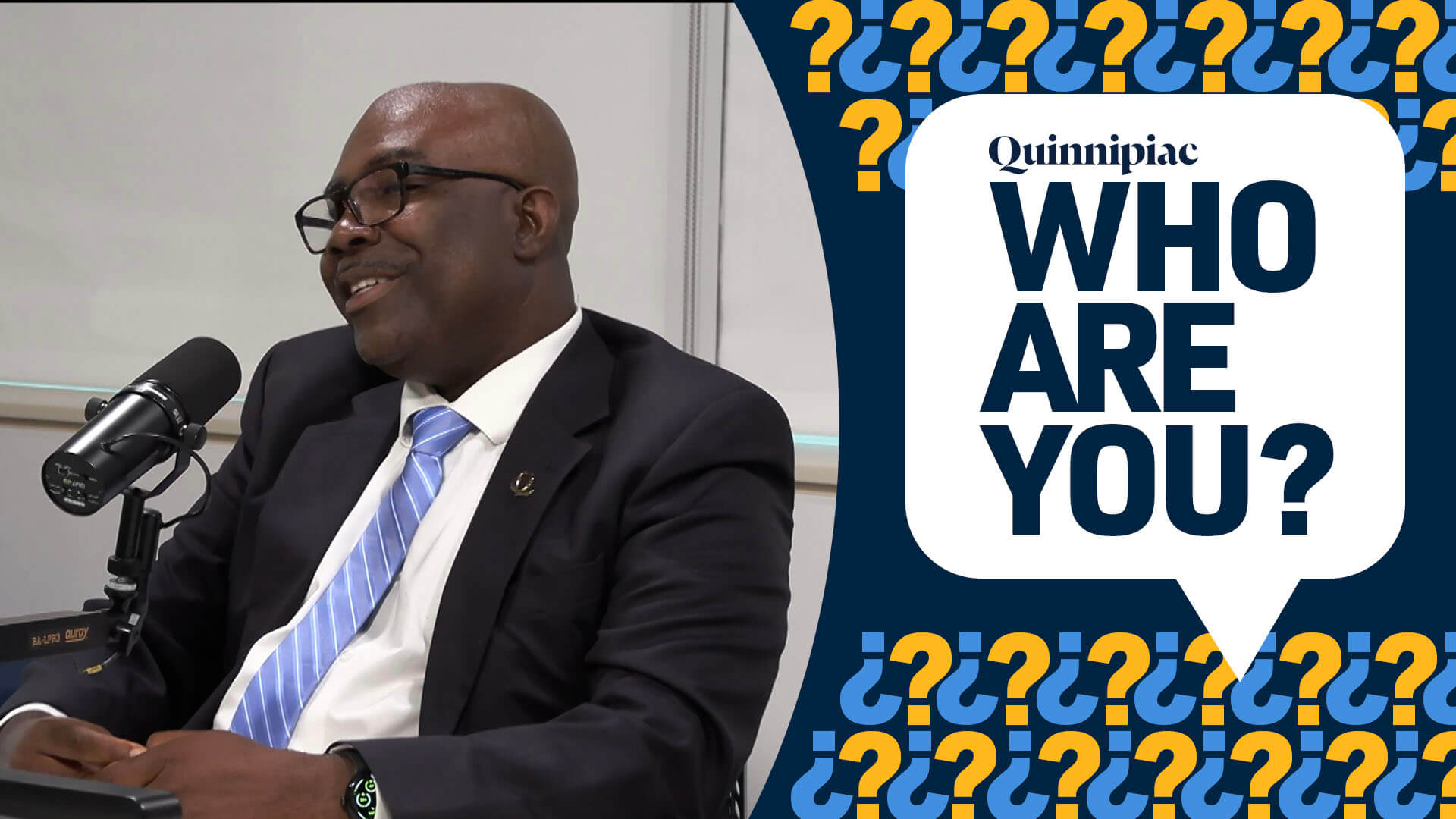
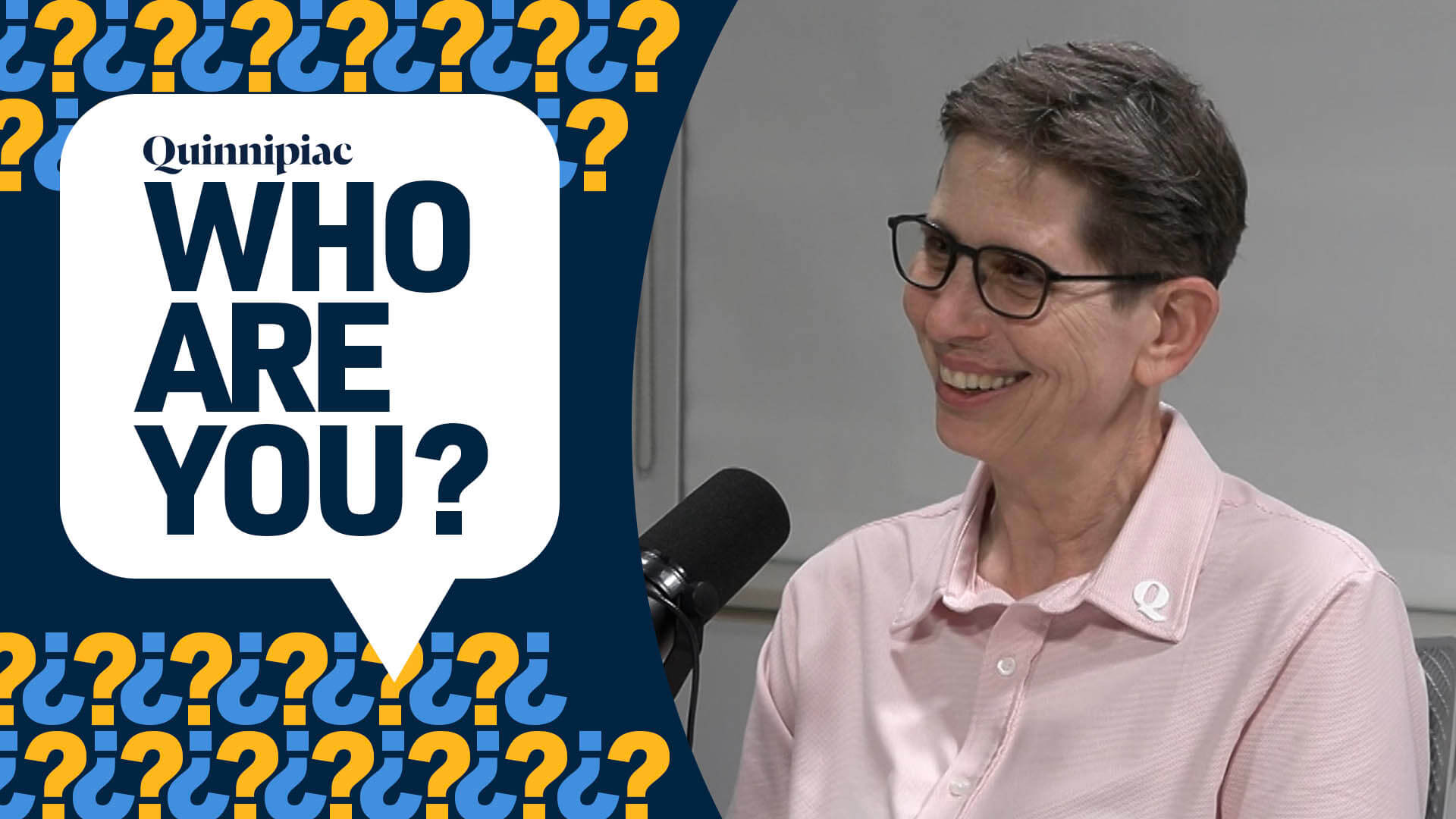
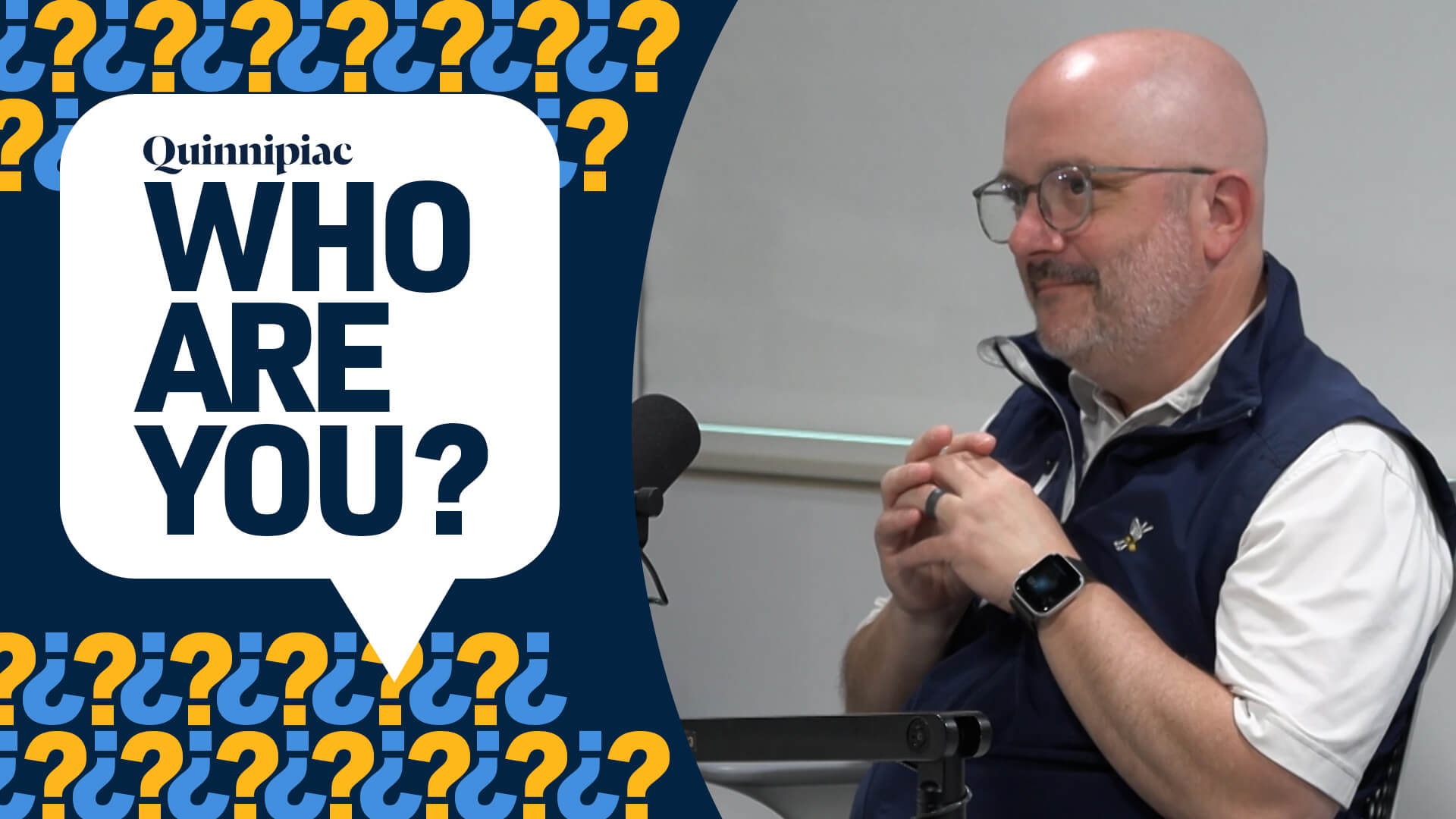
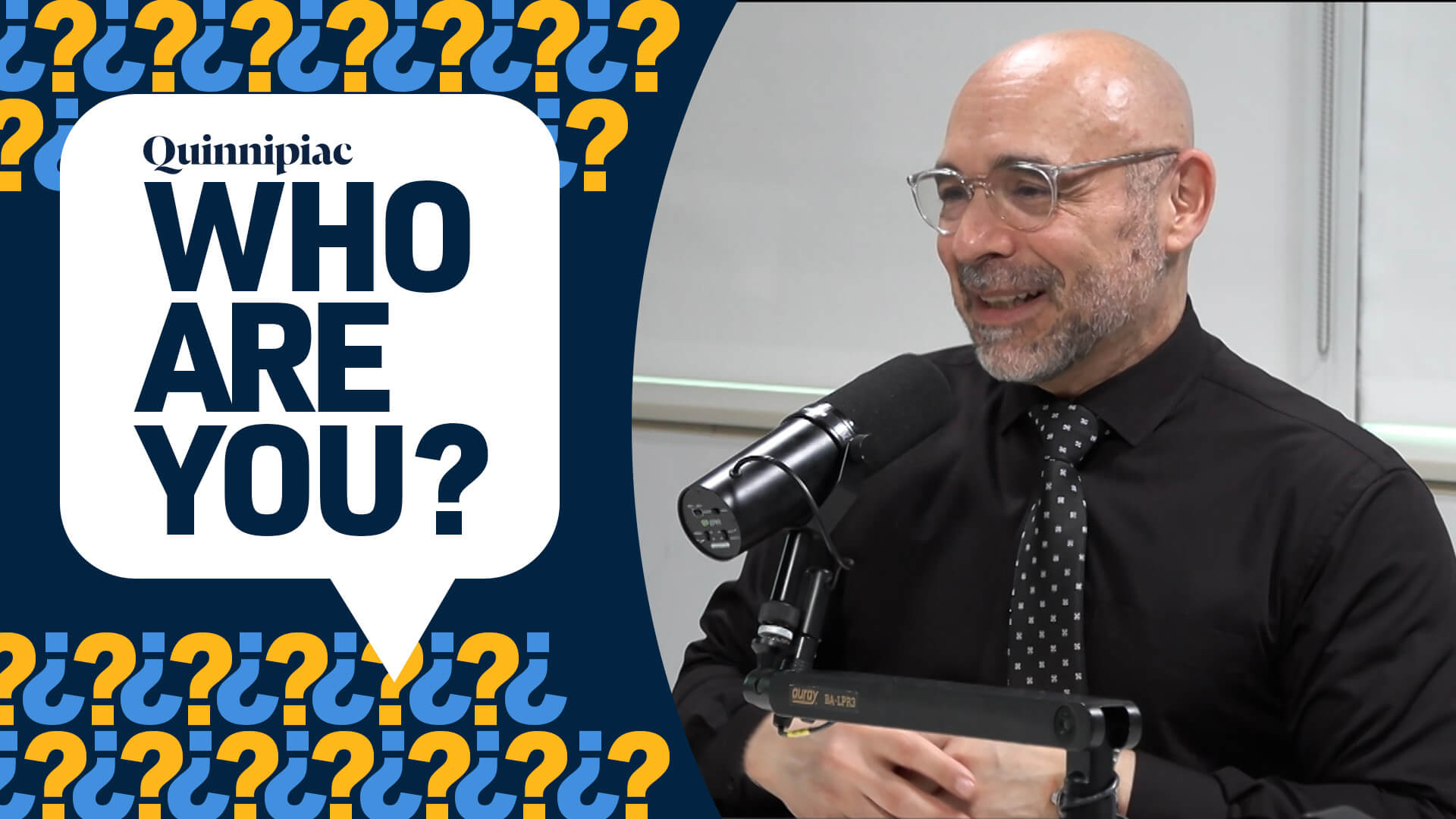
‘Who Are You?’ podcast with guest Professor Robert Yawson
Solving wicked problems and the benefits of interdisciplinary learning
Solving wicked problems and the benefits of interdisciplinary learning
Joel Vanner: Hello, and welcome to ”Who Are You?,” the Bobcats you know. The stories you don't. I'm your host, Joel Vanner, inside the podcast studio at Quinnipiac University's School of Communications, and I am joined today by my guest, Robert Yawson. Robert, welcome to the show.
Robert Yawson: Thank you for having me.
Joel Vanner: So we know your name, Robert, but tell me, who are you?
Robert Yawson: Yeah, I'm Professor of Management and the Chair of the Entrepreneurship, International Business, and Strategy Department at the School of Business. And only yesterday I was named the William S. Perlroth Chair of Business, which is a high honor.
Joel Vanner: Congratulations.
Robert Yawson: Thank you.
Joel Vanner: And you've been at Quinnipiac for...?
Robert Yawson: 13 years. This is my 13th year.
Joel Vanner: Awesome. So, let's say time travel back. Robert, as a child, what were your aspirations and goals? And how did that kind of manifest to where you are today?
Robert Yawson: Yeah, so, I was born in Ghana. I grew up in a very large family, nice siblings, and my dad was a college teacher, and all, what we knew was that if you grew up to become a teacher. We didn't even know any other profession. I spent all my life on college campuses. So myself and my siblings, the ambition is to grow up, go to school, and become a teacher. And that's the journey. If I trace it back, it brought me to Quinnipiac. I schooled in Ghana for my- most of my education to the master's level in a different field as a biochemist than-
Joel Vanner: As a biochemist?
Robert Yawson: Yes, my first degree was in chemistry, and I did my master's in Biochemistry.
Joel Vanner: Oh, wow.
Robert Yawson: Yeah.
Joel Vanner: What drew you to that field?
Robert Yawson: Because it's also my dad. My dad was a cultural scientist. So everything around us was science. And growing up, you follow your big brothers, and because they were in science, it's like automatic.
Joel Vanner: You have your idols that you look up to.
Robert Yawson: Yes, you just go, yeah so that was it. So it was more of a family thing than anything else. Yeah. And I did another postgraduate program in Israel, and that's where the changing started coming. And the transition to business actually occurred in Minnesota, one of the large public universities in Minnesota. Where I was training, I became a husband, I followed my wife, who was in the graduate school. So did my PED, another master's in public policy, and then a PED there.
Joel Vanner: And that was your transition into business?
Robert Yawson: Into business, yes.
Joel Vanner: So you made this change into the business world. What led to that change?
Robert Yawson: Yes, that's the question I normally get when I first introduce myself to students in class.
Joel Vanner: From Biochemistry to Business...
Robert Yawson: From Biochemistry to business. And it's partly an accident. It wasn't a planned change that I want to move from the hard sciences to business. It happened at where I was working in Ghana as a research scientist. The HR director resigned abruptly, and I was in my office. Then the director of the institute came and said, “You have to act”. As HR director with no experience, I said, I have no background in HR or business to do that. He said, well, we have an emergency, and the scientists will listen to a scientist in that transition.
Joel Vanner: So they know.
Robert Yawson: Yeah, so that was a bit of it, but I was still a practicing scientist. Then my wife came to the US for her graduate degree; I visited her, and as every international student will tell you, you get lost a lot. So where we were, we're trying to find a center at the International Student Center, and we got totally lost. So whilst navigating to where we are, I saw oh, a program, which is science management, science policy, said, Oh, this relate to what I'm doing. It's not taking me away from the sciences, but the science, how to manage scientists and others. So I inquired about it and well, yeah, it interested me a lot. And, of course, my wife was here too. It was another pull. So I went back home, wrote the GRE, got admitted into the school, and did a master's in public policy in science technology. Then after that, the business school and the public policy school was, I mean, almost in the same burden and the interactions and the people we worked with. And my interest started growing about talking about management of scientists. And it's not just the narrow foot, the entire business. And because of my background in the sciences, I had more opportunities as a business student, having and having in to talk to the Minnesota Senate about nanotechnology policy, how to manage that. And so it brought me so much opportunities. And that was how the transition came. So the transition was not plan change as it occurs with most people.
Joel Vanner: It wasn't a linear path.
Robert Yawson: It wasn't a linear path. Some accident, some interest, and it all converge to brought me into business, which I don't regret one bit.
Joel Vanner: So you're here at Quinnipiac in our School of Business. Tell me more about the programs that you oversee.
Robert Yawson: Yeah, so I'm the Chair of the Entrepreneurship, International Business Strategy department, and we joke around that it has the longest name.
Joel Vanner: Put that on a business card.
Robert Yawson: Yeah, in the school. But it's also on a more serious note: it's a very interesting department, interesting programs, because it's very interdisciplinary, and student there not just gets into one linear major, but different aspects of business. Entrepreneurship on its own is very interdisciplinary. International business is very interdisciplinary. Strategy. Every business student is required to take strategy. So the advantage student in this program have is you're already trained in that even before your capstones, and the job opportunities are wide. So I enjoy chairing the department. I'm also the coordinator for the Master of Science in Organizational Leadership. It's one of- we call it one of the first movers in the market. Quinnipiac was one of the first investors to introduce the MSOL program online, fully online and students enjoy it because it brings people from diverse backgrounds, engineers, medical doctors, from all professions who really want to go into managerial roles from their expertise. So students who come in, not just benefit from the professors in the program, but their own colleagues because people are coming from different aspects of industry, CEOs, medical doctors, engineers, etc. So that's what makes it exciting to be in charge of all these programs.
Joel Vanner: So it sounds like in the organizational leadership program, you have students from all different backgrounds that are coming in to learn, kind of like you had the sciences background and you came in to learn business, and that's where you are today. How do all of the experiences that you have inform how you teach in the classroom and how you relate to students?
Robert Yawson: So yeah, it gives you a broad background and excitement with some of the students. Some students coming into the program from very different background, like engineering, and they are a bit anxious. Their first foray into business classes. You introduce yourself, your background, or you are a scientist and you tell your story. Then in the classroom, it opens the interdisciplinary nature of class. Everybody contributes, so nobody feels that, "Oh, I don't belong here", because when you sell the program: one, to them as the interdisciplinarity, and it shows in the classroom, it's not just by selling it to them, they feel it, and you are able to relate to several people in the class. You bring topics which may not be directly engineering. We talk about synthetic biology; we talk about nanotechnology in a leadership class, in management class, and it makes them excited. So that way, that background in science, to them, with background in science. So that's what brings me to a classroom, and I enjoy it, and the students also enjoy it. It becomes more conversational, and through that students learn better than just telling them the theories and everything. It's very relatable because of the background.
Joel Vanner: And especially the Masters of Science and Organizational Leadership is fully online. So having that connection is really important, right?
Robert Yawson: It's really, really important. And because of that, you always get student coming to the office hours. Now they don't want to listen because it's virtually online. But no, "We want that online". "Tell me more". "You wrote this on that discussion board; I want to hear it from you". So because of that, they get engaged with you, and it doesn't seem like you are just behind the screen telling people that it is 100% virtual, that interaction. And that's the differentiation between Quinnipiac's program, the MSO program, is you have direct contact with professors who are on campuses. It's not like a prepackaged program and somebody delivering it. So that's the beauty of our program. And I believe my background, for example, really helps to give us that competitive advantage.
Joel Vanner: So with your experience, your transition into business, and all of the ways that you transition your experience into the classroom, tell me about your passions in your area of study. What continues to drive you in this area every day now that you're here and have been in the business world for quite a bit.
Robert Yawson: Yeah, so my primary research is on what we call “wicked problems”. Wicked problems are problems that cannot be solved with technical issues, but more of adaptive issues. And most of the problems we deal with as individuals, as business leaders, are intractable and very wicked. So how do you deal with that? We hear a lot about volatility, uncertainty, complexity, and ambiguity. And how do you manage that? And discussions on that alone is really interesting because it's real life. Everybody goes through that, and we all see the volatility around us. We see that uncertainty. So that's what I take from my research, my background, into the classroom, and it's, I teach very different courses in the PMBA — that's the professional MBA, the OL program, undergraduate IB, Entrepreneurship courses. And you try to have a theme through that, and it's all talking about how do you become adaptable? How do you, how flexible are you? Because we are not training students for the vocations now, because by the time they leave, what you taught them in class is already gone.
Joel Vanner: Right.
Robert Yawson: You train them to be more adaptable so that they become continuous learners. So they know how to learn and learn. And that's what I do in class, and I believe my research really helps in doing that.
Joel Vanner: Especially in the age of AI and considerations that that opens up in business, it's- you have to be thinking about what is in the future, not what's right in front of you
Robert Yawson: Not a job, you are not training them for the job, which is now because by the time they leave the program, those jobs are already gone.
Joel Vanner: Right.
Robert Yawson: So how do you train them to be more adaptable, to be learners, continuous learners? They know that, yes, I can do this job, even though that's not what it was when I was in school. But we've trained them to be able to do any job that comes in the future.
Joel Vanner: What advice would you give to students who are trying to navigate that experience, learning all they can learn about business, but also in the back of their mind thinking: things are going to be so different when I'm actually out there in the world?
Robert Yawson: So I usually make a joke in class, especially students with undeclared majors. At times, there's some anxiety: What am I going to do? Then I tell them, Oh, even at my master's level, I was still undeclared. Otherwise, I was, I'll be- You have to be very open to everything. And don't be in class and think that the professors know everything. They are the stages that know who create the knowledge with them. And by learning how to co-create knowledge, it gives you the competitive edge over others because if you go into industry, wherever you are working, you know that you can be adaptable because of the background, because of the type of training you have, you have the ability to learn new things, because you've been taught how to learn and not like just giving you the theories and do that. So you become more adaptable, flexible.
Joel Vanner: A learner, not an absorber.
Robert Yawson: A learner, not an absorber, yes. You learn to do the thing. Every new thing that comes your way will not scare you because you are ready for it. it.
Joel Vanner: And through that, too, you'll build connections. You'll have mentors. I know you're a mentor to many, and you'll build those connections that can help you out in the future, too.
Robert Yawson: Exactly. Yes. And one of the courses I teach is social networking, how you're able to network. And in this day and age, those are some of the most important skills every student needs. And you tell them, how do you network? It's not just social media networking, but even within an organization, how important it is for you to be in the environment, the centrality of all these things and it helps you to grow. Those are the adaptable skills I'm talking about, because if you have the network, you can always draw on them to do that. And that's what we do well here at Quinnipiac.
Joel Vanner: Well, Robert, thank you so much for joining me on the show today, sharing your story, and the work you do here at Quinnipiac. It was great to have you on.
Robert Yawson: Thank you. Thank you very much.
Joel Vanner: If you enjoyed today's episode, be sure to like, comment, and share, and find other episodes of ”Who Are You?,” on Apple, Spotify, and YouTube podcasts. Until next time, when I ask my next guest: who are you? I'm Joel Vanner. Bye for now.












Quinnipiac Today is your source for what's happening throughout #BobcatNation. Sign up for our weekly email newsletter to be among the first to know about news, events and members of our Bobcat family who are making a positive difference in our world.
Sign Up Now