



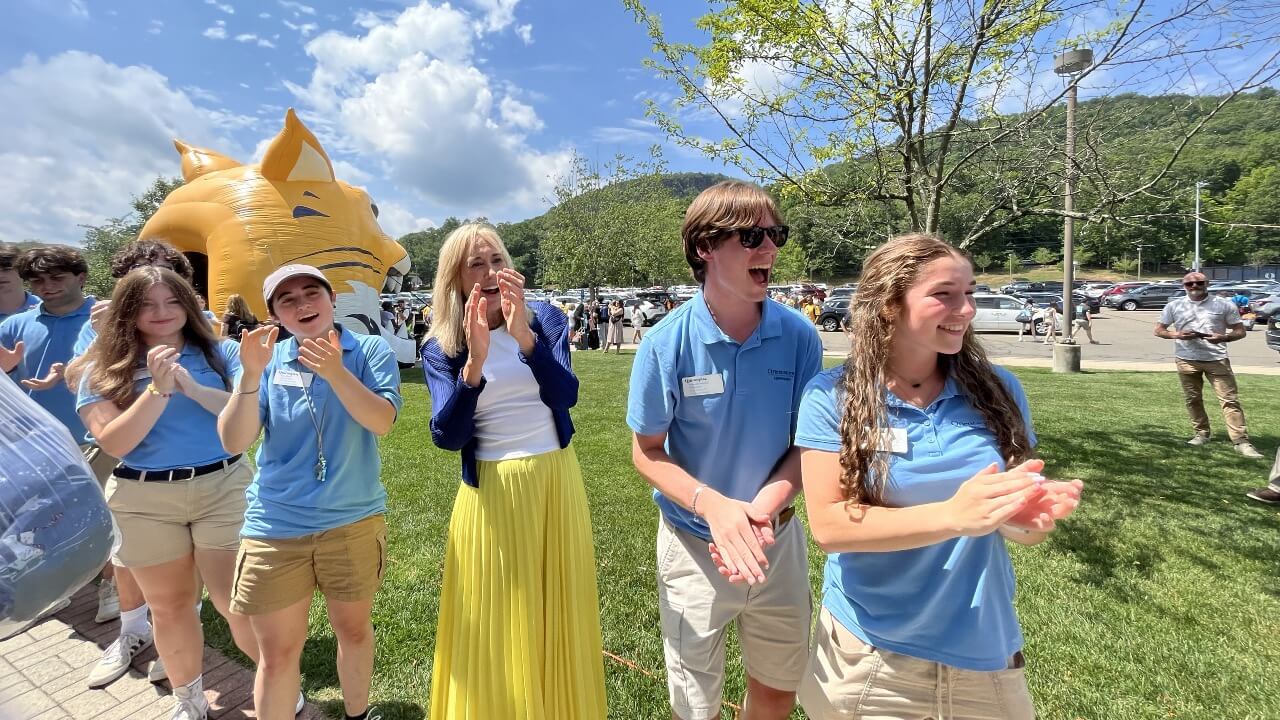
Before becoming an OL, Parr, president of the Student Government Association, did not necessarily picture himself taking on one of the university’s most visible student leadership positions.
“Before QU, I was a pretty timid guy. I’m still pretty socially anxious,” Parr said. “The difference between now and then, however, is that I know how to say 'yes.'”
That first major “yes” was Orientation. Since then, Parr has joined SGA, served as vice president for fraternal education on the Interfraternity Council and helped found Quinnipiac Runway, Quinnipiac’s Fashion Club.
“Becoming an Orientation Leader was the first big yes I ever gave,” Parr said. “I put myself out on a limb, and that taught me how to put myself out on an even bigger limb.”
For Caffyn-Parsons, a Division I women’s tennis player, Orientation opened a different door. During her first year, much of her college experience revolved around her sport, leaving little time to explore opportunities elsewhere on campus.
“My freshman year, almost everything I did revolved around tennis,” Caffyn-Parsons said. “Orientation was really the first experience that pushed me to see how much more of Quinnipiac there was to be a part of.”
That shift has since led Caffyn-Parsons to become a student tour guide, digital platform assistant and Student-Athlete Advisory Committee executive board member. Instead of replacing her identity as a student-athlete, those roles gave her additional communities and interests outside of athletics.
“Orientation gave me an outlet away from tennis and helped me build an identity on campus beyond being a student-athlete,” Caffyn-Parsons said. “Once that summer was over, I wanted to explore everything — clubs, jobs, leadership positions — and really become part of the Quinnipiac experience.”
Clark, president of the Class of 2027, experienced a similar shift in how he viewed his potential as a leader. Clark has since become involved with SGA and Admissions, but said Orientation first helped him recognize that leadership did not require changing who he was.
“Being an OL changed my perspective of myself as a leader by really showing me that I was capable of leading,” Clark said. “This experience gave me so much confidence and really helped me to see that I can be comfortable being myself and still be a successful leader.”
That confidence is developed alongside practical skills OLs repeatedly use throughout the program. Working with incoming students requires them to communicate with unfamiliar people, collaborate with other staff members, adapt quickly and speak in front of groups.
“The ability to connect with people quickly, collaborative work and public speaking have been the most useful for me,” Clark said. “Those skills influenced me to apply for Admissions and become a tour guide.”
Public speaking was also one of the most transferable skills for Caffyn-Parsons. Repeatedly speaking in front of first-year students throughout the summer made communicating with unfamiliar groups feel more natural when she stepped into other positions.
“Public speaking was something we were constantly practicing as OLs, and eventually it stopped feeling intimidating,” Caffyn-Parsons said. “That confidence made it easier for me to walk into a tour, a meeting or another leadership role and trust that I could handle it.”
For Parr, those communication skills eventually translated to an even larger audience. During Welcome Weekend, he addressed the incoming class, which was something he said would have once seemed nearly impossible.
“If I didn’t have the experience with public speaking and interpersonal communication that I gained from Orientation and the subsequent opportunities I took from it, there’s no chance in the world I could have gotten on that stage,” Parr said.
Orientation also teaches leadership through situations that cannot always be anticipated. OLs spend their summer working with different personalities and responding to the changing needs of incoming students, forcing them to adapt their approach.
“Learning how we could observe and deal with issues regarding students has helped me by giving me a toolbelt that I can apply flexibly to other positions and organizations I’m a part of,” Parr said.
Those skills can become especially valuable for students balancing several responsibilities at once. For Caffyn-Parsons, moving between athletics, SAAC, Admissions and her work as a digital platform assistant requires the same adaptability and communication that became routine during Orientation.
“The skills I gained through Orientation have followed me into every role I’ve taken on since,” Caffyn-Parsons said. “Whether I’m working with student-athletes, giving a tour or doing my job, I’m using some part of what Orientation taught me.”
But the pathway from Orientation into campus leadership is not built through training alone. All three students pointed to the people surrounding OLs as another reason the program can encourage students to become more involved.
“There’s a certain tenacity that each Orientation Leader tends to bring to the table when they join,” Parr said. “Everyone wants to make a difference and make their first-years’ lives easier.”
For Caffyn-Parsons, being surrounded by involved students was particularly influential. Coming from an experience primarily centered around tennis, the Orientation staff exposed her to peers whose college lives included organizations, campus jobs and leadership positions she had never considered pursuing herself.
“I was surrounded by people who were involved in so many different things, and seeing how passionate they were made me want to explore what was out there for me,” Caffyn-Parsons said. “Their involvement was contagious.”
Clark noticed that same effect. OLs spend an entire summer alongside students involved throughout campus, meaning conversations and friendships can naturally introduce them to organizations they otherwise may not have encountered.
“Seeing their involvement and impact in their own communities on campus has inspired me to join other orgs and apply for different positions,” Clark said.
That influence directly contributed to Clark’s involvement with SGA. During his first year as an OL, several members of Student Government were also on the Orientation staff, allowing him to learn about the organization through people he already knew.
“Their passion and the connections I made with them were a heavy influence in me running for my position last year,” Clark said.
Orientation also connects its staff with administrators, offices and resources across the university. Through training and the summer sessions, OLs develop a broader understanding of how Quinnipiac operates while building relationships with people they may work alongside later.
“OLs interact with so many different administrators and people of note on campus,” Clark said. “These connections have proved to be very valuable when it comes to working in a professional setting with these people.”
The progression can happen within Orientation itself, too. During Clark’s second year on staff, he began viewing himself not only as a resource for incoming students, but also as a mentor for first-year OLs.
“Being able to manage both my own first-years as well as make time to still provide support to the new staff showed me my growth,” Clark said. “My abilities had progressed to a point where I needed to take on more leadership to continue developing myself as a leader.”
For Parr, that realization came after completing his first Orientation session. Successfully guiding a group of incoming students gave him tangible evidence that the lessons from training could translate into results.
“I just helped to ease 13 new students into their first night at QU and did a pretty darn good job,” Parr said. “I think feeling that made me realize that I chose the right path and instilled me with the confidence I’ve needed to achieve more and more.”
For students like Caffyn-Parsons, that growth can also mean discovering that involvement does not have to remain confined to one area of college life. A student-athlete can also be a campus employee, tour guide and student leader, with each experience adding another dimension to their time at Quinnipiac.
“I went from having almost my entire college experience revolve around tennis to wanting to experience as much of campus as I could,” Caffyn-Parsons said. “Orientation gave me the confidence to keep saying yes to things I probably would not have considered before.”
That willingness to say yes is a common thread across all three students’ experiences. Orientation may begin with helping incoming students find their place at Quinnipiac, but in the process, OLs can end up finding new places for themselves.
“The skills and community that you gain during your time act as a funnel towards opportunity,” Parr said, “and it’s your job to grab it and run with it.”
For Clark, that message is particularly important for students who may not initially picture themselves as Orientation Leaders. He entered the program questioning whether his quieter personality fit his perception of the role.
“I was one of those people who thought since I was quiet and more introverted, this may not be for me,” Clark said. “But I had a great mentor who helped me realize there is no cookie-cutter OL.”
Orientation does not necessarily create one type of student leader. Instead, Parr, Clark and Caffyn-Parsons’ experiences show how the program can give students different opportunities to build confidence, find communities and discover where they want to contribute on campus.
“Some of the best OLs I’ve seen are made from the quiet students who find their voice on our staff,” Clark said. “I believe that anyone can become an OL and be successful in the position in their own way.”
For some students, finding that voice begins with a single summer. What follows can be a pathway into organizations, jobs, athletics and leadership opportunities that shape the rest of their college experience.
“I think saying yes is a sign of a great leader,” Parr said. “Being able to take a healthy risk to better yourself, others, or the program or organization you’re a part of is one of the most valuable skills you can have, and I have Orientation to thank for that.”
Read This Next













Stay in the Loop
Quinnipiac Today is your source for what's happening throughout #BobcatNation. Sign up for our weekly email newsletter to be among the first to know about news, events and members of our Bobcat family who are making a positive difference in our world.
Sign Up Now