



Quinnipiac students get a different kind of college experience at Masonicare
August 26, 2026
August 26, 2026
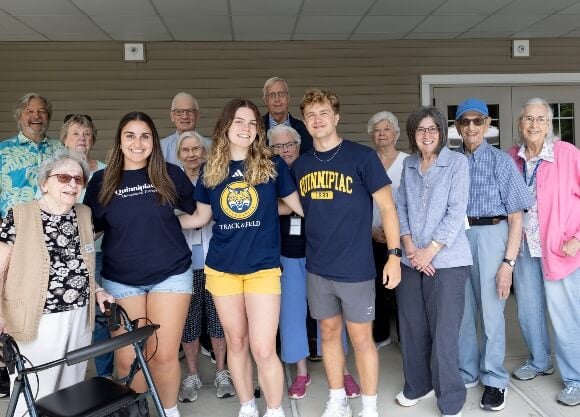
“It’s fun,” said Erin Brennan, a first-year graduate student in Quinnipiac’s occupational therapy program. “I love it."
Brennan is one of three Quinnipiac students participating this year in the university’s Students-in-Residence program at Masonicare in Wallingford. She is joined by seniors Danielle Tully and Charles Woolley. The students were welcomed Tuesday afternoon at Masonicare’s Ashlar Village, where they met residents and began settling into an experience designed to bring generations together.
The program has been in existence for about 10 years, said Cherie Macri, director of enCompass at Masonicare and an adjunct professor in health and exercise science at Quinnipiac. This is the first year Masonicare has welcomed three Quinnipiac students.
“We are excited to have the Quinnipiac students back at our community this year,” said Laura Gibbons, associate executive director of Masonicare. “It is a unique intergenerational opportunity for the students and our residents. It is wonderful to see the students engaging in day-to-day life at our community and the meaningful relationships they develop during their time with us. It is also a great opportunity for the students to learn more about our organization and gain valuable experience that they will take with them after they graduate.”
Tully and Brennan share an accommodation at Masonicare at Ashlar Village in Wallingford, a continuing care retirement community. Woolley lives in The Apartments at Masonic Ave., part of Masonicare’s lower campus independent living.
Adding a third student expands the program’s reach to about 200 additional residents, Macri said.
The students still spend their days taking classes. But when they return home, their surroundings look quite different from a typical college residence hall.
Brennan said the experience has reminded her of college in an unexpected way.
“In a way, it kind of feels like adult college,” Brennan said.
There are neighbors to get to know and activities and events to attend. Brennan said she has already become friendly with people in the community and goes to them for small things, much as she might with neighbors anywhere else.
The biggest difference may be the pace.
Tully, a senior from Boston studying occupational therapy, said the community is considerably quieter than the Quinnipiac residence halls she has called home.
But she quickly learned that quiet does not mean inactive.
At a welcome party in assisted living, Tully said, the residents were eager to keep the celebration going even after the students were thinking about calling it a night.
“They were ready to go longer than we were, honestly,” Tully said.
Peg Limbacher, an 83-year-old Masonicare resident and Quinnipiac alumna, is not surprised.
Limbacher first attended Quinnipiac decades ago, earning an associate degree in medical secretarial studies in 1963. She returned later and earned a bachelor’s degree in behavioral science in 1981.
Now she is watching current Quinnipiac students become part of her community.
“Fabulous,” Limbacher said when asked what she thinks of having the students around.
She said the interaction is valuable for residents and students alike. Young people get to spend time with older adults outside of a classroom or clinical setting, while residents get the energy and perspective of college students.
Macri sees the same exchange.
“I think it breaks stereotypes in both directions,” she said.
Tully joined the program because she wants to work with older adults as an occupational therapist.
“I wanted to immerse myself in the population that I want to work in someday,” she said.
The students attend activities, share meals with residents and spend required hours getting to know the community. They are not providing occupational therapy or other clinical services. Instead, they are learning about the people they may eventually serve in their careers.
Woolley, a senior health sciences major from Mahopac, New York, hopes to become a physician. He also works as an EMT, an experience that has often exposed him to people during difficult moments.
Living at Masonicare offers him a different perspective.
“You don’t ever get to see people how they normally live,” Woolley said.
That everyday perspective is one of the program’s central goals.
Macri said the students have already immersed themselves in the community, attending dinners, carnivals, dance parties and other activities. She said they were eager to participate even before they were required to fulfill program hours.
The residents, meanwhile, have made an effort to welcome the newcomers.
Woolley said he has received welcome letters from residents and that his photograph has been posted in the community.
“They’ve all seen my picture on the wall, so everyone kind of knows my name,” he said.
There is one problem: He does not know all of theirs yet.
“I’ve met hundreds of people,” Woolley said, explaining that he is still trying to learn everyone’s names.







Quinnipiac Today is your source for what's happening throughout #BobcatNation. Sign up for our weekly email newsletter to be among the first to know about news, events and members of our Bobcat family who are making a positive difference in our world.
Sign Up Now