



Quinnipiac joins state and healthcare leaders in calling for action to address Connecticut's primary care physician shortage
November 20, 2026
November 20, 2026
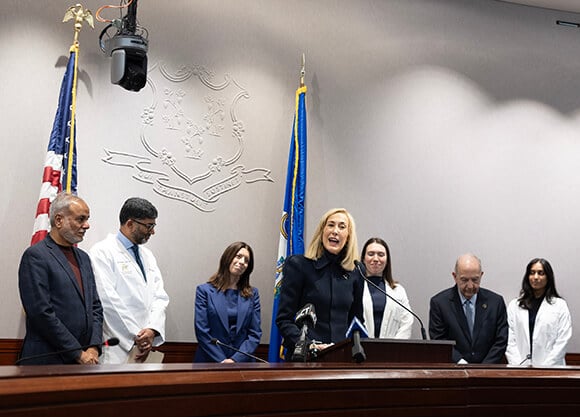
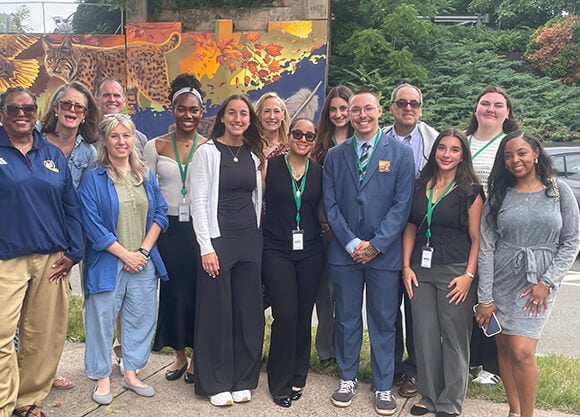
Speaking at a press conference at the Legislative Office Building in Hartford on National Rural Health Day, Hardin urged state leaders to act on recommendations from Connecticut's Physician Recruitment and Retention Working Group, including a proposed scholarship program for medical students who commit to practicing primary care in underserved areas of the state.
“Connecticut has a primary care shortage, and it hits our rural communities hardest,” Hardin said. “Projections are that by 2030, the state will need 400 new primary care doctors to help cover the shortage.”
The state’s northwest and northeast corners are both federally designated primary care shortage areas, Hardin said. Together, the two regions are home to more than 200,000 residents.
Dr. Lisa Coplit, dean of the Frank H. Netter MD School of Medicine at Quinnipiac, said that the state’s current primary care workforce covers only 45 to 48 percent of the state’s need.
“Connecticut ranks sixth in the nation in doctors per capita,” she said. “This isn’t a shortage of doctors. It’s a shortage of primary care doctors in the places that need them most.”
She highlighted disparities among three Connecticut counties:
In Fairfield County, there are 97 primary care physicians for every 100,000 residents.
In Litchfield County, there are 56 primary care physicians for every 100,000 residents.
In Windham County, there are 45 primary care physicians for every 100,000 residents.
“Many practices have stopped taking new patients,” Coplit said. “Families call again and again and hear the same answer: ‘We’re not taking new patients.’ When the wait gets long enough, as Hardin said, people stop trying and the emergency room becomes the front door.”
More than one-third of the state’s physicians are over 60, she said — and many are getting ready to retire. The state also struggles to retain physicians who complete their training here.
“Every year, we’re training more than 2,000 residents and fellows in the state and we are losing at least 50 percent of them,” she said. “Connecticut is in the bottom 10 states in the nation at retaining our residents.”
She emphasized the need for up-front scholarship support that keeps talented aspiring physicians from hitting the new federal loan limits.
“The average Quinnipiac Netter graduate leaves medical school with about $250,000 in debt, which is right along the national average. This year, it got harder. The federal Grad PLUS loan program ended for new students on July 1,” Coplit said. “Now students can borrow only $50,000 a year, up to a cap of $200,000 in total and you can see the problem with those numbers. They cannot even finish medical school. Meanwhile, primary care pays about 28 percent less than other specialties. Put those together, and the math pushes graduates toward higher-paying specialties or out of state where the cost of living is lower.”
Rural communities see it most acutely.
“Here’s something else people don’t realize: This problem is bigger than any one school,” Coplit said. “Connecticut has three medical schools: UConn, Yale and Quinnipiac Netter. Each one graduates roughly a third of the medical students every year who go on to become residents and physicians. No single school, public or private, can close this gap alone. It will take all three of us.”
Quinnipiac Netter is ready to do its part.
“We were built for primary care and serving our most underserved populations. Each year, 39 to 42 percent of our graduates go into primary care residency programs,” Coplit said. “With Hartford HealthCare, we already train residents in rural Torrington and Winsted in our rural family medicine and our rural psychiatry programs. At our rural residency clinic, new-patient waits dropped by nearly 90 percent. In just 90 days, more than 240 people who had no primary care doctor got one. We want to keep these doctors here.”
Sophia Marra, MD ’27, is a fourth-year medical student at the Frank H. Netter MD School of Medicine.
Before attending medical school, she worked at the VA in Boston, doing clinical research with veterans. It was there she learned about a life-changing VA scholarship.
“It's a full scholarship to medical school. In return, I'll serve at a VA for at least six years after residency. In other words: my education in exchange for my service,” she said. “To be frank, without that scholarship, I don't know if I'd be becoming a doctor. Medical school is a huge financial commitment, and I honestly don't know where I would have ended up.”
Marra said she felt so fortunate to have received the scholarship, particularly knowing that many of her classmates are taking on hundreds of thousands of dollars in debt.
“That debt is a weight you carry every single day. And quite frankly, my classmates are scared,” she said. “Not having that weight gave me freedom.”
The scholarship allowed Marra to explore her career options before ultimately deciding to pursue psychiatry.
“If I'd been carrying that debt, I think I would have been swayed toward a specialty that paid more. I think a lot of students are,” she said. “And in psychiatry, if it is not an emergency, patients can wait six, seven, eight months for an appointment. By then, we've lost vital time.”
There’s a catch to her scholarship, though.
“It's a national program, and the VA can send me wherever it needs me,” she said. “If it were up to me, I’d choose Connecticut. My family is here. My partner is here. This is where I learned medicine, and this is where I want to make my life. So I think Connecticut should make students like me the same kind of deal: Help us through medical school, and we'll stay and serve the communities that we trained in. For my classmates, I think it would be a no-brainer. Not having the weight of that debt would be life changing.”
Dr. Khuram Ghumman is the associate dean for strategic partnerships and family medicine clerkship director at Quinnipiac Netter. He has also served on both of the state’s physician recruitment and retention working groups, which brought together physicians, hospitals, all three of Connecticut's medical schools, patient advocates and state health officials.
“Sophia just described a deal,” he said. “The state’s own working group suggested this plan two years ago.”
In January, the working group sent its report to the General Assembly with three priority recommendations:
First, a scholarship program for future primary care doctors.
Second, tax incentives to keep primary care doctors practicing in Connecticut, with the largest incentives in healthcareshortage areas.
Third, grants for primary care practices that take on new patients with Medicaid patients.
“I want to focus on the first today to answer how we can keep Sophia in the state,” Ghumman said.
Here’s how the scholarship would work:
Up to 15 new scholarships a year: five at each of Connecticut's three medical schools.
Up to $75,000 a year, for students committed to primary care.
For every year of support, one year of primary care service would be in an underserved part of Connecticut.
Family medicine and psychiatry get top priority.
Under the recommendation, a student who doesn’t serve would repay the full amount, plus one and a half times interest.
“Why scholarships, and why not loan forgiveness? Because the timing matters,” he explained. “Loan forgiveness comes after they have already made some choices. They may have already chosen a speciality. They may have chosen to go to a different state for training. A scholarship reaches students while those choices are still open. There's no loan to forgive, because there's was no loan to begin with.”
But the money alone isn’t enough, Ghumman said.
“It's the service commitment that keeps doctors here, placing them where access is at its worst,” he said. “This isn’t untested. Mississippi has run a state-run scholarship like this since 2007. For every year of funded support, those students then practice in healthcare shortage areas. Connecticut can adapt the same model.”
Together, the working group's recommendations support a goal of 400 new primary care physicians by 2030.
“This problem has been studied twice over the past five years,” Ghumman said. “The working group has recommended a concrete approach. The next step is putting it into practice, with the goal of improving access to healthcare for Connecticut residents.”
Dr. Peter Yoo is the senior vice president and chief academic officer at Hartford HealthCare, Quinnipiac’s primary health system partner.
“Connecticut has some of the finest healthcare institutions in America,” he said. “The latest Leapfrog Hospital safety ratings have just come out just yesterday, and Connecticut ranks first, number one in the nation, number one. That's something for all of us to be proud of. Yet, for many people across our state, getting access to that excellent care is becoming more difficult. Finding a primary care physician can be challenging. Appointments can be hard to get. Wait times are getting longer, and in rural communities, a routine doctor's visit can mean a long drive, time away from work and a significant disruption to daily life. Sometimes the hassles and poor access mean putting off timely care, and manageable problems become unmanageable emergencies.”
Rural communities deserve particular attention and investments that reflect their circumstances, Yoo said.
“That's one reason our partnership with Quinnipiac and the Quinnipiac Netter School of Medicine means so much to us,” he said. “Together, we share a commitment to developing physicians who want to build their careers right here in Connecticut, in the communities where they are needed the most. Our rural family medicine residency is a wonderful example of just that. Our residents train at Charlotte Hungerford Hospital, right there in Torrington. It's an essential resource for the community and in primary care practices serving the quiet towns of rural northwestern Connecticut, where the population is aging and fewer physicians remain in practice. They care for local patients, they work alongside local physicians and come to understand the geography, the culture and the people who make these communities what they are.”
Over time, these young doctors develop relationships, put down roots and become parts of the communities that they themselves belong to, he said.
“Through our partnership with Quinnipiac and the Frank H. Netter MD School of Medicine, we hope to train a generation of physicians who know these communities, belong to them and will serve them for years to come,” he said. “Unfortunately, the financial realities of medical education could put that dream out of reach for some. Some will finish their training with $200,000, $300,000, even $400,000 in educational debt and find themselves choosing a career in a higher, higher-paying specialty simply because they cannot afford to do otherwise. We need to make it easier for talented young physicians to follow their dreams, to choose primary care and build their lives and careers in the Connecticut communities that need them most.”
Senate President Martin Looney called for a way to defray the cost of medical school.
“We are facing a a challenge in access to primary care in Connecticut, and I think it's important to point that out here on National Rural Health Day,” he said. “It is probably most pronounced in the rural areas of the state — in northeastern and northwestern Connecticut — but not the only areas of the state where there are problems. There are problems in the urban areas as well, especially in areas that may not have easy access to a community health center. There is a problem that we don't have enough people training for primary care because the financial incentives lead them in other directions.”
The state needs to find ways to overcome that barrier. The financial burdens lead people into areas of practice that they might not choose other things be equal, Looney said.
“This is an important issue — one of the most important issues,” he said. “Too many patients wind up by default in emergency rooms, the most expensive form of care, and also one in which it was fraught with difficulty, especially in urban hospitals. This is just an untenable situation that has to be addressed in many ways, but has to begin by addressing the problem with the shortage in primary care and availability to care.”
Connecticut Sen. Dr. Saud Anwar praised Quinnipiac for its efforts in preparing primary care physicians, particularly in the state’s most rural regions.
“They’re some of the finest trained physicians and finest medical students that I have come across,” he said. “From day one, they are actually committed to clinical care. From day one, they know that they are going to be learning how the outpatient clinic works, how the patient care works, and this is such an important part of the training that the curriculum is unparalleled. No other universities have done this before, so that's gives Quinnipiac the edge.”
He praised the Quinnipiac Netter School of Medicine for emphasizing the need to work in primary care in the state.
“Now Quinnipiac, we have to thank you because if we look at the number of your graduates staying in Connecticut, you're doing your share,” he said.
However, the state now has to do its part, Anwar said.
“We are training the best physicians in the country, but we are not keeping them,” he said. “So today actually highlights our opportunity to speak clearly about what we need to do. One, we need to actually make sure that we strengthen the quality of the trainees. We want to make sure that we give them the incentives to be able to stay in the state of Connecticut, and specifically in the underserved rural areas. And second, we actually need to make sure this is sustainable. It should not be a five-year thing. It has to be much longer — and invest in the institutions that provide the opportunities. That's that's a very basic, simple thing that we should expect from the state to do our share.”






Quinnipiac Today is your source for what's happening throughout #BobcatNation. Sign up for our weekly email newsletter to be among the first to know about news, events and members of our Bobcat family who are making a positive difference in our world.
Sign Up Now