



‘Panther Pat’ documentary celebrates first women’s pro football player
November 11, 2026
November 11, 2026
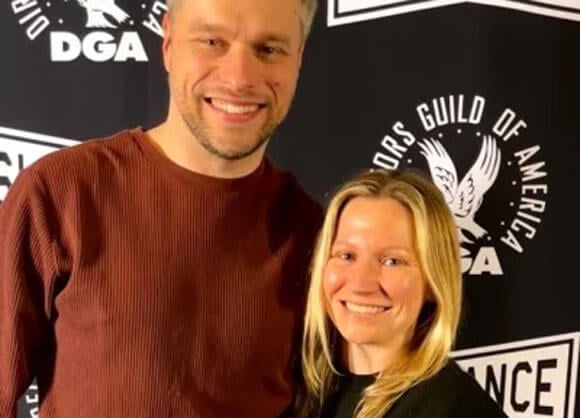
“And then, we finally looked at each other,” Brandon said, still smiling even now. “We were both like, ‘This is going to be such an amazing movie. She’s incredible.’ We knew right away she was special. We struck gold. We really struck gold.”
This is how it felt to meet Pat Palinkas, the first women’s professional football player who made history on Aug. 15, 1970, as the holder for the Orlando Panthers of the East Coast Football League. Her husband, Steve — “Big Steve” to his family — was the team’s kicker.
“Big Steve’s dream was to play professional football. I knew he was good enough and I was his holder,” Palinkas smiles in “Panther Pat,” the award-winning documentary short. “I had that magic touch.”
Just like Brandon and Höhne.
Brandon, an associate professor of film, television and media arts, directed and edited the movie. Höhne, an assistant professor of film, television and media arts, was the director of cinematography and a producer.
Earlier this week, a special screening of “Panther Pat” was shown at The Paley Museum in New York City. Two-time Super Bowl champion Eli Manning, one of the film’s five executive producers, moderated a discussion afterward.
It was latest recognition for a movie that celebrates a woman who refused to watch life from the sidelines.
“Panther Pat” has been shown in 15 film festivals across the country this year, including the Slamdance Film Festival in Los Angeles, where it was awarded the Documentary Short Grand Jury Prize.
For Palinkas, her story had been lost to the past until Brandon read a book about football in Connecticut and came across the Bridgeport Jets. As it turned out, a 235-pound linebacker for the Jets named Wally Florence was angry that Palinkas was playing that August day at the Tangerine Bowl in Orlando.
When Palinkas finally made it onto the field after the Panthers scored a touchdown, she bobbled the snap and Florence ran over her like a freight train. He later told reporters, “I wanted to break her neck.”
Undaunted, Palinkas went on to hold for two more extra points that day. The Panthers won the game convincingly, 26-7. Of course, Palinkas will always be remembered as more than a footnote to history.
Brandon and Höhne made sure of it.
Together, they crafted a 12-minute love letter to honor Palinkas and her contributions to football and fearlessness. Although the Palinkas family had some newspaper stories and game programs, there wasn’t enough archival material to carry the film.
Brandon and Höhne interviewed Palinkas multiple times over a two-year span, both at her home and over the phone. As her health declined, it became even more clear they needed to pivot creatively from their original documentary concept.
“For a while, we were thinking, ‘Do we reenact this? Do we get actors and make it look like the ’70s?’ But that seemed kind of boring and quite honestly, expensive,” Brandon said“And then, we remembered something Pat had said in one of our interviews, how when she was younger, girls were supposed to play with dolls and not play football or baseball.
“That just kind of clicked in our heads, and we were like, ‘Wait a second. We could be kind of cheeky and clever here and take these traditional girlhood toys and make them play on a football field.’ It just made sense,” she said. “So that’s what we did. Thankfully, it worked out really well. We needed it to finish the movie, but thematically, it aligned with what we were trying to do.”
Instead of making a brand-new film, they used Barbie dolls and vintage Fisher-Price toys, including those thumb-sized wooden kids with freckles and colorful baseball caps, to tell the story with stop-action animation and puppetry.
“We had never done stop motion or puppetry before,” Höhne said. “But from a cinematic perspective, it was fun because now the world that had always been so large was going to be shrunk down into this little black box theater that was like 6 inches by 6 inches.
“It’s admittedly a time-consuming process, but it’s so rewarding when you're coming out from a studio basement that we've built for this, and after 6 1/2 hours, you're coming back up to take a look at what you have,” he said. “And suddenly, you have 30 seconds to show for it after six hours, but it looks great and it looks beautiful. It’s just so worth it.”
But while it was a deliberate and painstaking process, it was also deeply gratifying to share “Panther Pat” with the world.
“It was an adventure of trial and error to make this film,” Brandon said. “I never played with dolls as a kid, but now I wish that I had because it was a blast just to make the little sets. We needed to figure out how to make a little car look like it’s moving. And how do we make a football move? All of those things.
“I thought people would like the movie, but I wasn't really expecting the reaction to be so positive. It's been my favorite movie that I've ever worked on,” she said. “It's so enjoyable to be in the theater when you see and hear people's reactions. They laugh. They cry. They gasp when Pat gets hit. It just shows the movie is emotionally connecting to people on a lot of different levels.”














Quinnipiac Today is your source for what's happening throughout #BobcatNation. Sign up for our weekly email newsletter to be among the first to know about news, events and members of our Bobcat family who are making a positive difference in our world.
Sign Up Now