



Nursing students immersed in patient-centered oncology care during Flynn Fellowship
July 30, 2026
July 30, 2026
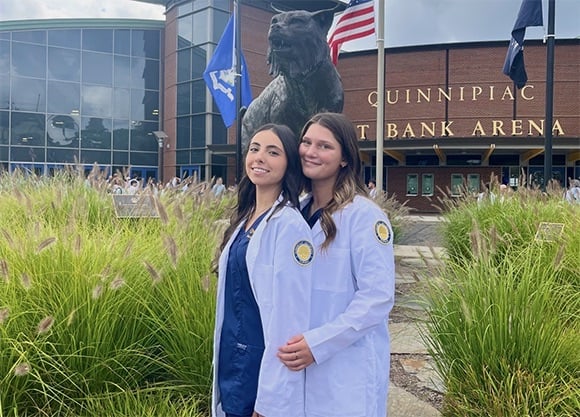
Started by Fred Flynn after his late wife, Susan, passed from ovarian cancer, the fellowship program supports the future of oncological care and helps nurses build the skills to best support their cancer patients. Split into four weeks of working at an inpatient oncology unit and four works in an outpatient clinic, the program has helped open the eyes for those interested in pursuing oncology.
Angiolillo, who spent the duration of her fellowship at Connecticut Children’s Medical Center in Hartford, Connecticut said she will always remember the impact of the program.
“The Flynn Fellowship is an incredible program that prepares aspiring oncology nurses while giving us a firsthand look at what it’s like to work in the specialty,” said Angiolillo. “During the fellowship, I shadowed nurses and was able to experience what a typical day and workload looked like at Connecticut Children’s.”
Angiolillo had worked at Connecticut Children’s the prior summer, where she initially heard about the Flynn Fellowship program.
“As I continued working on MS8, [the oncology floor], as a patient care assistant, my passion for pediatric oncology only grew,” she said. “I wanted the opportunity to continue learning by exploring evidence-based practice, collaborating with so many different members of the healthcare team and gaining a deeper understanding of pediatric oncology. The fellowship was the perfect opportunity to continue learning in an environment that had already become so meaningful to me.”
For Fox, the fellowship opportunity was brought to her attention by the Quinnipiac School of Nursing social media.
“I first learned about the Flynn Fellowship through an Instagram post on Quinnipiac University's School of Nursing page congratulating a student who had been selected as an oncology Flynn Fellow,” she said. “As someone who entered nursing school with a strong interest in oncology, I immediately thought, ‘I’m going to do that someday.’ As I learned more about the Flynn Foundation, I was inspired by Fred Flynn's story and how he transformed a personal tragedy into an opportunity to support future oncology nurses.”
Fox completed her fellowship at St. Vincent’s Medical Center in Bridgeport, Connecticut. The mentorship and experiences she had throughout the program have played a tremendous role in her growth as a future nurse.
“I developed my clinical skills by performing patient assessments, strengthening my communication with patients and their families and gaining experience with chemotherapy education while observing chemotherapy administration and monitoring for adverse effects,” she said. “More importantly, I learned what it truly means to care for patients throughout every stage of their cancer journey.”
As part of the program, fellows were also completed evidence-based research to help advance the future of oncological care.
Angiolillo focused her efforts on understanding the impact of primary nursing for inpatient pediatric oncology.
“My research explored whether assigning primary nurses to hospitalized pediatric oncology patients, compared with standard staffing assignments, could improve patient and family trust, emotional well-being, coping and the overall hospital experience,” she said.
Primary nursing is a relationship-based model of care in which one or more nurses consistently care for the same patient and develop an ongoing therapeutic relationship with them and their family throughout their hospitalization, said Angiolillo.
“My research found that primary nursing improves trust, communication, emotional support, continuity of care and individualized, relationship-centered care for patients and families,” she said. “It also benefits nurses by improving accountability, continuity and job satisfaction. One of the most impactful statistics I found showed that over 93% of patients and families preferred having one of their primary nurses care for them whenever possible. Another study found that implementing a primary nursing model was associated with a 78.5% reduction in missed nursing care. Those findings really reinforced how beneficial primary nursing can be for both patients and nurses.”
At the conclusion of the fellowship, fellows present their research to the nurses, leadership and staff at the hospital.
“It was so meaningful to contribute to conversations about ways we can continue improving the patient and family experience,” she Angiolillo. I hope this research encourages more conversations about the importance of relationship-centered care. One of the biggest things I learned throughout this project is that nursing is not only about clinical skills; it’s also about how you make people feel.
For Fox’s research, she collaborated with two fellows from other universities to determine whether implementing structured, nurse-led, serious-illness conversations proactively could improve oncological patient outcomes.
“Our interest in this topic was sparked after I sat in on a hospice conversation with a patient who shared that she felt too overwhelmed and emotionally exhausted to make important decisions about her care,” she said. “That experience made me realize how crucial it is to begin these conversations earlier in a patient's cancer journey, rather than waiting until a crisis.”
Fox and her team found that having structured, ongoing, serious-illness conversations can help reduce anxiety for both patients and their families by ensuring that patient values are discussed throughout treatment. They also found that nurses are uniquely positioned to lead and reinforce these conversations because they spend the most time with patients, build trusting relationships and serve as their strongest advocates throughout their care.
“I believe this research has the potential to improve oncology care by encouraging earlier and more consistent conversations about patients' goals, values and preferences throughout their cancer journey,” Fox said. “Rather than waiting until treatment is no longer effective or a patient is facing a difficult turning point, these conversations can help patients and families feel more informed, prepared and supported when making difficult decisions. By empowering nurses to initiate and reinforce these discussions, we can strengthen patient advocacy, reduce anxiety and ensure that care remains centered around what matters most to each individual patient.”
Fox knew from a young age that oncology was the career path for her, and the Flynn Fellowship truly helped her confirm that decision.
“There are countless lessons I'll take with me from the Flynn Fellowship, but the greatest lessons came from my patients,” she said. “Getting to know them throughout their cancer journeys taught me far more than any textbook ever could. Whether it was celebrating with a patient ringing the bell after completing treatment, sharing a laugh with a patient who reminded me so much of my grandmother or simply sitting with someone during one of the hardest days of their life, every interaction taught me something meaningful. My patients showed me the importance of providing individualized care, celebrating every victory, no matter how small, and understanding that while we can't always change a patient's outcome, we can always make a difference in how they feel. Above all, they reminded me that every patient deserves compassion, dignity and respect. These are lessons that will stay with me throughout my nursing career and continue to shape the kind of oncology nurse I hope to become.”
Angiolillo had a similar revelation after completing the fellowship.
“If I had to choose my biggest takeaway, it wouldn’t be a clinical skill,” she said. “It would be realizing just how much your presence can mean to a patient and their family. The nurses I had the privilege of learning from showed me that nursing is so much more than treatments. It’s about being someone patients and families can trust during one of the hardest times in their lives. Throughout the fellowship, I saw firsthand how meaningful continuity of care can be and how much comfort a familiar face can bring. That lesson is something I will carry with me throughout my entire nursing career.”
Angiolillo is especially grateful to Quinnipiac for preparing her for the program.
“I cannot thank Quinnipiac enough for the foundation it gave me going into this fellowship. It was such a validating feeling when the nurses would talk to me about a medication, diagnosis or medical term and I could confidently understand exactly what they were talking about. That really showed me how well Quinnipiac had prepared me.”
Fox is also grateful to the School of Nursing faculty for their support in her growth.
“I truly believe every member of the Quinnipiac nursing faculty has helped shape the foundation of my nursing career,” she said. “I am especially grateful to Professor Kayley Bozarth and Professor Sarah Ballough for taking the time to write letters of recommendation in support of my Flynn Fellowship application. Their mentorship played an important role in helping me earn this incredible opportunity. I also felt incredibly supported by Professor Bridget Rich, who attended my Flynn Fellowship graduation. Seeing her there to celebrate the accomplishment alongside me meant so much and reminded me how invested the Quinnipiac faculty are in their students' success.”
With an unwavering passion for nursing, both students knew that Quinnipiac was the perfect place to grow into successful, well-rounded nurses.
“When I was looking at colleges, I knew I wanted a school with a strong nursing program that would prepare me to become the best nurse I could be,” said Angiolillo. “Quinnipiac immediately stood out to me because of its hands-on learning approach and beautiful campus.”
Angiolillo’s mom also attended Quinnipiac, so the university immediately felt like home to her.
“When I visited for myself, I just had a feeling that it was where I was meant to be,” she said. “Looking back now, I know I made the right decision. Quinnipiac has given me incredible opportunities, like my internship and the Flynn Fellowship at Connecticut Children’s, that have helped shape both the nurse and the person I’m becoming.”
Fox also knew that Quinnipiac was the right fit for her after visiting the campuses for a nursing-specific event and meeting faculty like Phil Martinez, clinical associate professor of nursing.
“What truly stood out to me was the School of Nursing's commitment to holistic, patient-centered care, which closely aligned with my own values as a future nurse,” she said. “I vividly remember attending one of the School of Nursing Academic Exploration Days, where Professor Martinez gave a mini anatomy lecture. His enthusiasm for teaching was contagious, and I remember thinking, ‘I can't wait to be in one of his classes someday.’ After taking his adult medical-surgical nursing course, I can confidently say he is just as passionate and inspiring as I imagined. His excitement for teaching has only strengthened my own excitement for nursing.”
For both students, the community they have found across the university has enhanced their college experience.
“My favorite part about Quinnipiac is the sense of community,” she Fox. “I have always felt incredibly supported by my professors, classmates and friends, both inside and outside the classroom. One of the most rewarding parts of my college experience has been working as a facility supervisor at the Recreation and Wellness Center. It has given me the opportunity to meet students from across the university, build meaningful connections and be a welcoming face for the Quinnipiac community. Those experiences have made Quinnipiac feel like so much more than just a place to earn my degree — they've truly made it feel like home.”
Angiolillo has also found a strong community, both inside and outside of the nursing program.
“My roommates and I have been together since freshman year, and they’ve become some of my best friends,” she said. “We have built such a special support system over the last few years, and I know those are friendships I’ll have long after graduation. Even within the nursing program, there’s such a strong sense of community. Whether we’re studying together before exams or waking up early to carpool to clinicals, we’ve all grown through the program together.”
As the roommates advance into their senior year in the nursing program, they are excited to take the lessons they learned from the Flynn Fellowship and apply them to their future careers.
“I would just like to thank Mr. Flynn and the Flynn Foundation for making this incredible opportunity possible,” said Angiolillo. “This fellowship has had such a meaningful impact on both my education and my future career, and I will always be grateful for the experience.”








Quinnipiac Today is your source for what's happening throughout #BobcatNation. Sign up for our weekly email newsletter to be among the first to know about news, events and members of our Bobcat family who are making a positive difference in our world.
Sign Up Now