



Students and professors explore and research menstruation legislation
November 20, 2024
November 20, 2024
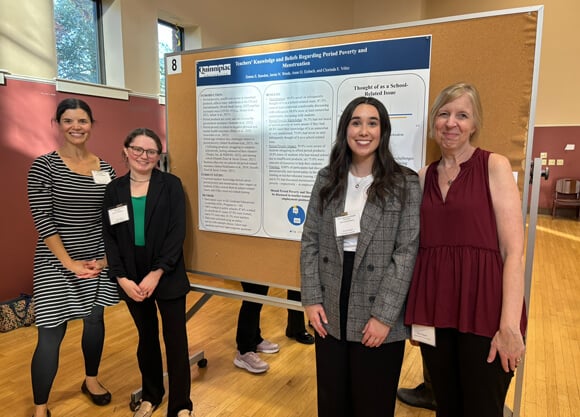
Throughout the past few years, the research lab run by Eisbach and Velez has explored the impact that a lack of access to basic needs can have on families in the community. The lab specifically focused on diaper needs, when families are unable to afford enough diapers to keep their baby clean and period poverty, when families are unable to afford enough products to manage menstruation.
Rawdon and Wrede, both psychology majors, took part in the research lab during their academic career. During her time, Rawdon has the opportunity to volunteer at the Diaper Bank of Connecticut where she developed a deep connection to those struggling with period poverty after learning about its impact.
“After this experience, I was curious to learn more about whether others were aware of the challenges that many individuals face since before volunteering, I really was not that aware of how many people are impacted by period poverty,” said Rawdon.
As the lab was wrapping up its work on diaper needs, new questions and research ideas needed to be posed surrounding period poverty. Wrede knew this was something she would be interested in because of how sensitive menstruation and period poverty can be.
On September 1, the Menstrual Equity law went into effect in Connecticut. Under this law, public schools are required to provide free menstrual products in restrooms accessible to students in grades 3-12, including all girls’ bathrooms, all gender-neutral bathrooms and at least one men's/boy's bathroom.
The pair began their shared research by developing a survey targeting Quinnipiac Educational Leadership Students as those in the program are furthering their education to be able to move into leadership roles in the school system. Rawdon and Wrede wanted to focus the survey on whether or not these educators were aware of period poverty and the impact it can have, as well as the effects of the new legislation.
“Many educators have also personally provided supplies to students using their own money. Regarding the new legislation, a very small percentage of educators had heard of the legislation before this survey. Educators believe the new legislation is important to students’ well-being and education,” said Wrede.
Under the continued guidance of Eisbach and Velez, Rawdon and Wrede had the opportunity to present their research at the New England Psychological Association conference in October. When presenting their research, the pair wanted to raise awareness about period poverty and the effects it can have especially in an educational setting.
The two want more people to be aware of period poverty and the legislation surrounding menstruation. Although they will be graduating soon, working with Eisbach and Velez has been an experience the two are grateful for during their time as students.
Once Rawdon and Wrede graduate, Eisbach and Velez plan to continue the research and encourage students to take part in research opportunities, while also collaborating with other areas and departments on campus, including the School of Education. While expanding on the research, Eisbach and Velez look forward to bringing in a new cohort of students to conduct research in the lab, while also encouraging all students to take part in research opportunities.
“Students have various opportunities to conduct and participate in research. Some courses offer these types of experience, but also students can volunteer in faculty labs or pursue independent studies with faculty here at Quinnipiac, or get involved with our QUIP-RS program,” said Velez.
























Quinnipiac Today is your source for what's happening throughout #BobcatNation. Sign up for our weekly email newsletter to be among the first to know about news, events and members of our Bobcat family who are making a positive difference in our world.
Sign Up Now