



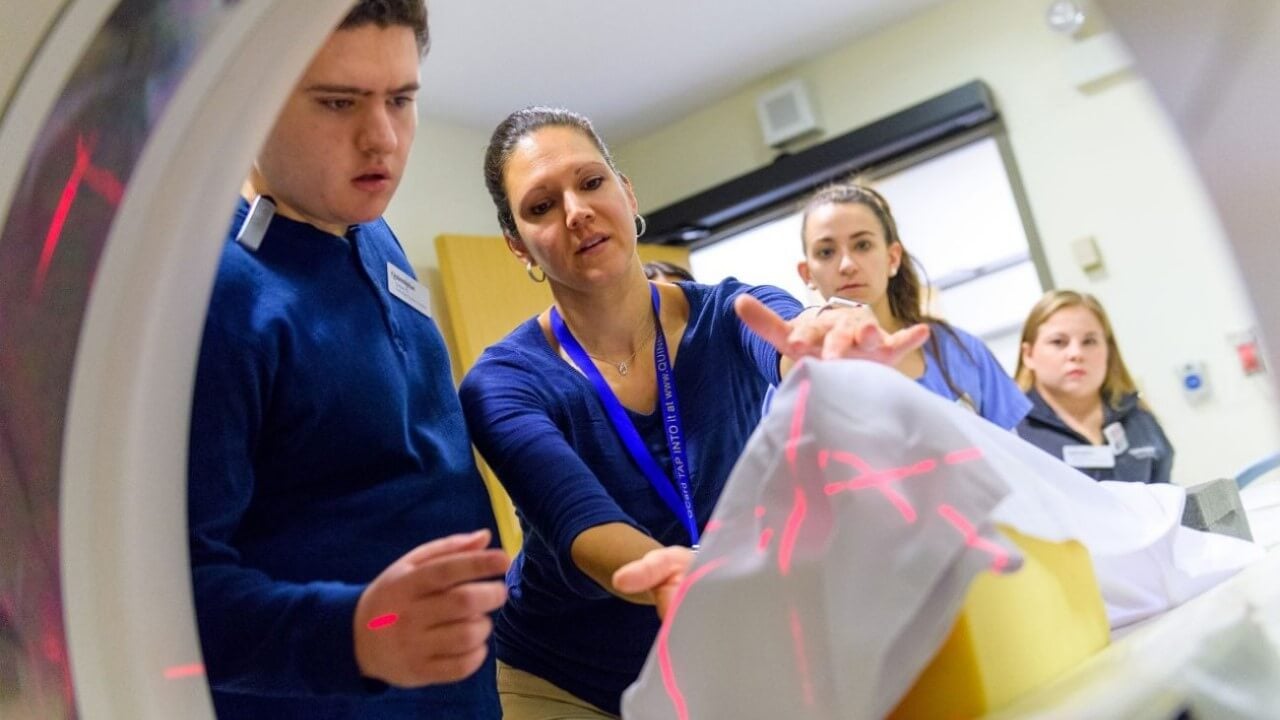
The remains of four individuals uncovered in late 2019 in Ridgefield, Connecticut have been studied in Quinnipiac’s imaging labs on the North Haven Campus. Tania Grgurich, clinical professor of diagnostic imaging, has played an integral role in the research of these remains, which began in 2020 before the COVID-19 pandemic halted their research.
Recently, the study resumed with members from numerous departments working together to understand the stories buried under the Ridgefield soil.
“This study has been a collaborative effort involving multiple disciplines across several institutions, including diagnostic imaging, anthropology, bioarcheology, archaeoentomology, DNA analysis and other related fields,” said Grgurich.
Members of the Quinnipiac School of Health Sciences faculty and staff have made significant contributions to the research with the equipment available in the imaging suite.
“To date, our Quinnipiac imaging team has performed X-ray and CT examinations of the skeletal remains of four individuals, as well as specimen imaging of other artifacts recovered from the burial site,” said Grgurich.
Beyond the medical imaging, many other resources across Quinnipiac’s programs and other universities were utilized to better understand the historical context in which the four individuals lived.
“In addition to the X-ray, CT and specimen imaging studies conducted at Quinnipiac by my colleagues and me, experts from collaborating institutions performed a range of specialized analyses, including genetic, isotopic, entomological, anthropological and historical, just to name few. This has truly been a collaborative effort,” said Grgurich.
Students from the diagnostic imaging and radiologic sciences departments have also had hands-on learning through their work with these historical remains in a unique, once-in-a-lifetime experience.
“For the initial imaging studies, students performed the X-ray examinations and assisted with the CT imaging procedures”, said Grgurich. “The experience provided them a unique opportunity to work with the remains of individuals who may have been connected to a significant event in American history, which they found both fascinating and rewarding. The students were able to connect the abstract events that they had learned about in their history classes to tangible evidence of people that may have been involved in those historic events.”
Students also used the opportunity to put skills learned in the classroom to use.
“Beyond the historical significance of the project, students were challenged to apply their knowledge and critical thinking skills in a non-traditional imaging situation,” said Grgurich. “They were able to adapt techniques typically used for living patients to the imaging of skeletal remains, gaining valuable experience in creative problem-solving, radiation exposure factor manipulation and interdisciplinary collaboration.”
It is through the unique interprofessional resources that these teams can develop meaningful findings and insights.
“Through this multidisciplinary approach, we may be able to determine whether these individuals were indeed connected to the Battle of Ridgefield and, if so, gain insight into their lives, affiliations and roles during this significant event in American history,” said Grgurich.
The research team hopes that understanding the lives of these individuals can expand our knowledge of the founding of the United States.
“These remains represent real individuals whose lives and experiences may potentially form part of our nation’s history. Our team seeks to better understand who these people were and the circumstances in which they lived and died,” said Grgurich.
For the research team working in Connecticut, the unique proximity that these remains have to the state’s history make this project particularly interesting.
“Historical events are often remembered through battles, political leaders and major milestones, but the study of human remains reminds us that these events were shaped by ordinary people whose lives, hardships and sacrifices contributed to our nation’s history,” said Grgurich. “The possibility that these individuals may have been connected to a battle that took place in Connecticut, literally so close to home makes the research that much more exciting. Being reminded that this history unfolded in our own communities helps create a more personal connection to the past and brings a deeper appreciation for the people and events that helped shape our nation.”
In this Article
Read This Next










Stay in the Loop
Quinnipiac Today is your source for what's happening throughout #BobcatNation. Sign up for our weekly email newsletter to be among the first to know about news, events and members of our Bobcat family who are making a positive difference in our world.
Sign Up Now